The digital landscape is defined by a paradox of decay: the very day a website launches, it enters a state of inevitable obsolescence. While the underlying code may remain functional and the servers stay online, the site’s relevance begins to erode the moment it goes live. In the fast-paced environment of modern digital commerce, market shifts, evolving brand identities, and the relentless pace of competitor updates mean that a website’s "perfect" launch-day state is, quite often, its high-water mark. This phenomenon, frequently described by web developers as "digital rot," is now the focus of a significant shift in engineering philosophy: the move toward autonomous, self-optimizing websites.
The premise is straightforward: rather than treating a website as a static product that requires periodic, resource-heavy redesigns, architects are increasingly looking toward autonomous agents that continuously maintain and optimize site performance, accessibility, and content alignment. However, as pioneers in this space—including Pierre Burgy, co-founder of the autonomous platform Fimo—have discovered, the barrier to adoption is not technological capability. It is a fundamental psychological and organizational resistance to the idea of a website that modifies itself without human oversight.
The Lifecycle of Digital Decay
Industry data suggests that the average lifespan of a professional website design is between two and three years. Beyond this point, the technical debt accumulated through unpatched components, outdated SEO practices, and misaligned messaging creates a drag on business performance. Historically, this decay has been treated as a law of nature. Organizations have built their operations around "maintenance cycles," where large teams spend months auditing and rebuilding sites to bring them back up to modern standards.
This cycle is expensive and inefficient. It creates a "stop-and-start" momentum where innovation is tethered to the availability of human labor. When a developer or a designer is preoccupied with fixing a broken meta tag or compressing an unoptimized image, they are being pulled away from high-value tasks—such as user experience strategy or feature innovation. The vision of an autonomous website is to flip this dynamic: agents operate in the background, handling the "eighty percent" of site health—accessibility audits, asset optimization, and design system synchronization—allowing humans to focus on the twenty percent of work that requires subjective judgment.
The Fallacy of Full Autonomy
When the concept of "autonomous websites" first gained traction in developer circles, the immediate reaction was often one of total automation. The assumption was that if an agent could fix a broken link, it should eventually be empowered to rewrite copy, adjust layouts, and publish content independently.
However, user testing and real-world deployment on platforms like Fimo revealed a critical insight: stakeholders do not want a fully autonomous site. The resistance to total automation stems from the reality that websites are not monolithic entities owned by a single person. They are collaborative hubs. A designer might feel that an agent’s automated change to a color contrast violates the brand identity, while a developer might view the same change as a necessary, rule-bound accessibility fix.
This divergence proves that the "line of autonomy" is not a static industry standard, but a personal boundary that shifts depending on one’s role within an organization. For the developer, the autonomous agent is a tool of efficiency; for the brand manager, it is a potential liability. Therefore, the challenge for the next generation of web infrastructure is not to build a "black box" that governs a site, but to build a framework that allows teams to define precisely where their judgment ends and the agent’s labor begins.
The Three Tiers of Web Maintenance
To understand the practical application of this technology, analysts categorize web maintenance into three distinct tiers.
The first tier, the "No-Brainer" category, consists of repetitive, rule-bound tasks. This includes ensuring compliance with WCAG accessibility standards, propagating design tokens across a site, and fixing broken URLs. These tasks require no artistic or strategic intent; they are binary, objective, and tedious. Automating this layer is arguably the greatest win for modern engineering teams, as it removes the administrative burden that leads to developer burnout.
The second tier, the "Untouchable" category, encompasses creative judgment. This is the domain of brand voice, high-level user experience strategy, and the emotional resonance of a design. These elements define why a company exists and how it connects with its audience. Industry experts agree that these tasks should never be fully delegated to an agent. The risk of an algorithm misinterpreting a brand’s "taste" is too high to justify the efficiency gains.
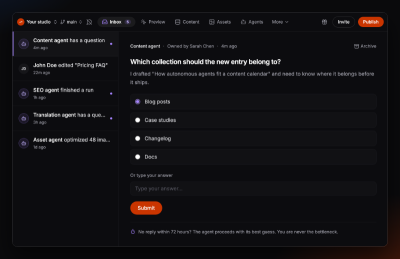
The third tier is the "Contextual Boundary," which is the most complex. This is where tasks exist that are subjective to the stakeholder. As seen in the example of dark-mode implementation, a feature may be viewed as a technical task by one person and a brand statement by another. The implication for developers is clear: software must provide granular, role-based controls. It is not enough to have a simple "on/off" switch for autonomy; organizations require a system of composition where agents can be tailored to specific departments.
Building the Agent: A New Paradigm
The transition from a "frozen" website to a living, evolving entity requires a change in how software is deployed. Rather than downloading a package and setting it to run, users must treat agents as evolving partners. This involves a process of "trust-based delegation."
- The Initial Audit: An agent is introduced to monitor, but not act upon, the site. It generates logs and reports, showing stakeholders exactly what it would change.
- Narrow Delegation: The team authorizes the agent to fix only the most objective, low-risk issues, such as image compression or metadata cleanup.
- Observation and Verification: Stakeholders review the agent’s history and logs. Because the changes are documented and reversible, the team begins to build confidence in the agent’s consistency.
- Widening the Scope: As the agent proves its adherence to the site’s constraints, the team grants it authority over more complex, rule-based tasks.
This approach mitigates the fear that an agent will make a rogue decision that ruins a site’s aesthetic. By keeping the human in the loop—at least as an auditor—the risk of "digital decay" is addressed without sacrificing the human element of design.
The Real Risk: A Frozen Asset
The most compelling argument for this shift is not that agents are perfect, but that the status quo of the "frozen site" is fundamentally broken. A website that does not change is a liability. In an era where search engines prioritize freshness and users expect seamless, lightning-fast interactions, a site that remains static for months on end is essentially shrinking.
The fear that an agent will change something without permission is often eclipsed by the reality that the business is losing traffic, failing compliance checks, and presenting an outdated face to the world because the human team is too busy to manage the details.
The professional consensus is shifting: the point of autonomy was never to remove the human from the creative process. It was to remove the manual drudgery of maintenance. By offloading the "chores" of the web to agents, organizations can ensure their digital presence remains a living, breathing asset rather than a digital artifact of a bygone launch day. As these tools mature, the divide between the "frozen" site and the "autonomous" site will likely become the defining metric for digital competitiveness in the coming decade.