The Seven-Stage Roadmap to Mastering Voice Agents and Conversational AI Architecture

Voice interfaces have transcended their origins as experimental novelty features to become the primary medium through which humans interact with artificial intelligence. From high-frequency customer service contact centers to sophisticated medical diagnostic assistants and pervasive smart home ecosystems, the shift toward audio-first interaction is redefining the digital landscape. While the underlying intelligence of these systems often relies on Large Language Models (LLMs) familiar to many developers, the implementation of voice agents introduces a complex, multi-layered architecture that demands a mastery of audio processing, real-time latency management, and human-centric conversation design.
The Evolution of Conversational Interfaces
The trajectory of voice-activated technology has been marked by a transition from command-based systems to fluid, generative agents. In the early 2010s, voice assistants were largely limited to rigid "if-then" logic, capable only of recognizing specific keywords to trigger pre-programmed tasks. The introduction of transformer-based architectures and massive scale language models in the 2020s fundamentally altered this dynamic.
According to recent market analysis from industry research firms, the global conversational AI market is projected to reach valuations exceeding $40 billion by 2030, driven largely by the integration of voice agents into enterprise workflows. This growth is underpinned by a significant reduction in the cost of high-quality speech synthesis and the democratization of Automatic Speech Recognition (ASR) APIs, which have reached near-human parity in transcription accuracy under optimal conditions.
Anatomy of a Voice Agent Pipeline
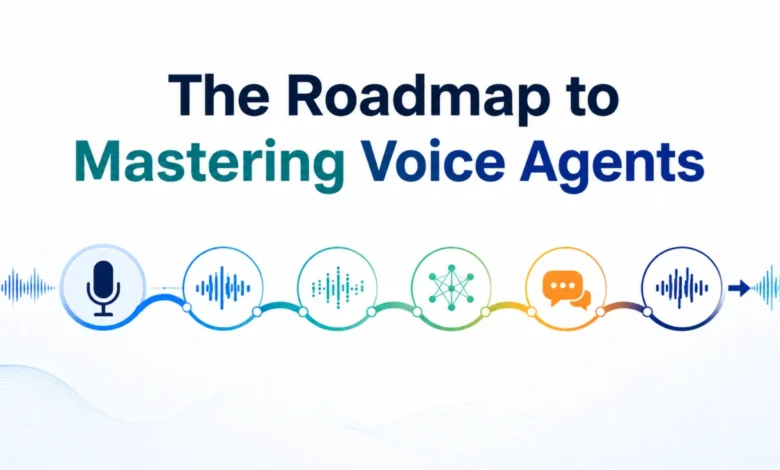
A voice agent operates as a specialized wrapper around a core reasoning engine. While a text-based agent merely receives a string of characters and outputs another, a voice agent must facilitate a three-stage conversion process:
- Speech-to-Text (STT) / ASR: The agent must ingest raw audio, filter out background noise, and transcribe spoken phonemes into actionable text. This stage is critical; even a 5% word error rate (WER) can cascade into significant misunderstandings in the subsequent reasoning layer.
- Language Processing and Reasoning: This represents the "brain" of the agent, where the transcribed text is processed by an LLM. The challenge here is context retention—maintaining the thread of a conversation without the visual cues of a chat interface.
- Text-to-Speech (TTS): The final stage involves converting textual tokens into natural, prosody-rich audio. Modern systems are moving away from robotic, synthetic tones toward expressive voices that simulate human emotion and pacing.
Technical Challenges: The Latency Hurdle
The most significant engineering hurdle distinguishing voice agents from text agents is the intolerance for latency. In a text-based environment, a user may accept a three-to-five-second delay for a complex query. In a spoken conversation, a delay exceeding 600 to 800 milliseconds creates an "uncanny valley" effect, where the interaction feels disconnected and unresponsive.
Industry experts emphasize that this latency constraint dictates the entire system architecture. Developers must often employ "streaming" architectures, where the system begins generating the first few words of a response while the tail end of the query is still being processed. This requires high-performance infrastructure capable of handling parallel threads of audio streaming and token generation, often necessitating the use of edge computing to reduce round-trip times between the user and the server.
A Structured Roadmap for Development
To navigate the complexities of this field, developers are increasingly adopting a seven-stage progression model designed to build institutional knowledge from foundational principles to production-grade deployment.
Stage 1: Establishing the Pipeline Foundation
The initial phase requires a deep dive into the physics and informatics of audio data. Practitioners must familiarize themselves with sampling rates, bit depths, and the differences between lossy and lossless audio compression. Understanding the impact of ambient noise on the Word Error Rate (WER) is a prerequisite for any robust deployment.
Stage 2: Prompt Engineering for Audio
Language models behave differently when they are "reading" spoken inputs versus written ones. Developers must learn to prompt models to produce concise, grammatically complete sentences that lack visual markup like bullet points or bold text. The objective is to create a "spoken syntax" that is natural to the human ear.
Stage 3: Architecting for Real-Time Streaming
This stage moves beyond the theoretical. It involves the integration of WebSocket connections and low-latency API endpoints. The goal is to achieve "interruption handling," where the agent can instantly cease speaking if the user begins talking—a task that requires sophisticated backend state management.
Stage 4: The Discipline of Conversation Design
Perhaps the most overlooked aspect is the psychological design of the conversation. This involves creating "repair strategies"—what the agent says when it doesn’t understand the user—and designing the "turn-taking" logic. A well-designed agent uses fillers, pacing, and appropriate silence to mimic the rhythm of human discourse.
Stage 5: Contextual Memory and Tool Integration
A voice agent that cannot remember a user’s previous preferences is functionally limited. This stage involves implementing vector databases for long-term memory and Function Calling capabilities, allowing the agent to interface with external APIs—such as CRM systems or inventory databases—in real-time during a call.
Stage 6: Deployment and Telephony Infrastructure
Moving from a development environment to a production system requires navigating the complexities of telephony protocols like SIP (Session Initiation Protocol) and WebRTC. At this stage, developers must also implement monitoring tools to track latency, token usage, and user satisfaction metrics.
Stage 7: Advanced Specialization
The final stage involves optimizing for edge cases, including multi-lingual support, real-time emotion detection, and voice cloning for personalized branding. This stage is where the agent moves from being a utility to a personalized digital persona.
Broader Implications and Future Outlook
The implications of mastering this technology are profound. For healthcare, voice agents offer a pathway to accessible, 24/7 triage that can alleviate the burden on human staff. In the retail sector, they represent the next frontier of hyper-personalized customer engagement.
However, the rapid deployment of these systems also brings challenges. Privacy concerns regarding voice data storage, the potential for "hallucinations" in critical scenarios, and the ethical considerations of AI-generated voices are now at the forefront of policy discussions. Industry leaders and regulatory bodies are currently collaborating on standards to ensure that voice agents are transparent, secure, and respectful of user data.
As we move toward a future where human-computer interaction is dominated by speech, the divide between those who can build these systems and those who cannot will become a defining factor in the tech industry. By following a structured, methodical approach to learning—moving from the raw audio pipeline through to the nuances of human-machine conversation design—developers can bridge the gap between simple chatbots and sophisticated, lifelike voice agents. The future of AI is not just intelligent; it is vocal, and the path to building it is clearer today than it has ever been.