Accelerating Cloud Infrastructure Management Through the AWS Infrastructure as Code Model Context Protocol Server

Modern organizations increasingly rely on Infrastructure as Code (IaC) to manage their cloud environments with the precision, repeatability, and scalability required for digital transformation. By defining infrastructure through machine-readable definition files rather than physical hardware configuration or interactive configuration tools, DevOps teams have achieved significant gains in deployment consistency and compliance. However, as infrastructure complexity scales, the "inner loop" of development—the iterative process of writing, testing, and deploying code—has become marred by significant cognitive friction. Engineers currently spend a disproportionate amount of time context-switching between fragmented toolsets, including web-based documentation portals, disparate linting utilities, deployment consoles, and logging systems. This operational overhead not only slows down feature release cycles but also complicates incident recovery, potentially turning minor configuration errors into hours of manual, high-pressure investigation.
To address this systemic inefficiency, AWS has introduced the AWS Infrastructure as Code (IaC) Model Context Protocol (MCP) Server. This innovation seeks to unify the fractured IaC workflow by embedding essential development capabilities directly into an AI assistant’s interface. By integrating documentation search, template validation, and real-time deployment troubleshooting into a single conversational environment, the IaC MCP Server aims to minimize the cognitive load placed on engineers, thereby enhancing productivity and reducing the risk of human error in complex, multi-resource cloud deployments.
The Problem: Fragmented Workflows in Infrastructure Engineering
The current state of IaC development is characterized by high context-switching costs. A typical developer task—such as deploying a stack containing an Amazon S3 bucket, an AWS Lambda function, and associated IAM roles—requires an engineer to toggle between multiple browser tabs and terminal windows. This fragmentation is not merely a matter of personal convenience; it is a significant bottleneck for enterprise operations.
Data from industry DevOps surveys consistently indicates that developers spend upwards of 30% of their time troubleshooting environment-specific configurations rather than writing new features. When a deployment fails, the time taken to correlate stack events from CloudFormation with the granular audit logs found in AWS CloudTrail often exceeds the time required to write the original template. This "troubleshooting tax" is a primary contributor to delayed feature delivery and increased operational risk. By collapsing these disparate steps into a unified AI-assisted workflow, the AWS IaC MCP Server represents a strategic shift toward an integrated development environment (IDE) for cloud infrastructure.
Technical Architecture and Workflow Integration
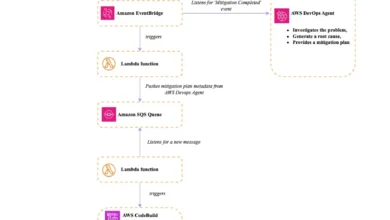
The AWS IaC MCP Server functions as a bridge between the developer’s AI assistant and the AWS ecosystem. The architecture is designed to support the full lifecycle of a CloudFormation stack. The process begins with the AI assistant leveraging the search_cloudformation_documentation tool to retrieve accurate, up-to-date resource property references, effectively eliminating the need to manually browse technical documentation.
Following the authoring phase, the server employs specialized validation tools. It utilizes cfn-lint for structural and syntactic verification and cfn-guard for policy-as-code compliance, ensuring that templates adhere to internal security standards before they are ever submitted to the AWS API. The deployment phase then proceeds, with the server orchestrating the interaction between the user’s code and the CloudFormation service. Crucially, the final stage of the workflow involves automated troubleshooting, where the server correlates failed deployment events with CloudTrail logs to provide a precise, actionable diagnosis of the root cause.
A Case Study in Deployment Troubleshooting
To illustrate the efficacy of this approach, consider a scenario involving a common configuration pitfall: the iam:PassRole permission error. In this walkthrough, a service role is intentionally deployed with insufficient permissions, omitting the ability to pass an execution role to a Lambda function. In a traditional workflow, an engineer might receive an opaque "Access Denied" error message, prompting a manual search through CloudTrail logs to identify the missing permission.
With the IaC MCP Server, the process is streamlined. The AI assistant, acting as an orchestrator, observes the deployment failure and invokes the troubleshoot_cloudformation_deployment tool. By querying stack events and cross-referencing them with the relevant CloudTrail history, the assistant identifies the specific missing permission. The engineer can then issue a single command to update the template, fix the permission, and redeploy. This transition—from error detection to remediation—takes minutes rather than hours, representing a massive reduction in the mean time to recovery (MTTR).
Strategic Implications for DevOps Teams
The implications of this technology extend beyond individual productivity; they touch on the broader culture of "Infrastructure as Code." By lowering the barrier to entry for complex deployments, the IaC MCP Server empowers teams to adopt more rigorous validation and security practices. When validation tools like cfn-guard are seamlessly integrated into the conversation, developers are more likely to perform security checks as a matter of routine, rather than as an afterthought.
Furthermore, the shift toward AI-orchestrated infrastructure management allows organizations to standardize their deployment patterns. By using the AI assistant to enforce consistent configurations across multiple stacks, teams can ensure that security best practices—such as S3 object locking and access logging—are implemented uniformly. This consistency is the foundation of high-velocity, low-risk deployment pipelines.
Addressing Cost and Operational Governance
While the efficiency gains are clear, organizations must remain mindful of the operational costs associated with these automated workflows. The use of AWS resources, including Lambda invocations for processing and S3 storage for logs, incurs standard service fees. However, the cost of automation is often offset by the reduction in engineering hours spent on manual troubleshooting.
The cleanup phase, which can be similarly automated through the AI assistant, ensures that unused resources do not linger, preventing "cloud sprawl" and unnecessary billing. By utilizing the MCP server to orchestrate the deletion of stacks—including the clearing of S3 buckets—teams can maintain a clean, cost-efficient cloud footprint.
Future Outlook: The AI-Driven Infrastructure Era
The introduction of the AWS IaC MCP Server is part of a broader industry trend toward AI-augmented development. As AI models become more capable of understanding complex infrastructure dependencies, the role of the DevOps engineer will evolve from manual configuration to high-level orchestration and policy definition.
Industry analysts suggest that this shift will likely lead to a reduction in configuration drift—a common issue where the actual state of infrastructure deviates from the defined code. Because the AI assistant can provide real-time feedback during the authoring process, the likelihood of deploying misconfigured resources decreases significantly.
For teams currently struggling with the complexity of multi-resource stacks, the path forward is clear: integrate the toolchain into a unified, AI-supported interface. The AWS Infrastructure as Code MCP Server is not merely a convenience; it is a foundational component for the next generation of cloud operations. By reducing the friction inherent in the development loop, it allows organizations to focus on what matters most: delivering value to users with speed, security, and reliability.
To adopt these practices, engineering leaders should encourage their teams to experiment with the companion repository provided by AWS, which offers a template for implementing this workflow. By standardizing on a model-based context approach, companies can move away from the "siloed" experience of the past and toward a cohesive, intelligent, and highly efficient future for infrastructure management. As the cloud continues to evolve in complexity, the ability to maintain clarity and control within the development cycle will remain the ultimate competitive advantage for modern digital enterprises.