Large language models (LLMs) are fundamentally designed to predict the next token in a sequence based on statistical probability, a mechanism that serves them well for creative writing or basic information retrieval but often falters when faced with complex, multi-step logical challenges. As artificial intelligence moves from simple chatbot interactions to autonomous agent systems capable of executing workflows, the industry has shifted its focus from merely generating fluent text to ensuring rigorous reasoning. Two primary frameworks—Chain of Thought (CoT) and Tree of Thoughts (ToT)—have emerged as the gold standards for managing this transition, each offering a distinct approach to how machines process logic and mitigate errors.
The fundamental limitation of standard LLM inference is its tendency to "leap" to conclusions. When a model is asked a question, it begins generating an answer immediately, often committing to a trajectory before it has fully mapped the logical requirements of the task. For simple math or factual queries, this is rarely an issue. However, in agentic environments—where an AI must navigate a file system, call APIs, and parse intermediate output—a single misstep early in the process can cause a cascade of errors that are difficult to debug or reverse. To address this, researchers have implemented "reasoning layers" that force the model to pause, contemplate, and structure its output before finalizing a decision.
The Evolution of Reasoning: A Chronological Context
The development of these frameworks follows the rapid expansion of AI capabilities over the last few years. The "Chain of Thought" concept gained mainstream prominence around 2022, following research papers from Google Brain and others demonstrating that simple prompting techniques could dramatically improve performance on arithmetic and common-sense reasoning benchmarks. By simply adding phrases like "Let’s think step by step," developers observed that models were less likely to arrive at incorrect, hallucinated conclusions.
Following this, in 2023, the research community began identifying the limitations of linear reasoning. If an LLM calculates the first step of a complex logic problem incorrectly, the remainder of the chain is effectively poisoned. This realization led to the introduction of Tree of Thoughts, a framework popularized by researchers at Princeton University and Google DeepMind. ToT was designed to mirror the human process of decision-making under uncertainty, where one considers multiple possibilities, evaluates their success, and pivots when a path proves unproductive.
Chain of Thought: The Linear Standard
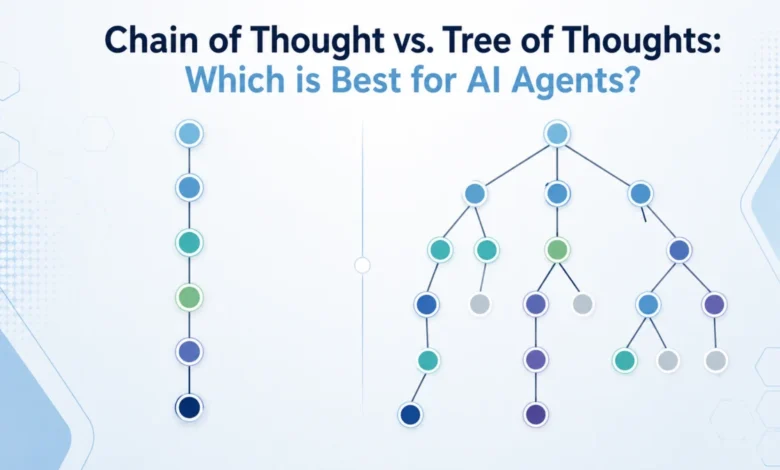
Chain of Thought remains the most widely deployed reasoning framework in production environments. It functions as a single, uninterrupted logical narrative. When an agent is prompted with a request, it is instructed to produce a series of intermediate steps that bridge the gap between the prompt and the terminal answer.
The primary advantage of CoT is its efficiency. Because it generates a single path of reasoning, it is computationally inexpensive and minimizes latency. In most enterprise AI applications, such as internal document analysis or automated customer service triage, the logic required is rarely branching. The agent simply needs to follow a set of predefined logical protocols to reach a valid conclusion.
However, the lack of a "correction mechanism" is a significant drawback. In a linear chain, there is no inherent mechanism to revisit an earlier step if a contradiction is found later. If the agent makes a minor mathematical error in step two of a ten-step process, the error remains in the context window, and the model—blinded by its own previous text—will continue to build upon that faulty foundation.
Tree of Thoughts: The Branching Strategy
Tree of Thoughts (ToT) introduces a non-linear, recursive approach to AI reasoning. Instead of a single sequence, the model generates multiple potential "next steps" (the branches) at each junction. A secondary process—or the model itself—then evaluates these branches, assigning a score or a confidence level to each. If a particular branch leads to a logical dead end or a prohibited action, the system is designed to "prune" that branch and backtrack to a more promising node.
This methodology is computationally intensive, often requiring dozens of separate model calls to resolve a single query. This creates a significant trade-off in terms of latency and cost. For example, a single task that might cost $0.01 using standard inference could cost significantly more under a ToT framework due to the sheer volume of tokens generated for the discarded, "incorrect" branches.
Data and Performance Metrics
Evidence from academic benchmarks highlights the stark difference in efficacy between these two methods. On the Game of 24 (a mathematical puzzle requiring strategic planning), research has shown that standard LLMs using basic prompting achieve a success rate of less than 10%. With Chain of Thought, that rate increases marginally. However, when using the Tree of Thoughts framework, success rates have been reported to exceed 70%.
These metrics demonstrate that for tasks requiring strategic foresight—such as automated software debugging, long-form creative planning, or complex data synthesis—the additional cost of ToT is not merely an overhead; it is a prerequisite for success. In professional settings, the "cost per successful task" is often lower with ToT because it avoids the recurring expenses associated with manual human intervention when a cheaper, linear model fails.
Implications for AI Agent Architecture
The integration of these frameworks into AI agent systems is shifting how developers build software. Modern agentic architectures are increasingly "modular," meaning they select a reasoning framework based on the nature of the incoming request.
For instance, an agent tasked with scheduling a meeting might utilize a simple Chain of Thought, as the logic is straightforward and linear. Conversely, an agent tasked with conducting a multi-step security audit of a codebase might trigger a ToT process. In this scenario, the agent would treat every potential security vulnerability as a branch to be explored. If the first path leads to a "false positive" flag, the agent backtracks, re-evaluates the code, and attempts a different line of inquiry.
This shift has profound implications for the future of enterprise software. It suggests that AI agents will not be "one-size-fits-all" utilities. Instead, they will act as orchestrators, dynamically deciding how much "thought" (or computation) a specific problem warrants.
Expert Perspectives and Industry Direction
Industry analysts and lead researchers generally agree that we are moving toward a "hybridized" era of AI reasoning. Leading AI labs are currently working on optimizing the search algorithms that underpin ToT, aiming to reduce the number of tokens required to evaluate a branch. By training models specifically to act as "evaluators" for their own outputs, companies like OpenAI, Anthropic, and Google are attempting to lower the barrier to entry for complex, multi-step reasoning.
The consensus is that for the foreseeable future, Chain of Thought will serve as the "reflex" of the AI, providing immediate, cost-effective responses for standard queries, while Tree of Thoughts will function as the "deliberation" layer, reserved for high-stakes, ambiguous, and non-routine problem solving.
Summary of Differences
| Feature | Chain of Thought (CoT) | Tree of Thoughts (ToT) |
|---|---|---|
| Logic Structure | Linear, sequential | Branching, recursive |
| Complexity | Low; minimal prompt engineering | High; requires algorithm management |
| Computational Cost | Low; single-pass generation | High; multiple calls/branches |
| Error Recovery | Limited; cannot backtrack | Robust; supports pruning and backtracking |
| Best Used For | Standard logic, math, summarization | Strategic planning, complex debugging |
Ultimately, the choice between these frameworks represents the broader challenge of the AI industry: balancing the desire for "smarter" systems with the practical constraints of budget and speed. As AI agents become more integrated into critical infrastructure, the ability to selectively apply high-level, tree-based reasoning will become the defining factor in which agents provide real value and which remain stuck in the cycle of generating confident, but ultimately incorrect, responses.