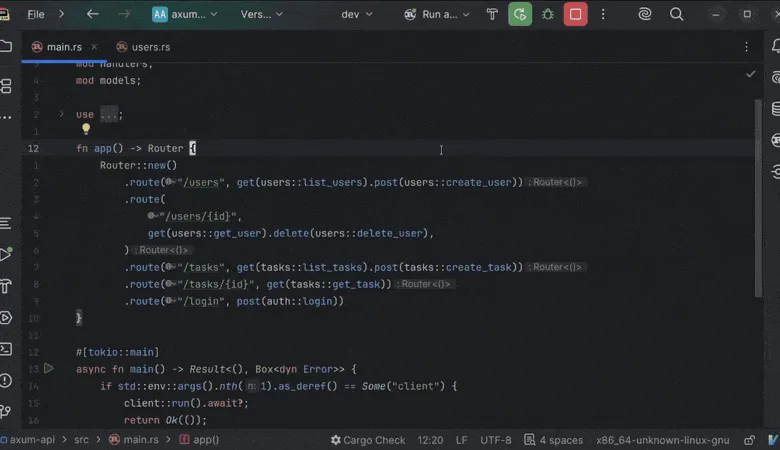
The release of RustRover 2026.2 by JetBrains marks a significant milestone for the Rust development community, particularly for those engaged in web backend creation. Central to this update is the introduction of comprehensive support for Axum, one of the most rapidly ascending web frameworks within the Rust ecosystem. This enhancement is poised to streamline the development of web services, APIs, and distributed systems, offering developers improved navigation of routes, clearer understanding of request flows, and direct generation of client calls within the integrated development environment (IDE). This development underscores Rust’s continued expansion beyond its traditional domains into the critical arena of web backend development, a shift that carries substantial implications for the language’s broader adoption and enterprise viability.
The Ascendance of Rust in Web Backend Development
For many years, the Rust programming language was predominantly associated with systems programming, embedded development, and performance-critical infrastructure. Its rigorous memory safety guarantees, zero-cost abstractions, and robust concurrency model made it an ideal candidate for operating systems, game engines, and low-level utilities where performance and reliability are paramount. However, recent trends indicate a pronounced shift, with Rust increasingly establishing a strong foothold in backend and web development. According to the JetBrains Developer Ecosystem 2025 survey report, building web backends with Rust has emerged as the third most popular use case for the language, signifying a growing trust in its stability and ecosystem support for long-lived, business-critical applications.
This expansion is not merely a lateral move into existing territories occupied by languages like Python, Node.js, or Go. Instead, Rust is carving out a distinct niche where the stakes are inherently high. Its adoption is most prominent in infrastructure APIs, sophisticated data processing pipelines, high-throughput microservices, edge computing solutions, and security-sensitive services. In these contexts, the cost of memory safety bugs or concurrency issues can be catastrophic, making Rust’s guarantees particularly appealing. The language’s ability to deliver both performance comparable to C++ and memory safety without a garbage collector provides a compelling value proposition for organizations seeking to build highly reliable and efficient backend systems.
The Rust ecosystem has responded to this growing demand with a proliferation of mature web frameworks and libraries. While frameworks like Actix-web, Rocket, and Warp have long been present and continue to see significant use, Axum has recently distinguished itself. Its rapid adoption is evidenced by its impressive metrics, including over 850,000 daily downloads on crates.io and more than 25,000 GitHub stars, positioning it as a leading choice for new Rust web projects. This surge in popularity can be attributed to its ergonomic design, modular architecture, and, crucially, its seamless integration with Tokio, Rust’s most widely used asynchronous runtime.
Diving Deeper into Axum: A Framework of Choice
Axum, maintained by the same team behind Tokio, is an HTTP routing and request-handling library that prioritizes developer ergonomics and modularity. Its design philosophy is deeply rooted in the existing infrastructure of the Rust async ecosystem, particularly leveraging Tokio and Hyper. This design choice allows Axum to "get out of the way," enabling developers to build upon a solid, well-understood foundation rather than introducing an entirely new paradigm.

At its core, Axum empowers developers to define routes that map incoming HTTP requests to specific handler functions. It facilitates the extraction of data from requests, including path parameters, query strings, and JSON or form bodies, into strongly typed Rust structures. Moreover, Axum simplifies the generation of structured responses, ensuring type safety and reducing the likelihood of runtime errors.
What truly sets Axum apart from many other web frameworks, however, is its innovative approach to middleware. Unlike frameworks that often implement their own proprietary middleware systems, Axum directly utilizes tower::Service. Tower is a powerful, generic abstraction for asynchronous services that provides a rich ecosystem of reusable components. By building on tower::Service, Axum inherently gains access to a vast array of functionalities such as timeouts, tracing, compression, rate limiting, and authorization, simply by integrating existing Tower middleware. This interoperability means that middleware components can be seamlessly shared across applications built with Hyper or Tonic (a gRPC framework), effectively expanding the "Axum ecosystem" to encompass the broader Tokio ecosystem. This strategic integration fosters a cohesive and powerful development environment, minimizing redundant efforts and maximizing code reusability across different layers of an application stack.
The current design of Axum intentionally maintains tight integration with Tokio and Hyper, focusing on optimizing for this specific async runtime and transport layer. While runtime and transport layer independence is not a primary goal at present, this focused approach contributes to a more streamlined and performant framework, as detailed extensively in its comprehensive documentation.
The Significance of Axum’s Production Adoption
Axum’s practical utility extends far beyond theoretical discussions, finding robust application in critical production environments and influential open-source tooling. One of the most prominent examples is crates.io, the official Rust package registry. This platform, a cornerstone of the entire Rust community, serving every cargo build command globally, operates on an Axum backend. Its reliance on Axum speaks volumes about the framework’s stability, performance, and scalability under immense load, solidifying its reputation as a production-grade solution.
Another significant adoption comes from Cloudflare. Their workers-rs crate directly supports Axum, enabling developers to craft Cloudflare edge functions using the familiar Axum routing model. This integration allows developers to leverage Rust’s performance and safety features for serverless computing at the edge, where low latency and efficient resource utilization are paramount. The ability to deploy Axum-based services on Cloudflare Workers extends the framework’s reach into highly distributed and performance-sensitive environments.
Beyond these high-profile instances, Axum has rapidly become the recommended foundation for several emerging Rust web stacks and starter templates. Loco, a Rails-inspired Rust framework designed for rapid application development, is built directly on top of Axum, leveraging its robust capabilities for routing and request handling. Similarly, Lichess, one of the world’s largest free online chess servers, heavily utilizes Axum for several of its core background services and microservices, attesting to its suitability for complex, real-time applications requiring high availability and performance. These examples collectively illustrate that Axum is increasingly becoming the default recommendation when developers inquire about building web services in Rust, signaling its maturity and widespread acceptance.
RustRover 2026.2: Bridging the Gap for Axum Developers

Despite Axum’s growing popularity and robust capabilities, the developer experience, particularly when navigating complex route structures and generating client calls, has traditionally involved manual searching and interpretation of code. This is where RustRover 2026.2 introduces a transformative set of features, providing crucial IDE-level support for both Axum and the Reqwest HTTP client library. This integration is a testament to JetBrains’ commitment to fostering a more productive and intuitive development environment for the Rust community.
The core of this new support lies in the IDE’s enhanced understanding of Axum routes within a project. RustRover can now intelligently resolve URLs, discover endpoints, and facilitate seamless navigation between defined routes and their corresponding handler functions. This dramatically reduces the cognitive load on developers, allowing them to quickly grasp the flow of requests through their application without laborious manual code exploration. Route calls are now augmented with visual cues such as references and inlay hints, which provide immediate context and clarify endpoint relationships at a glance. These visual aids are particularly beneficial in large projects with numerous routes and nested modules, making the codebase significantly more approachable.
For instance, developers can now directly jump from a route definition to its handler, or conversely, identify all routes that lead to a specific handler. This bi-directional navigation capability is invaluable for debugging, refactoring, and understanding existing codebases. The IDE’s ability to recognize and highlight route parameters, query parameters, and body types further enhances this understanding, ensuring that developers are always aware of the expected input and output structures for each endpoint.
Technical Enhancements and Workflow Streamlining
Beyond route navigation, RustRover 2026.2 also introduces robust support for Reqwest, the popular Rust HTTP client. This integration enables powerful request generation capabilities, allowing developers to construct client calls with minimal manual setup. For example, the IDE can now infer request parameters and body structures based on the Axum endpoint definitions, providing intelligent autocompletion and type-checking for client-side interactions. This feature is particularly useful when building client applications that consume Axum-based APIs, ensuring consistency and reducing the boilerplate code typically associated with HTTP requests.
The ability to generate client calls directly from the IDE significantly accelerates the development workflow. Instead of manually crafting Reqwest::Client::post() or Reqwest::Client::get() calls, including headers, body, and URL construction, developers can leverage RustRover to scaffold these calls based on the detected Axum routes. This not only saves time but also minimizes the potential for errors due to mismatched types or incorrect endpoint paths. Furthermore, the IDE’s understanding extends to providing navigation features within Reqwest calls, allowing developers to jump from a client call directly to the corresponding Axum route definition, providing an end-to-end view of the request-response cycle.
While marked as "initial support," this first iteration of Axum and Reqwest integration lays a strong foundation. JetBrains has historically adopted an iterative approach to feature development, driven heavily by community feedback. This indicates that future releases of RustRover will likely see further refinements and expanded capabilities, addressing specific pain points identified by developers working with Axum in real-world scenarios. The call for users to report issues and provide feedback directly via JetBrains’ YouTrack platform underscores this commitment to continuous improvement.
Broader Implications for the Rust Ecosystem and Enterprise Adoption

The enhanced Axum support in RustRover 2026.2 carries significant implications for the broader Rust ecosystem and its trajectory towards wider enterprise adoption. First, it substantially lowers the barrier to entry for developers interested in building web backends with Rust. The learning curve for new frameworks can be steep, but comprehensive IDE support, with its intelligent code completion, navigation, and error highlighting, makes the process far more approachable. This could attract a larger pool of developers from other ecosystems, further accelerating Rust’s growth in the backend space.
Second, for existing Rust developers, these features translate directly into increased productivity and reduced development cycles. Automating tedious tasks like route tracing and client call generation allows developers to focus on core business logic rather than boilerplate, ultimately leading to faster delivery of high-quality software. This efficiency gain is particularly attractive to enterprises where developer productivity directly impacts project timelines and costs.
Third, the move by JetBrains to prioritize Axum support signals a recognition of the framework’s growing prominence and stability. JetBrains’ IDEs often serve as benchmarks for language ecosystem maturity, and official support lends significant credibility to a framework. This endorsement could encourage more organizations to consider Axum for their critical backend projects, further solidifying its position as a de facto standard for Rust web development.
Finally, the tight integration with the Tokio ecosystem through Tower middleware reinforces a powerful paradigm of composability and reusability. By championing this approach within its IDE, JetBrains is implicitly promoting best practices that lead to more maintainable and scalable backend systems. This strategic alignment with the foundational components of Rust’s asynchronous programming model strengthens the entire ecosystem.
Community Contributions and Future Outlook
It is crucial to acknowledge that the advancements celebrated in RustRover 2026.2 would not be possible without the foundational work of the open-source community. The sustained efforts of the Tokio team and the dedicated Axum contributors have built and maintained an exceptional piece of infrastructure. Axum, being free, MIT-licensed, and relied upon by a growing number of production systems worldwide, exemplifies the power of collaborative open-source development. The explicit note of gratitude from JetBrains, urging users to consider sponsoring the Tokio project on GitHub, highlights the critical importance of open-source sustainability. Such contributions ensure that the Rust ecosystem continues to evolve and improve, benefiting every developer and organization that leverages its robust tools.
Looking ahead, the initial nature of Axum support in RustRover 2026.2 suggests a roadmap for further enhancements. Potential future features could include advanced refactoring tools for routes, integrated API testing directly within the IDE, more sophisticated code generation for various Axum components, and deeper integration with other popular Rust web libraries. As the Rust community continues to push the boundaries of what is possible in web development, JetBrains’ commitment to providing cutting-edge IDE support will undoubtedly play a pivotal role in shaping the future landscape.
Developers are encouraged to download RustRover 2026.2 and explore its new Axum capabilities. The ongoing feedback from the community will be instrumental in guiding the evolution of these features, ensuring they meet the real-world demands of building high-performance, safe, and scalable web backends with Rust. This release is more than just an update; it represents a significant step forward in making Rust a more accessible and powerful choice for web developers globally.