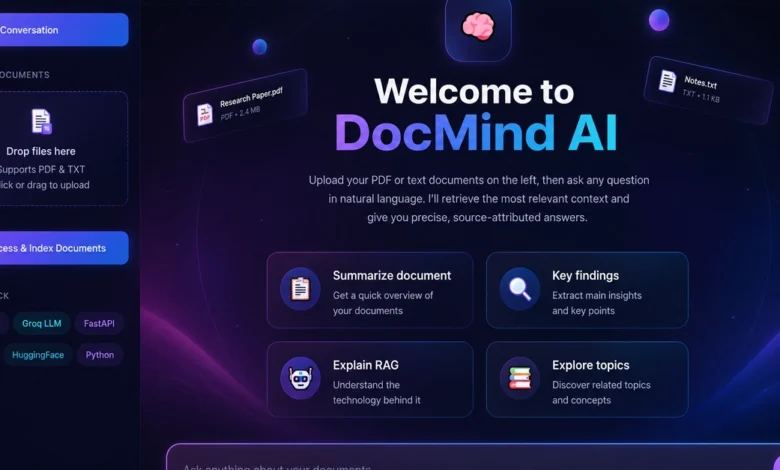
The incident, which was resolved through a targeted code update, underscores the critical importance of meticulous configuration management in distributed web applications and highlights common pitfalls in modern deployment workflows. DocMind AI, a project submitted as part of DEV’s Summer Bug Smash, leverages a robust technology stack including a FastAPI backend, Groq’s LLaMA 3.3 for generative capabilities, Pinecone for vector storage, and HuggingFace embeddings for semantic search, all fronted by a Netlify-hosted user interface with integrated voice input/output. The core functionality of the chatbot allows users to upload documents, pose questions, and receive contextually grounded answers, making it a powerful tool for knowledge retrieval and document intelligence.
Understanding DocMind AI: A Deep Dive into Retrieval-Augmented Generation
DocMind AI represents a cutting-edge application of Retrieval-Augmented Generation (RAG), a paradigm that significantly enhances the capabilities of large language models (LLMs) by integrating them with external knowledge bases. Unlike traditional LLMs that rely solely on their pre-trained parameters, RAG systems first retrieve relevant information from a vast corpus of documents and then use this information to inform the LLM’s generation process. This approach mitigates issues such as hallucination, where LLMs generate plausible but incorrect information, and allows the model to provide answers grounded in specific, verifiable data.
The architecture of DocMind AI is a testament to modern AI development practices. The FastAPI backend, known for its high performance and asynchronous capabilities, serves as the central hub for processing user requests, managing document uploads, and orchestrating interactions between various components. FastAPI’s Pythonic nature and automatic documentation generation streamline development, making it a popular choice for AI-driven APIs.
For the crucial generative aspect, DocMind AI employs Groq’s LLaMA 3.3. Groq’s specialized Language Processing Units (LPUs) are designed to offer unparalleled speed and efficiency for LLM inference, allowing DocMind AI to deliver near real-time responses to user queries. This choice of a high-performance LLM provider is vital for maintaining a responsive and satisfying user experience, especially when dealing with complex document analysis.
The "retrieval" component of RAG is powered by Pinecone, a leading vector database. When documents are uploaded to DocMind AI, they are first processed by HuggingFace embeddings, which convert the textual content into high-dimensional numerical vectors. These embeddings capture the semantic meaning of the text, allowing for efficient similarity searches. Pinecone then stores these vectors, enabling the system to quickly identify and retrieve document chunks that are most relevant to a user’s query. This vector-based approach ensures that the chatbot can pinpoint precise information even within extensive document sets, a significant advantage over keyword-based search methods.
The frontend, hosted on Netlify, provides the user interface, including the voice input/output features that enhance accessibility and convenience. Netlify’s continuous deployment and global CDN capabilities ensure that the application is always available and performs optimally for users worldwide. This integrated stack demonstrates a robust, scalable, and intelligent system for document interaction.
The CORS Conundrum: A Hyphen’s Impact on Connectivity
The core of the recent operational hiccup stemmed from a subtle yet critical misconfiguration in the backend’s Cross-Origin Resource Sharing (CORS) policy. CORS is a fundamental web security mechanism implemented by web browsers to prevent malicious websites from making unauthorized requests to a server on a different domain. It’s a cornerstone of the Same-Origin Policy, which dictates that a web page can only interact with resources from the exact same origin (scheme, host, and port) from which it was loaded. When a frontend application hosted on one domain attempts to communicate with an API on another domain, CORS rules come into play.
In principle, DocMind AI’s FastAPI backend had correctly implemented CORS using the CORSMiddleware. The middleware was configured to allow requests from specific origins, rather than employing a broad and less secure wildcard (*). Furthermore, allow_credentials was set to False, and explicit allow_methods (GET, POST, OPTIONS) and allow_headers (Content-Type, Accept) were defined, reflecting good security practices. This robust configuration was designed to protect the API while enabling legitimate cross-origin interactions.
However, a routine redeployment of the frontend application to Netlify inadvertently introduced a critical domain mismatch. The new Netlify site was assigned the URL https://docmindai-chatbot.netlify.app – notably, with a hyphen between "docmindai" and "chatbot." The backend’s allow_origins list, however, still contained only the older domain, https://docmindaichatbot.netlify.app, which lacked this hyphen. To the browser’s strict Same-Origin Policy, these two URLs, despite their visual similarity, represent entirely distinct origins.
Consequently, every request originating from the newly deployed frontend was blocked by the browser’s security mechanisms before it could even reach the FastAPI backend. This resulted in network errors on the client side, typically manifesting as "CORS error" messages or a lack of Access-Control-Allow-Origin headers in the response. Crucially, the backend logs showed no record of these blocked requests, a classic signature of a client-side CORS enforcement. The server was never aware of the incoming requests because the browser proactively intervened. This situation was further complicated by the fact that the older frontend deployment, still pointing to the docmindaichatbot.netlify.app domain, continued to function normally, creating a deceptive impression that "the app works" while the new deployment remained inaccessible.
Debugging the Invisible: The Developer’s Challenge
Debugging CORS issues can be particularly challenging due as they often manifest client-side without corresponding server-side errors. Developers frequently encounter requests failing in the browser’s network tab, displaying messages like "blocked by CORS policy" or "No ‘Access-Control-Allow-Origin’ header is present on the requested resource." The absence of server logs for these failed requests often leads to initial confusion, as developers might mistakenly investigate backend API availability or internal server errors.
In the case of DocMind AI, the diagnostic process involved a systematic elimination of possibilities. The first step was to verify the API’s operational status independently. Using tools like curl to directly query the backend API confirmed that the API itself was functioning correctly and responding as expected. This immediately ruled out a general server outage or a fundamental flaw in the API logic.
The crucial diagnostic clue emerged from observing the browser’s network tab when accessing the new Netlify frontend. It clearly indicated that requests were failing due to the absence of the Access-Control-Allow-Origin header in the API’s response. This, combined with the successful curl tests and the lack of server-side error logs, strongly pointed towards a client-side origin blocking issue – the definitive hallmark of a CORS misconfiguration. The specific difference in the domain name, a single hyphen, was then identified as the root cause.
The Resolution: Precision in Configuration
The resolution was straightforward yet critical: update the backend’s CORSMiddleware configuration to include the new, hyphenated Netlify domain in its allow_origins list. The change involved a single line addition to the FastAPI application’s setup.
Before:
allow_origins=["https://docmindaichatbot.netlify.app"],After:
allow_origins=["https://docmindai-chatbot.netlify.app", "https://docmindaichatbot.netlify.app"],This commit, identified as 291e6d8 – Update CORS to allow new Netlify domain, ensured that the backend was now explicitly configured to accept requests from both the old and new frontend deployment domains. It is important to note that the developer consciously chose to retain the strict, explicit list of allowed origins rather than resorting to a wildcard (allow_origins=["*"]). While a wildcard would have immediately resolved the symptom, it would have significantly weakened the API’s security posture, potentially exposing it to Cross-Site Request Forgery (CSRF) and other vulnerabilities. The existing configuration, with allow_credentials=False and a tight allow_methods/allow_headers list, represents a secure and responsible approach for a public API, even without the use of cookies or authentication tokens. The quick resolution of this issue further exemplifies the iterative development and problem-solving spirit inherent in initiatives like DEV’s Summer Bug Smash.
Broader Implications and Best Practices for Modern Web Development
This seemingly minor bug fix carries significant implications for developers building and deploying modern web applications, particularly those utilizing decoupled frontends and backends. The incident highlights several key areas for consideration and best practices:
1. Netlify’s Dynamic Naming and Deployment Nuances:
Netlify, like many modern hosting platforms, often generates unique URLs for deployments, especially for preview branches or when a site is re-deployed. While custom domains provide stability, the default *.netlify.app URLs can vary. Developers must recognize that even a single character difference in a domain name makes it a completely different origin in the eyes of the browser. This underscores the need for developers to actively verify the exact deployed URL of their frontend and ensure it matches the backend’s CORS configuration. Relying on an assumed or previously working URL without verification after a redeploy can lead to unexpected connectivity issues.
2. CORS as a Persistent Challenge:
CORS issues are among the most common and often frustrating problems encountered in web development, especially with the proliferation of single-page applications (SPAs) and microservices architectures. The strict enforcement of the Same-Origin Policy is crucial for web security, but its nuances can be a steep learning curve. Developers should have a solid understanding of CORS headers (e.g., Access-Control-Allow-Origin, Access-Control-Allow-Methods, Access-Control-Allow-Headers, Access-Control-Allow-Credentials), preflight requests (OPTIONS method), and how browsers handle cross-origin interactions.
3. The Imperative of Explicit Security Configurations:
The decision to maintain an explicit list of allowed origins rather than using a wildcard is a critical security practice. While allow_origins=["*"] offers convenience, it opens the API to requests from any domain, which can be a severe security vulnerability, particularly if the API handles sensitive data or state-changing operations. For public APIs, a carefully curated list of trusted origins, combined with restricted methods and headers, is the recommended approach. This principle extends beyond CORS to all aspects of application security, emphasizing a "least privilege" mindset.
4. Comprehensive Deployment Checklists:
Integrating CORS origin verification into a pre-deployment or post-deployment checklist is a valuable practice. This ensures that critical configuration parameters are cross-referenced with the actual deployment environment. For projects with continuous integration/continuous deployment (CI/CD) pipelines, automated checks could potentially compare configured origins against environment variables or dynamically generated deployment URLs, providing an early warning system for such mismatches.
5. Leveraging Monitoring and Error Reporting Tools:
While the immediate bug fix was manual, tools like Sentry (the sponsor of DEV’s Summer Bug Smash) play a vital role in identifying and diagnosing such issues more proactively. Sentry, an error monitoring platform, can capture client-side JavaScript errors, including those related to CORS policy violations. By aggregating these frontend errors, Sentry can alert developers to widespread connectivity problems that might otherwise go unnoticed or be difficult to pinpoint across various user environments. Furthermore, robust logging on the backend, even for blocked requests (if middleware is configured to log them), can provide deeper insights.
6. Environment Variable Management for Dynamic Origins:
For applications deployed across multiple environments (development, staging, production) or with potentially dynamic frontend URLs (e.g., Netlify deploy previews), managing allowed origins through environment variables or a configuration service is a more robust solution. This allows the allow_origins list to be dynamically populated based on the deployment context, reducing the risk of hardcoding errors and simplifying configuration updates.
In conclusion, the DocMind AI incident serves as a pertinent case study in the subtle complexities of modern web development. A single hyphen, seemingly innocuous, exposed a critical communication breakdown between frontend and backend. Its resolution, while simple, reinforces fundamental principles of web security, meticulous configuration management, and the importance of a systematic approach to debugging. As web applications grow in complexity and distributed architectures become standard, vigilance against such configuration discrepancies remains paramount for ensuring seamless functionality and robust security.