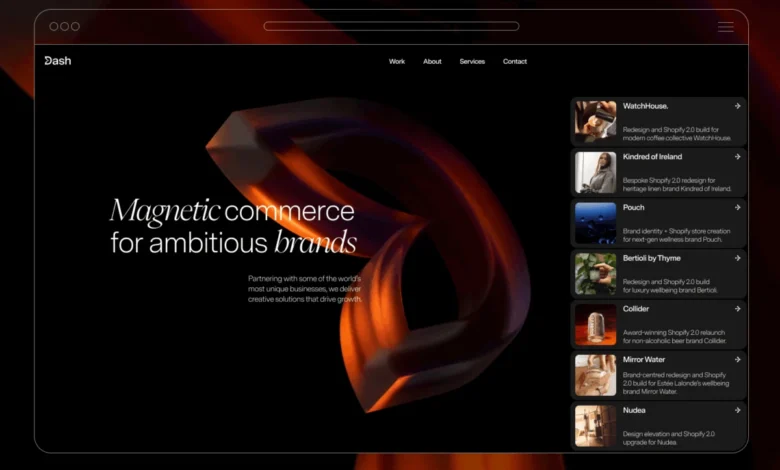
Dash Creative, a prominent digital experience agency, has unveiled its newly rebranded identity and a sophisticated website that exemplifies its "magnetic commerce" philosophy. The comprehensive overhaul, driven by a desire to distinguish itself in a competitive digital landscape, introduces an innovative approach to user engagement, characterized by dynamic interactions and a refined aesthetic. This strategic repositioning aims not only to refresh the agency’s visual presence but also to articulate its core value proposition: creating digital experiences that inherently draw users in, fostering deeper connection and conversion.
The Strategic Imperative: A Rebrand Rooted in Purpose
The decision for a rebrand had been a long-standing consideration for Dash Creative. In an increasingly saturated market, the agency recognized the need to move beyond merely looking different and instead, to truly own its unique contribution to the digital sphere. This introspection led to the formulation of "magnetic commerce" – a simple yet profound concept positing that effective digital experiences do more than convey information; they exert an irresistible pull, captivating users and guiding them intuitively through a journey. This guiding principle became the bedrock for every subsequent design and development decision, shaping the brand’s new visual language and interactive paradigms.
The core idea found its first tangible expression in the redesigned Dash Creative logo. The emblem features a distinct part of the ‘D’ seemingly drawn inward, as if by an unseen magnetic force. This singular detail was not merely an aesthetic choice but a conceptual anchor, serving as the genesis for the site’s entire motion design language. The logo, rendered as a rotating 3D object, naturally led to an intuitive cursor interaction: dragging the cursor over it causes it to visibly pull, mirroring the "magnetic" concept in real-time. This early decision established a high bar for motion across the entire website, ensuring that interactivity was always purposeful and conceptually aligned.
Crafting an Immersive User Experience: Beyond Static Design

Beyond the hero logo, the design team drew significant inspiration from iOS design principles for handling elements like project cards and Calls to Action (CTAs). The project cards, in particular, were meticulously crafted to evoke the familiar, tactile sensation of iOS notifications. This approach injected an element of delightful unexpectedness into the user interface, making interactions feel both intuitive and fresh. While the brand guidelines were notably strict, this constraint proved to be a powerful catalyst for creativity, preventing design drift and pushing the team towards more considered, impactful solutions. According to Sarah Chen, Lead Designer at Dash Creative, "The strictness of our new brand guidelines was initially perceived as a challenge, but it quickly became our greatest asset. It forced us to think deeper, to distill our ‘magnetic commerce’ concept into every pixel and interaction, ultimately leading to a more cohesive and distinctive outcome."
The entire project, from initial concept to final launch, spanned several months. While the core "magnetic commerce" concept coalesced relatively quickly, the bulk of the development time was dedicated to the meticulous refinement of content and the precise tuning of animations. This emphasis on iterative perfection underscores Dash Creative’s commitment to delivering not just visually appealing websites, but deeply engaging digital experiences that perform flawlessly.
A Multi-Tool Approach to Cutting-Edge Development
The successful execution of Dash Creative’s new website was a testament to a carefully selected and integrated technology stack, each component chosen for its specific strengths and ability to contribute to the overarching vision.
- Figma served as the primary design tool. Its robust capabilities for systematic design, including precise control over typography, spacing, and components, proved invaluable. With tightly defined brand guidelines, Figma ensured consistency across all design elements while simultaneously facilitating rapid iteration and collaborative feedback. The platform’s ability to maintain a single source of truth for design assets was critical in streamlining the creative process.
- Webflow was chosen for the website’s build, strategically demonstrating the platform’s advanced capabilities to prospective clients. As Dash Creative’s own site, it functions as a live portfolio, showcasing what is achievable within Webflow’s ecosystem. Most of the site’s interactive elements and animations are powered by Webflow’s native animation system, leveraging its visual interface for efficient development.
- GSAP (GreenSock Animation Platform) was integrated to handle interactions that demanded a higher degree of precision and control than Webflow’s native system could provide. This included the more intricate cursor-driven behaviors, such as the logo’s magnetic pull, and complex sequencing of animations, ensuring buttery-smooth transitions and sophisticated micro-interactions that elevate the user experience. Its robust API allowed for fine-tuned control over timing, easing, and transformations.
- Custom WebGL was deployed for the hero background, a critical element that could not be achieved with standard web technologies. This bespoke solution underscores Dash Creative’s commitment to pushing the boundaries of web interactivity and performance.
The Technical Core: Distorting Live Surfaces with WebGL
One of the website’s most compelling features is its hero background, a dynamic, distorting live surface implemented entirely using custom WebGL. The initial concept was straightforward: to use a fullscreen video as a texture and dynamically distort it in response to cursor movement. The paramount goal was to create a background that felt highly responsive and alive, yet remained subtle enough not to detract from the site’s primary content.

-
Conceptualizing the Dynamic Hero: A key distinction was made early on: the effect should not behave like a simple ripple emanating from the cursor’s center. Instead, the distortion was designed to carry momentum, propagating in the direction of cursor movement. This nuanced behavior creates the impression of a surface being actively pulled and manipulated, rather than merely reacting to a static hover state, reinforcing the "magnetic" theme. This subtle difference significantly enhances the perceived tactility and responsiveness of the interface.
-
Shader-Based Implementation: The entire distortion effect is executed within a fragment shader, a small program run on the GPU for each pixel. This approach avoids layering effects over the video and instead directly remaps the video’s texture coordinates. The cursor’s position defines the immediate area of influence, while its historical movement direction dictates how the distortion propagates across the surface. A damped sine function is at the heart of generating the wave-like displacement, ensuring a natural, fluid motion that gradually dissipates.
The configurable values, essential for tuning the visual characteristics of the distortion, are defined once and passed into the renderer:
const SETTINGS =
  radius: 0.41,
  amplitude: 0.082,
  frequency: 13,
  speed: 0.98,
  carry: 6,
  stagger: 12,
  centerPower: 2,
  verticalDampPower: 2.2,
  motionGain: 220,
  speedDecay: 0.86,
;
The underlying geometry for this effect is remarkably simple, consisting of a single fullscreen quad:
const vertices = new Float32Array([
  -1, -1, 0, 0,
   1, -1, 1, 0,
  -1,  1, 0, 1,
  -1,  1, 0, 1,
   1, -1, 1, 0,
   1,  1, 1, 1,
]);
The core of the distortion logic resides within the fragment shader, where the maskFn calculates the influence based on cursor proximity, and the wave function generates the displacement:
float maskFn(vec2 uv)
  vec2 d = uv - uMouseSm;
  d.x *= uAspect;
  float dist = length(d);
  return pow(smoothstep(uRadius, uRadius - uSoft, dist), uCenterPow);


float wave = sin(
  d.y * uFreq +
  dot(d, dir) * uCarry +
  uTime * uSpeed +
  d.y * uStagger
);

d += dir * (wave * amp * maskFn(uv) * damp);
This elegant solution ensures that the background responds dynamically to cursor interaction, exhibiting a natural momentum and decay rather than a simplistic, instantaneous reaction.

- Ensuring Fluidity: Motion Persistence and Smoothing: To achieve a more organic and less mechanical feel, the interaction state is smoothed and decayed on the JavaScript side before values are passed to the shader. This crucial step introduces persistence, allowing the distortion to gradually lose momentum after the cursor stops moving, rather than ceasing abruptly.
motionTarget *= SETTINGS.speedDecay;
const mappedMotion = Math.min(motionTarget * SETTINGS.motionGain, 1);

motion += (mappedMotion - motion) * SETTINGS.momentum;
dirSm.x += (dirTarget.x - dirSm.x) * SETTINGS.dirSmooth;
dirSm.y += (dirTarget.y - dirSm.y) * SETTINGS.dirSmooth;
This careful handling of motion data creates a more continuous and immersive experience, where the digital surface appears to possess a physical inertia.
-
Balancing Impact and Readability: A significant design consideration was to ensure the hero background, despite its dynamism, would not compete with the site’s content. The effect is intentionally placed behind the typography, adding depth and visual interest without compromising text legibility. The influence field employs a soft falloff rather than a harsh, defined edge, preventing the distracting "spotlight" effect often seen in cursor-reactive designs. Furthermore, vertical damping limits the spread of the wave, giving the distortion a more directional and controlled shape, rather than an even expansion in all directions. The rest of the hero section maintains a deliberate minimalism: a stark black background, a full-bleed video, and the shader applied directly to its texture. This restraint ensures that the focus remains on the innovative interaction itself.
-
Underlying Architecture: The WebGL implementation boasts a remarkably simple architecture, promoting efficiency and ease of integration. The HTML structure comprises a hero container, a hidden video element serving as the texture source, and a WebGL canvas layered above it.
<section id="us-sine-bg" class="hero-sine-bg">
  <video id="bgvid" class="hero-sine-bg__video" muted playsinline autoplay loop></video>
</section>
The renderer’s responsibilities are streamlined, primarily focusing on initializing WebGL, compiling shaders, setting up buffers, binding textures, updating uniforms (like cursor position and time), and issuing draw calls. It avoids complex scene graphs, extensive post-processing pipelines, or additional geometry, working solely with a single texture, a fullscreen quad, and a pair of shaders. This minimalist approach makes it exceptionally straightforward to integrate into a production environment. To optimize performance, frame uploads to the GPU only commence once the video source is fully ready:
if (video.readyState >= 2)
  gl.texImage2D(gl.TEXTURE_2D, 0, gl.RGBA, gl.RGBA, gl.UNSIGNED_BYTE, video);

rafId = requestAnimationFrame(renderFrame);
This lightweight render loop, coupled with the smoothing of interaction values and the localized canvas within the hero section, ensures that the dynamic background contributes to a premium user experience without imposing undue performance burdens. The modularity of this approach also means it can be readily adapted and reused with different video sources, distortion profiles, or across various sections of a website, offering significant flexibility.
Project Journey and Key Learnings

Reflecting on the entire rebrand and website development process, the Dash Creative team expressed satisfaction that the final product accurately communicates the agency’s desired message and ethos. While the technical implementation, particularly the WebGL component, came together with relative speed, the most significant investment of time was dedicated to the iterative refinement of motion and content. This phase involved countless small adjustments to timing, easing curves, and textual copy, which often yielded more substantial positive impact than the introduction of entirely new effects. This highlighted a critical challenge: knowing when to stop adding features and instead focus on perfecting existing ones.
"The journey reinforced a fundamental principle for us," stated Mark Thompson, CEO of Dash Creative. "True innovation in digital experiences isn’t just about cutting-edge technology; it’s about how meticulously that technology is integrated to serve a clear concept. The subtle interplay of content, timing, and interaction defines a truly magnetic experience."
Looking Ahead: The Mobile Frontier and Industry Impact
One key reflection from the project was the realization that the heavy reliance on cursor interaction significantly alters the user experience on touch devices. While the desktop experience is exceptionally fluid and engaging, the team acknowledges that a more deliberate consideration for touch-first interactions would be integrated earlier in future design processes rather than adapting later. This insight underscores the ongoing challenge for web developers to create universally excellent experiences across diverse input methods.
Overall, the project served to reinforce Dash Creative’s foundational belief that interaction is most effective when it elegantly supports the underlying concept, rather than existing purely for self-attention. The new website stands as a powerful testament to the agency’s technical prowess and creative vision, setting a new benchmark for immersive and purposeful digital experiences. By boldly embracing "magnetic commerce," Dash Creative has not only revitalized its own brand but also provided a compelling case study for how thoughtful design and advanced development can converge to create truly captivating online journeys for users and, by extension, drive tangible results for businesses in the digital economy. This project positions Dash Creative as a thought leader in experiential web design, demonstrating that the future of e-commerce lies in creating connections that are as intuitive and engaging as they are functional.