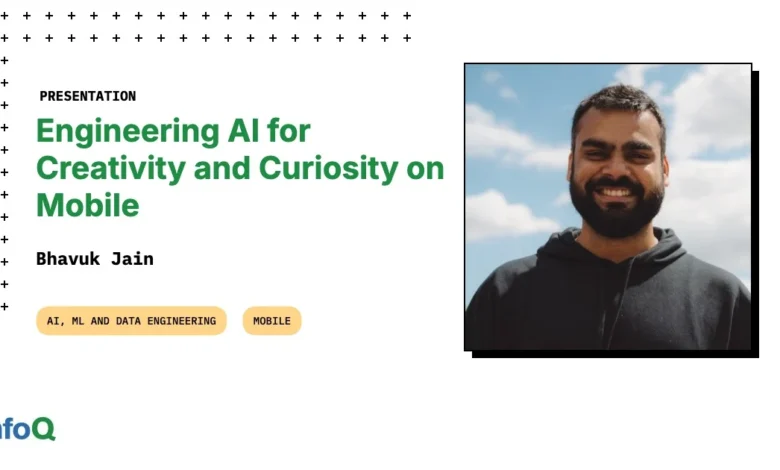
Google’s advanced strategies for integrating artificial intelligence into its mobile ecosystem were recently detailed in a presentation by Bhavuk Jain, an engineering lead at the tech giant. Jain’s insights illuminated the complex journey of transforming foundational AI models into user-facing products, specifically showcasing two innovative features: AI Wallpapers, which leverages generative AI for personalized creative expression, and Circle to Search, an understanding AI designed to enhance mobile search intuition. The discussion, likely part of an industry knowledge-sharing event such as an InfoQ presentation, underscored Google’s commitment to delivering both creative empowerment and frictionless information retrieval to its vast user base.
Jain’s presentation provided a deep dive into the architectural principles and product development methodologies that underpin modern AI systems. He began by highlighting common user pain points: the cumbersome process of identifying a product seen on a screen (e.g., sneakers on Instagram) and the time-consuming search for the perfect device wallpaper. These everyday frustrations, he explained, served as the direct inspiration for the two features discussed, framing them as solutions to tangible user needs in the mobile landscape.
The Foundational Path: From Raw Models to Refined Products
Modern AI product development rarely starts from scratch. Instead, it typically begins with massive foundational models, which, while powerful, are inherently unpredictable and unconstrained. Google’s approach refines these models through a rigorous four-step architectural process to create viable, user-ready products.
The first crucial step is Post-training, where the raw base model is aligned with human preferences, stylistic nuances, and essential safety rules. This phase is akin to teaching a brilliant but wild student manners and social norms. Techniques like Reinforcement Learning from Human Feedback (RLHF), known for its flexibility but complexity due to managing multiple models, and Direct Preference Optimization (DPO), a simpler and more scalable method that works directly on preferred versus rejected outputs, are employed. Jain emphasized the critical role of rigorous evaluation during this stage, particularly in defining clear, measurable criteria for human raters to assess subjective qualities like "good behavior" or "effective summaries" based on format, quality, completeness, and accuracy. This early architectural decision between flexibility and scalability sets the tone for subsequent development.
Following alignment, Fine-tuning specializes the generalist model into an expert tailored for a specific use case. This can involve standard supervised fine-tuning with input-output pairs (e.g., questions and answers) or the more modern Parameter-Efficient Fine-Tuning (PEFT) techniques like LoRA, QLoRA, and adapters. PEFT allows for dramatically cheaper and faster training by freezing most original weights and training only tiny, specialized modules. Jain noted that sometimes, fine-tuning isn’t even the answer; if the problem is a lack of fresh or factual knowledge, the solution lies in grounding.
This leads to the third essential step: Retrieval and Grounding. This layer combats "hallucinations" – instances where AI models generate plausible but factually incorrect information – by connecting the model to external sources of truth. These sources can include structured knowledge bases, fresh web results, or on-device context. By reducing reliance on the model’s parametric memory (frozen at training time), grounding ensures accuracy and currency. This is where modern AI systems integrate search, embeddings, Retrieval-Augmented Generation (RAG), and tool use to provide real, verifiable knowledge.
The final stage encompasses Inference, Guardrails, and Deployment. After alignment, specialization, and grounding, the model is wrapped in a robust layer of infrastructure and, crucially, equipped with a multilayered safety architecture known as guardrails. These mechanisms constrain what the model can see, say, and do, mitigating the inherent unpredictability of even fine-tuned models. Deployment, the "moment of truth," involves running the model reliably at scale across diverse requests, modalities (text, images, audio, video), and products. This requires unified multimodal serving pipelines, sophisticated techniques for managing latency, cost, and scaling (batching, caching, autoscaling), and comprehensive observability through rich logging and metrics.
Case Study 1: AI Wallpapers – The Generative Challenge of Creativity
AI Wallpapers, a feature that allows users to create unique, high-quality wallpapers instantly by describing an idea, stands as a prime example of generative AI engineering focused on creativity. Developed approximately two-and-a-half years ago when AI models were still nascent, the project found wallpapers to be the "perfect canvas."
The motivation was multi-faceted:
- Personalization: It offered an immediate user benefit, aligning with Android’s Material You design philosophy, which adapts the phone’s interface to match the wallpaper, creating a uniquely personal experience.
- Clear User Need: Data indicated that changing wallpapers is the most popular way users customize their phones, often involving significant time spent scrolling through galleries.
- Technological Readiness: Generative AI offered an infinite range of high-quality content, empowering users to become artists rather than just content consumers.
However, building AI Wallpapers presented four core challenges:
- UX Challenge (Prompt Engineering): Prompt engineering is powerful but complex. Asking average users to craft sophisticated prompts like "cinematic lighting, 8K, ethereal watercolor" was deemed a "recipe for failure." The goal was to simplify this into an intuitive mobile UI.
- Quality Challenge: Generative models don’t inherently possess "good taste." They might produce technically correct but artistically unappealing or "weird" images. Achieving consistent artistic control was paramount.
- Safety Challenge: For a feature deployed on millions of consumer devices, preventing inappropriate, harmful, or copyrighted content generation was a "non-negotiable day one problem" that couldn’t be addressed post-launch.
- Viability Challenge (Price of Success): Early server-based models were powerful but expensive. As usage grew, operational costs became a significant concern, threatening long-term viability.
To address the UX challenge, Google made a "non-obvious bet" on a guided creation model rather than an open, blank text box approach. While prevailing wisdom favored maximum user freedom, observation of public products revealed user frustration with the "blank canvas problem" and the burden of being an expert prompt engineer. The blank text approach also maximized the difficulty of setting reliable guardrails. By choosing simplicity and restriction, Google aimed for consistent quality and a tractable approach to risk assessment. This decision was validated through extensive user experience research.
With restriction came the responsibility to invest heavily in delight. This included subtle UI animations, such as words moving in a wavy or horizontally scrolling manner, and playful error messages (e.g., a T-Rex trying to paint instead of a generic "Error 404"). These elements transformed potential moments of frustration into engaging experiences, reinforcing the product’s quality and user-friendliness.
The architectural design for AI Wallpapers was a sophisticated loop. User selections on the frontend were sent to a prompt engineering service, which translated simple choices into highly structured, detailed prompts, often injecting artistic modifiers and negative keywords for quality control. These prompts then passed through a backend service equipped with the first layer of guardrails (fast server-side checks using classifiers and block lists). Once cleared, the prompt went to an inference platform, where a fine-tuned media generation service produced the image. A second safety layer of visual classifiers analyzed the output image for visual safety before an upscaling step enhanced its resolution. This layered safety strategy allowed the feature to be opened to users aged 13 and above.
Achieving artistic quality was tackled by recognizing that "models aren’t all made equal." Google focused on identifying the model’s inherent strengths—the "sweet spots" where it consistently produced outstanding results across different idea clusters like art, animals, or clothing. This upfront work allowed them to constrain user choices to domains where the model excelled, simplifying quality control. Large-scale testing, involving a pipeline that generated thousands of images with varied stylistic modifiers and manual human review, was critical. Designers and researchers evaluated images not just for technical correctness but for aesthetic quality and "wow factor," using explicit criteria for format, completeness, and appeal. This human-in-the-loop process informed the design of suggestion chips and structured prompt formats, turning learnings into effective prompt keywords. Over a million images were reviewed to select the few words that would appear in the final UI, demonstrating the meticulous attention to detail. This structured approach also yielded engineering benefits, such as prefix caching for faster inference. Collaboration with internal research teams further supercharged quality, creating feedback loops that improved core models and enabled fine-tuning for specific categories.
The journey to scale for AI Wallpapers was built on a philosophy of "scaling from day one." Relentless UX exploration defined evaluation criteria and metrics. A rigorous evaluation pipeline with human raters ensured consistent high-quality results. The architecture leveraged a scalable endpoint reused across multiple Google products, reducing overall cost and improving reliability. The feature’s launch was met with "incredible" user praise, calling it "freaking insane" and a "childhood dream," validating the guided creation approach. It was integrated across various Android surfaces and adopted by major OEMs like Samsung, demonstrating its widespread impact.
Case Study 2: Circle to Search – The Understanding Challenge of Curiosity
Shifting gears from creation to understanding, Jain introduced Circle to Search, a feature designed to make visual search deeply intuitive. The concept is straightforward: if you can see something on your mobile screen, you can search for it instantly without leaving your current app. From an engineering perspective, this is a complex, real-time, multimodal retrieval task.
The motivation behind Circle to Search stemmed from the inherent friction of traditional visual search workflows. Users previously had to take a screenshot, switch apps, upload the image, and then search – each step a potential point of abandonment. The project’s "North Star" was to eliminate this friction entirely, aiming for "zero context switching, zero interruption, and just a seamless flow from curiosity to answer." Building upon the foundation of Google Lens, which already possessed "world-class visual understanding," Circle to Search sought to integrate AI more deeply and achieve profound system-level OS integration.
Google Lens is "world-facing," requiring users to open a separate app and point their camera. Circle to Search, in contrast, is "screen-facing," turning whatever is on the screen into the query. This seemingly small shift has massive implications, transforming the task into a real-time retrieval problem demanding extremely low latency and highly relevant results.
The high-level architecture of Circle to Search begins on-device. A user gesture (circle, tap) triggers the capture of on-screen content, which is not merely a flat screenshot but a "multimodal prompt" containing both pixels and the structural layout of the device. This rich prompt is fed into an AI pipeline for core reasoning and heavy lifting. The final answer is then seamlessly overlaid onto the user’s current screen.
The AI pipeline itself is sophisticated. The multimodal input first hits a core multimodal model, fine-tuned to understand the relationships between an image, the user’s question, and the screen’s context. This model then initiates parallel reasoning and retrieval across multiple sources: the knowledge graph for structured facts and web and image search for visually similar items, products, and articles. For instance, circling sneakers might trigger queries to identify the brand and model via the knowledge graph while simultaneously finding shopping links and reviews via web search. The final stage involves synthesis and delivery, where an AI overview synthesis model crafts a helpful natural language answer. Crucially, this answer must pass through a final, non-negotiable checkpoint: safety and responsibility filters, which act as runtime guardrails to ensure helpful and harmless outputs.
Two key AI models underpin this instant experience: the Multitask Unified Model (MUM) and Gemini integration. MUM moves beyond simple keyword matching to intent understanding across modalities. If a user circles shoes (image) and types "blue" (text), MUM understands both visual attributes and semantic refinements to provide a precise answer. Gemini integration powers richer AI overviews and contextual help, handling complex reasoning.
A game-changing aspect of Circle to Search is its deep system-level integration directly into the Android OS. This enables a simple, universal gesture that works everywhere, removing the friction of the old screenshot-and-upload workflow. Because of this system-level integration, the AI receives a deeper level of context—not just a flat image, but the semantic layout of the screen. This allows the AI to pinpoint the exact pixels belonging to a selected object (e.g., a handbag in a busy photo), leading to highly accurate search results.
Guardrails for Circle to Search prioritize accuracy and safety. First, the visual AI is grounded in factual data by cross-referencing recognized entities with the reliable knowledge graph, preventing errors from relying solely on pixels. Second, a dedicated safety layer ensures that every synthesized result, especially those using generative models, passes a final responsible AI filter to catch harmful or inappropriate content. Finally, the system is designed to handle ambiguity gracefully. In low-confidence scenarios (blurry images, obscure objects), the worst outcome is a wrong guess, which erodes trust. The user experience offers broad suggestions instead of returning potentially incorrect answers, prioritizing reliability over false certainty.
The impact of Circle to Search has been significant. It achieved massive scale, launching on over 300 million devices. This easier access directly contributes to a 70% year-over-year increase in visual searches, making it a fast-growing query type, particularly among younger users, with strong performance in shopping and translation.
Key Learnings and Actionable Takeaways for the AI Industry
Jain concluded his presentation by distilling key learnings from these two distinct AI engineering challenges: generation and understanding. While principles like scalability and quality are universal, each case study offered unique insights.
From AI Wallpapers, the generative product, the primary lesson was the power of clear principles and tight product definitions in managing the "blank canvas problem." The "non-obvious bet" on guided creation and an obsession with the evaluation pipeline for artistic quality were critical. Over-investing in moments of delight transformed a restrictive experience into a magical one.
From Circle to Search, the understanding product, the main takeaway was that while model improvement helped, the deep OS integration made the feature truly seamless and frictionless, which users loved. This integration also unlocked a deeper level of intelligence by providing the AI with the semantic layout of the screen. Building user trust was paramount, emphasizing the importance of grounding visual AI in factual data by cross-referencing model perceptions with structured knowledge bases.
Jain offered actionable takeaways for different roles within the tech industry:
- For AI Engineers: "Think about productizing your AI and not just deploying it." A powerful model is merely the starting point; the real work lies in building the entire system around it, including evaluation pipelines, cost/latency optimizations, and safety guardrails, to create a reliable and trustworthy experience.
- For Tech Leaders: "Champion principle-led development." Difficult decisions, such as the guided creation approach for AI Wallpapers, must be guided by core principles like quality and safety, serving as a "North Star." Leaders must define these principles and empower teams to adhere to them.
- For Product Managers and Designers: "Obsess over the user’s workflow." As demonstrated by Circle to Search, identifying and eliminating friction in the user’s journey is crucial, even when the underlying AI is highly advanced.
Challenges and Future Outlook
During the Q&A session, Jain addressed critical aspects of AI product development. Regarding development velocity versus safety and quality, he acknowledged that projects like AI Wallpapers required a significant timeline—approximately a year—especially when models were less advanced. The emphasis was always on ensuring high quality and safety from the outset, rather than rushing to market.
On testing arbitrary inputs, Jain highlighted the crucial role of human-in-the-loop processes, involving product managers, UX designers, and human reviewers. This iterative approach allowed teams to evolve the testing pipeline and refine models based on human feedback, using prompt modifiers to achieve desired artistic styles or technical specifications.
Finally, addressing the challenge of operational costs, especially with expensive early AI models, Jain outlined several strategies: migrating to more efficient models, batching prompts, utilizing prefix caching, and reusing shared internal endpoints across multiple Google products. He expressed optimism that as AI models become more efficient, costs will naturally decrease, making advanced AI features more sustainable at scale.
In essence, Google’s journey with AI Wallpapers and Circle to Search exemplifies a comprehensive strategy for AI productization: a blend of cutting-edge research, meticulous engineering, user-centric design, and an unwavering commitment to safety and scalability. These efforts are not just about deploying powerful algorithms but about thoughtfully integrating intelligence into everyday mobile experiences, enhancing both creativity and curiosity for users worldwide.