AWS CloudFormation Unleashes Express Mode, Dramatically Accelerating Infrastructure Deployment for Developers


In a significant move poised to redefine the pace of cloud infrastructure development, Amazon Web Services (AWS) has announced the general availability of CloudFormation Express mode. This innovative feature marks a substantial leap forward in optimizing development workflows, offering immediate feedback on infrastructure deployments by separating the configuration completion from the full resource stabilization process. The introduction of Express mode is a direct response to the escalating demand for faster iteration cycles in modern software development, particularly for developers, AI agent workflows, and complex dependent stack deployments.
The announcement builds upon a foundational update in March 2024, when AWS introduced "optimistic stabilization" to CloudFormation, which alone reduced deployment times by up to 40%. Express mode takes this acceleration further, fundamentally altering how developers perceive and interact with CloudFormation’s completion signals. Rather than waiting for resources to be fully ready to serve traffic, Express mode reports completion as soon as the resource configuration is successfully applied, allowing developers to proceed with subsequent tasks without delay. This strategic shift is designed to dramatically enhance developer productivity and streamline continuous integration/continuous delivery (CI/CD) pipelines, especially in non-production environments where rapid iteration is paramount.
Understanding the Foundation: Infrastructure as Code and CloudFormation’s Role
At its core, AWS CloudFormation is a pivotal Infrastructure as Code (IaC) service that empowers users to model and provision AWS resources using declarative templates in JSON or YAML. Beyond direct template usage, it integrates seamlessly with higher-level abstraction tools like the AWS Cloud Development Kit (CDK) and the AWS Serverless Application Model (SAM). The promise of IaC is consistency, repeatability, and version control for infrastructure, treating it like application code. However, the speed at which this infrastructure can be deployed and updated has always been a critical factor influencing development velocity.
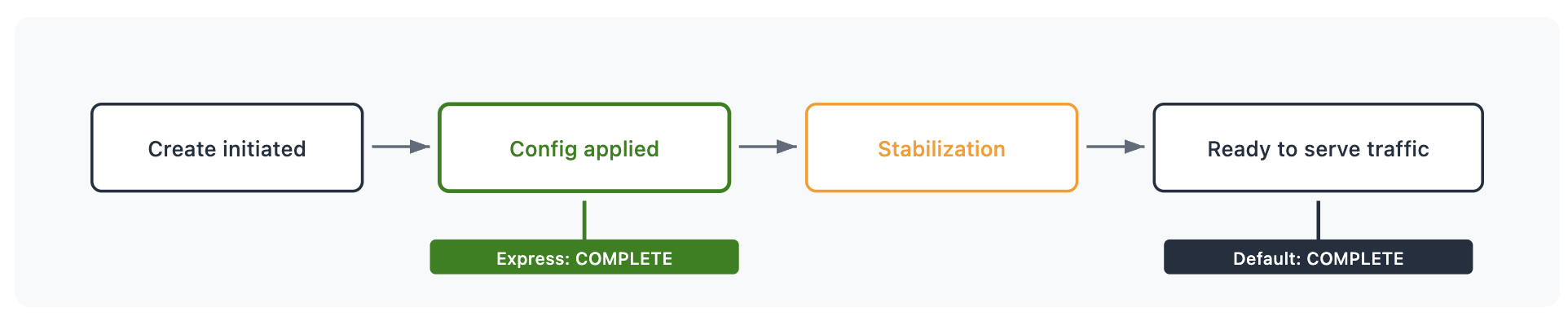
Traditional CloudFormation deployments follow a rigorous stabilization process. When a resource like an Amazon SQS Queue is created, or an Amazon EC2 instance is launched, there’s an inherent delay between the moment the resource is technically "created" or "launched" and when it is fully operational and ready to serve live traffic. For instance, an EC2 instance might be "running" but still installing necessary software, or an Amazon CloudFront distribution might be "created" but still propagating to edge locations worldwide. Similarly, an Amazon ECS service could be "active" but waiting for its containers to pass health checks and reach desired capacity. This period, known as "stabilization," ensures that upon a CREATE_COMPLETE signal, the resource is truly production-ready.
This default behavior, while crucial for production environments where immediate traffic readiness is non-negotiable, often introduced unnecessary delays in development and testing cycles. Developers iterating on a new feature might only need to confirm that the configuration was accepted and the resource attributes (like an ARN or DNS name) are available, not necessarily that the resource is fully stabilized and accepting live traffic. The "optimistic stabilization" update in early 2024, marked by the CONFIGURATION_COMPLETE event, was the first step towards addressing this, allowing CloudFormation to intelligently reduce stabilization waits when possible, yielding significant speed improvements. Express mode is the logical progression of this strategy, offering explicit control to the user.
Express Mode: A Paradigm Shift in Deployment Feedback
Express mode fundamentally redefines the "done" signal for CloudFormation deployments. Instead of waiting for full resource readiness, CloudFormation now reports a stack operation as complete as soon as the resource’s configuration has been applied successfully. While resources continue their background stabilization process to become fully operational, the immediate feedback empowers developers to move on. CloudFormation provides clear status reasons, such as "Resource operation completed using express mode. It may continue becoming available in the background," ensuring transparency regarding the resource’s state.
This distinction is crucial. The actual time it takes for a resource to become ready to serve traffic remains unchanged. What Express mode accelerates is the iteration cycle of the developer or automated agent. By not blocking on the potentially lengthy stabilization wait, it allows for quicker validation of template correctness, faster attribute retrieval, and the ability to trigger subsequent dependent actions. This is particularly impactful for resources like CloudFront distributions, which can take 5-10 minutes to propagate globally, or EC2 instances which require time to fully boot and pass health checks. With Express mode, these multi-minute waits can be reduced to mere seconds for configuration confirmation.
Importantly, Express mode does not compromise core CloudFormation functionalities. Regardless of the chosen deployment mode, CloudFormation continues to:
- Perform comprehensive pre-deployment template validation, catching syntax or logical errors before any provisioning begins.
- Manage resource dependencies correctly, ensuring that resources are provisioned in the right order.
- Handle retries for transient issues, maintaining the robustness of the deployment process.
- Provide detailed event streams and logs for auditing and troubleshooting.
Key Scenarios Where Express Mode Shines
The benefits of Express mode are most pronounced in specific development and automation scenarios:
-
Accelerated Development Iteration: Consider a developer building a complex application stack involving a Virtual Private Cloud (VPC), subnets, security groups, and an Application Load Balancer (ALB). Often, the immediate need is to obtain the ALB’s DNS name or the security group ID to configure the next application layer, not necessarily to send live traffic to the ALB right away. In the default mode, the developer would wait for the ALB to fully stabilize, which could take several minutes. With Express mode, the ARN, DNS name, and security group bindings are available in seconds, allowing the developer to immediately proceed with configuring their application, significantly compressing the feedback loop. This translates to more frequent commits, faster bug fixes, and a more agile development process.
-
Optimizing AI Agent Workflows: The rise of autonomous infrastructure management powered by AI agents demands an extremely tight feedback loop. An AI agent tasked with iterating on infrastructure definitions – deploying, observing results, adjusting, and redeploying – cannot afford multi-minute delays for each iteration. For an agent experimenting with CloudFront distribution configurations, the critical feedback is whether the configuration was accepted and provisioned, not whether it has propagated globally. Express mode transforms a potentially 5-10 minute CloudFront deployment into a sub-minute confirmation. This allows the AI agent to validate, refine, and redeploy multiple times within the window a single default deployment would have consumed, vastly improving the efficiency of AI-driven infrastructure optimization. This capability aligns with the broader trend of AI-assisted coding and operations, where real-time feedback is crucial for model training and decision-making.
-
Expediting Dependent Stack Deployments: In large-scale cloud environments, applications are often composed of multiple interdependent CloudFormation stacks. These dependencies can be explicit (e.g., using CloudFormation’s export/import mechanisms) or implicit. When deploying such a multi-stack architecture, each individual stack operation completing faster with Express mode has a compounding effect on the overall deployment time. While Express mode still respects and manages dependencies, it reduces the idle waiting time between the provisioning of one stack and the initiation of the next, leading to a much faster end-to-end deployment of complex systems. This is particularly beneficial in microservices architectures where dozens or hundreds of small, interconnected stacks might need frequent updates.
Implementation and Accessibility
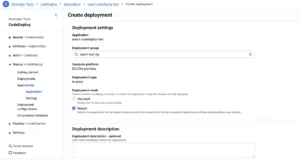
AWS has ensured that enabling Express mode is straightforward and requires no changes to existing CloudFormation templates. It’s an operational flag, not a template modification. Users can activate Express mode per operation using a single parameter across various AWS tools:
-
AWS Command Line Interface (CLI):
aws cloudformation create-stack
  --stack-name my-app
  --template-body file://template.yaml
  --deployment-config '"mode": "EXPRESS"'
By default, Express mode disables rollback for even faster iteration. If a resource fails to configure, the stack remains in its current state, allowing for immediate fixes and retries. For scenarios requiring rollback, this can be explicitly re-enabled:
aws cloudformation create-stack --stack-name my-app --template-body file://template.yaml --deployment-config '"mode": "EXPRESS", "disableRollback": false' -
AWS Cloud Development Kit (CDK):
CDK users can leverage the--expressflag:cdk deploy --expressTo enable rollback with Express mode in CDK:
cdk deploy --express --rollback -
AWS Serverless Application Model (SAM) CLI:
SAM users can employ the--expressflag withsam deployorsam sync:sam deploy --express sam sync --expressTo persist the Express mode setting for future SAM deployments, the
--save-paramsflag can be used, storing the configuration insamconfig.toml:
sam deploy --express --save-paramsThe
--disable-rollbackflag also functions alongside--expressin SAM to control rollback behavior.
Express mode is also fully supported with CloudFormation change sets, allowing users to preview changes before execution while benefiting from the accelerated deployment configuration. Furthermore, when Express mode is enabled on a parent stack, it automatically propagates to all nested stacks within the hierarchy, ensuring consistent, accelerated completion across complex, modular architectures. For a comprehensive overview of supported features and any specific limitations, AWS directs users to the official CloudFormation Express mode documentation.
Broader Implications and Strategic Importance
The introduction of CloudFormation Express mode is more than just a performance enhancement; it represents a strategic evolution in how AWS supports cloud development. In an increasingly competitive cloud landscape, where developer experience and iteration speed are key differentiators, Express mode positions CloudFormation as an even more agile and developer-friendly IaC tool.
- Elevated Developer Experience: By significantly reducing waiting times, AWS empowers developers to maintain a "flow" state, minimizing context switching and frustration often associated with lengthy deployments. This directly translates to higher productivity and job satisfaction.
- Enhanced DevOps and CI/CD: Faster deployments mean shorter CI/CD pipeline execution times. This allows for more frequent testing, earlier detection of issues, and quicker delivery of new features or bug fixes to pre-production environments. Organizations can achieve true continuous delivery with greater ease.
- Economic Impact: Time saved in development cycles translates directly to cost savings. Reduced compute time in CI/CD pipelines, faster time-to-market for new features, and more efficient resource utilization during development all contribute to a more economical cloud operation.
- Competitive Edge: While other IaC tools like HashiCorp Terraform and Pulumi offer their own advantages, CloudFormation’s deep integration with the AWS ecosystem, combined with features like Express mode, reinforces its position as the native and often preferred choice for AWS-centric organizations. This continuous innovation helps AWS retain and attract developers to its platform.
- Future of Automation: The explicit support for AI agent workflows highlights AWS’s foresight into the future of autonomous infrastructure. As AI takes on more responsibility in managing cloud resources, the ability to provide rapid feedback loops will be indispensable for building robust and intelligent automation systems.
AWS officials, while not providing direct quotes on the announcement, have consistently emphasized the company’s commitment to simplifying and accelerating the cloud development journey. The pattern of innovation, from the original CloudFormation service to optimistic stabilization and now Express mode, clearly illustrates a continuous effort to align the platform with the dynamic needs of modern development practices.
Conclusion
CloudFormation Express mode is a powerful new capability that provides developers with immediate confirmation of infrastructure configuration, decoupling it from the often-lengthy stabilization process. This strategic separation allows users to decide whether their immediate need is to confirm configuration correctness or to wait for full traffic readiness. For development iteration, AI agent workflows, and dependent stack deployments, where resource identifiers are more crucial than immediate traffic serving, Express mode delivers unparalleled speed. For production deployments, where "stack complete" must unequivocally mean "ready to serve traffic," the default stabilization behavior remains the optimal and recommended choice. By offering this flexibility, AWS further empowers its vast developer community to build, deploy, and iterate on cloud infrastructure with unprecedented velocity, solidifying CloudFormation’s role as an indispensable tool in the modern cloud development toolkit.
Related posts: