AWS DevOps Agent and LaunchDarkly Revolutionize Feature Flag Orchestration for Enhanced Release Management and Incident Response

Organizations operating in today’s dynamic digital landscape increasingly rely on feature flags to manage software releases, conduct A/B testing, and enable progressive rollouts. However, the critical link between these powerful development tools and essential incident response mechanisms has historically remained manual and fragmented. When an outage inevitably strikes, engineering teams face the daunting task of manually identifying relevant flags, assessing their impact, deciding whether to toggle them, and coordinating these changes across diverse teams. This often leads to critical delays, escalating customer impact and operational costs during moments of peak pressure. The newly announced integration between AWS DevOps Agent and LaunchDarkly, facilitated by the Model Context Protocol (MCP) server feature, marks a significant leap forward, automating feature flag recommendations and actions within both proactive deployment reviews and reactive incident response workflows. This collaboration empowers engineers to make faster, more informed decisions, thereby enhancing reliability and reducing the mean time to resolution (MTTR) for critical incidents.
The integration leverages the AWS DevOps Agent’s ability to connect to LaunchDarkly’s hosted MCP server. This connection allows the DevOps Agent to query flag states, read complex targeting rules, and surface actionable recommendations directly within existing engineering workflows, eliminating the need for context-switching and manual data correlation. This post delves into the two primary use cases this powerful integration addresses: bolstering release management through proactive flag recommendations and accelerating incident response with flag-based containment strategies. Furthermore, we will explore the underlying connection architecture, a reusable DevOps Agent Skill designed for pre-deployment flag validation, and provide guidance for getting started.
Bridging the Gap: The Challenge of Manual Feature Flag Management
The proliferation of microservices architectures and continuous delivery pipelines has made feature flags indispensable for modern software development. They enable teams to deploy code more frequently and with reduced risk, allowing new features to be developed, tested, and released to specific user segments without requiring a full code redeployment. However, the benefits of feature flags are often hampered by a lack of integrated tooling. Without automated connections between feature flag platforms and operational tools, organizations often encounter several critical pain points:
- Increased Latency During Incidents: Manually identifying the feature flag associated with a problematic deployment, checking its state, and coordinating its deactivation adds precious minutes, or even hours, to incident resolution times. Industry reports consistently highlight that every minute of downtime can cost businesses thousands, sometimes millions, of dollars, underscoring the urgency of rapid containment.
- Higher Risk of Deployment Failures: Without automated checks, developers might inadvertently deploy high-risk changes without adequate feature flag coverage. This exposes users to potential regressions and makes rollbacks more complex and time-consuming. Studies suggest that a significant percentage of production incidents are traced back to recent deployments, emphasizing the need for robust pre-deployment validation.
- Developer Cognitive Overload: Engineers are forced to juggle multiple dashboards and tools – their IDE, CI/CD pipeline, incident management platform, and feature flag console – leading to context-switching, errors, and decreased productivity.
- Lack of Auditability and Governance: Manual processes make it challenging to maintain a clear audit trail of why a flag was recommended, how it was configured, and when it was toggled during an incident or deployment.
This integration directly addresses these challenges by embedding intelligent, context-aware feature flag recommendations into the heart of DevOps workflows.
Proactive Defense: Revolutionizing Release Management with Intelligent Flag Recommendations
The release management capabilities, now in public preview within AWS DevOps Agent, are designed to scrutinize code changes meticulously before they ever reach production environments. This comprehensive readiness review goes beyond traditional static analysis, incorporating functional testing in AWS-managed verification environments, assessing risks stemming from cross-codebase dependencies, evaluating adherence to organizational standards and best practices, and mathematically verifying access control configurations in CloudFormation against Well-Architected principles.
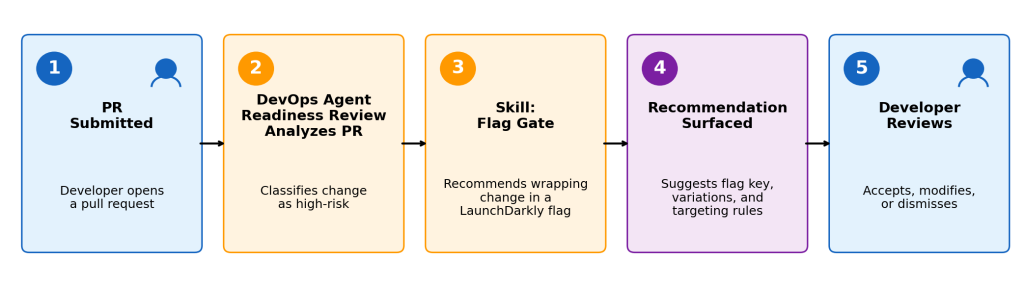
Crucially, AWS DevOps Agent is built for extensibility, allowing organizations to tailor its capabilities through custom Skills. This is where the integration with LaunchDarkly truly shines. When the agent identifies a high-risk change, a custom Skill can evaluate the adequacy of existing feature flag coverage. By operating on deployment metadata and performing code analysis, the Skill identifies gaps and surfaces precise recommendations directly to the developer. For instance, it can recommend the immediate implementation of a LaunchDarkly feature flag when a critical change is detected without proper isolation.
Figure 1: DevOps Agent’s readiness review identifies high-risk PRs and recommends LaunchDarkly feature flag coverage before code ships.
An AWS spokesperson emphasized the strategic importance of this proactive approach: "Our goal with AWS DevOps Agent is to shift security and reliability left, empowering developers with intelligent guardrails. Integrating with LaunchDarkly allows us to provide contextual feature flag recommendations directly within the developer’s workflow, significantly reducing the likelihood of high-impact incidents stemming from risky deployments. This isn’t just about catching errors; it’s about building a culture of preventative reliability."
The Power of the High-Risk Feature Flag Recommendation Skill
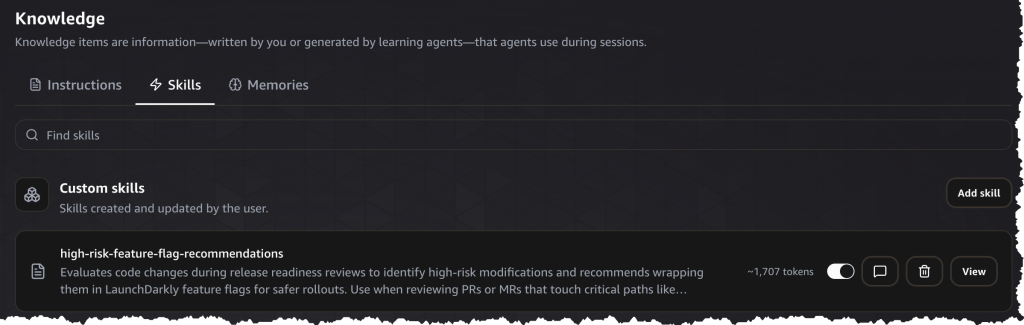
The custom release readiness flag Skill within AWS DevOps Agent classifies incoming code changes into distinct risk tiers: Critical, High, and Moderate. This classification is based on the nature of the modification, examining areas such as payments, authentication, database schemas, third-party integrations, new API endpoints, and performance-sensitive code paths. The Skill then recommends feature flag coverage proportional to the identified risk level, ensuring that the most sensitive changes receive the most robust protection.
Figure 2: The high-risk-feature-flag-recommendations Skill configured in AWS DevOps Agent’s Knowledge panel.
When a gap in feature flag coverage is identified, the Skill generates a comprehensive recommendation that includes:
- A descriptive feature flag name: Following best practices for clarity and consistency.
- The appropriate LaunchDarkly flag type: Whether a simple boolean, a multivariate flag for A/B testing, or a number/string flag for configuration adjustments.
- A recommended targeting strategy: Guiding the phased rollout, such as starting with internal test accounts, followed by a small percentage of production traffic, or targeting specific user segments.
- Clear kill switch guidance: Explaining the behavior when the flag is disabled, including the fallback code path, any necessary cleanup, or data consistency implications. This ensures operators understand the immediate impact of toggling the flag.
Example Scenario: Protecting a Critical Tax Calculation Service
Consider a development team preparing to deploy an update to a core tax calculation service. This particular change modifies the fundamental tax rate computation logic, impacting all order totals across multiple geographical regions. AWS DevOps Agent, during its automated readiness review, classifies this deployment as "High-Risk" due to its direct financial implications and broad impact. The pre-deployment flag gate Skill then performs its analysis, identifying:
- The specific code changes related to the tax calculation logic.
- The absence of any existing LaunchDarkly feature flag governing this specific modification.
- The potential for significant financial errors and customer dissatisfaction if issues arise post-deployment.
In response, the Skill surfaces a clear, actionable recommendation: "This deployment modifies tax calculation logic with no existing feature flag coverage. Recommend wrapping the new tax computation in a LaunchDarkly flag (e.g., tax-calculation-v2) with a phased rollout targeting internal test accounts first, followed by 5% of production traffic."
This recommendation empowers the developer to immediately act. They can create the suggested flag in LaunchDarkly, adjust the proposed configuration to align with their specific rollout plan, or, if they decide to proceed without a flag, document the justification as part of the immutable deployment record. This ensures transparency and accountability, even when recommendations are overridden.
Figure 3: AWS DevOps Agent release management report identifying checkout pricing changes deployed without LaunchDarkly feature flag coverage, including a suggested fix with sample code.
Closing the Loop with Kiro IDE: Shifting Left Feature Flag Creation
The value of DevOps Agent’s release management capabilities is further amplified when paired with Kiro IDE. Kiro IDE directly integrates with LaunchDarkly’s MCP server, bringing flag integration capabilities into the earliest stages of the development workflow. When a developer begins building a new feature within Kiro, the IDE can query LaunchDarkly via MCP to ascertain if a flag already exists for that feature. If not, it can generate the necessary code with the flag evaluation built in from the outset.
This creates a seamless, continuous flow: AWS DevOps Agent identifies potential risks and recommends flag coverage during the readiness review; the developer, working within Kiro IDE, can then generate the flag and wrap the relevant code in a single, integrated action; consequently, the deployment ships with robust flag coverage already in place. This eliminates disruptive context-switching between tools and the manual creation of flags in a separate console, boosting developer productivity and ensuring consistency.
Furthermore, developers can utilize Kiro’s flag integration independently during feature development, even before a deployment triggers a release management review. This establishes layered coverage: if Kiro catches it during development, DevOps Agent validates the targeting rules at deployment time. If the developer bypasses Kiro or uses an alternative toolchain, DevOps Agent still identifies the gap, acting as a crucial safety net.
Reactive Offense: Accelerating Incident Response with Flag-Based Containment
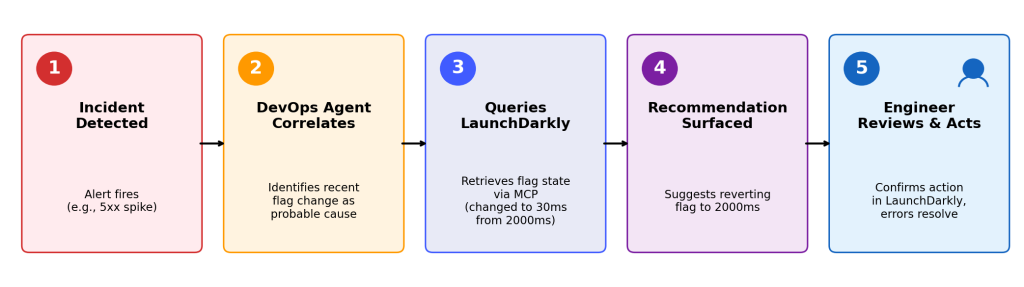
During an active incident, every second counts. The speed of containment directly correlates with the reduction of customer impact and financial loss. DevOps Agent plays a pivotal role in incident response workflows by intelligently querying LaunchDarkly to understand the current state of feature flags, then recommending precise containment actions based on its findings.
Figure 4: DevOps Agent identifies a flag change (30ms from 2000ms) as the probable cause, queries LaunchDarkly for state, and recommends reverting the value.
When an incident is detected, DevOps Agent automatically correlates the affected service with recent deployments and any associated feature flag changes. It then queries LaunchDarkly to identify feature flags linked to those deployments and their current status – whether they are enabled, their specific targeting rules, and their rollout percentage. If a relevant, enabled flag is identified as a potential contributor to the incident, the agent recommends disabling or modifying it as a primary containment option, often before suggesting a full deployment rollback.
A LaunchDarkly executive highlighted the operational benefits: "Our collaboration with AWS DevOps Agent provides a critical capability for rapid incident resolution. By giving incident responders immediate, intelligent recommendations for flag-based containment, we can significantly reduce MTTR. Toggling a feature flag to return behavior to a known good state is often far quicker and less disruptive than orchestrating a full deployment rollback, which can involve complex CI/CD pipelines and longer deployment cycles."
Example Scenario: Resolving a Bot Service Outage
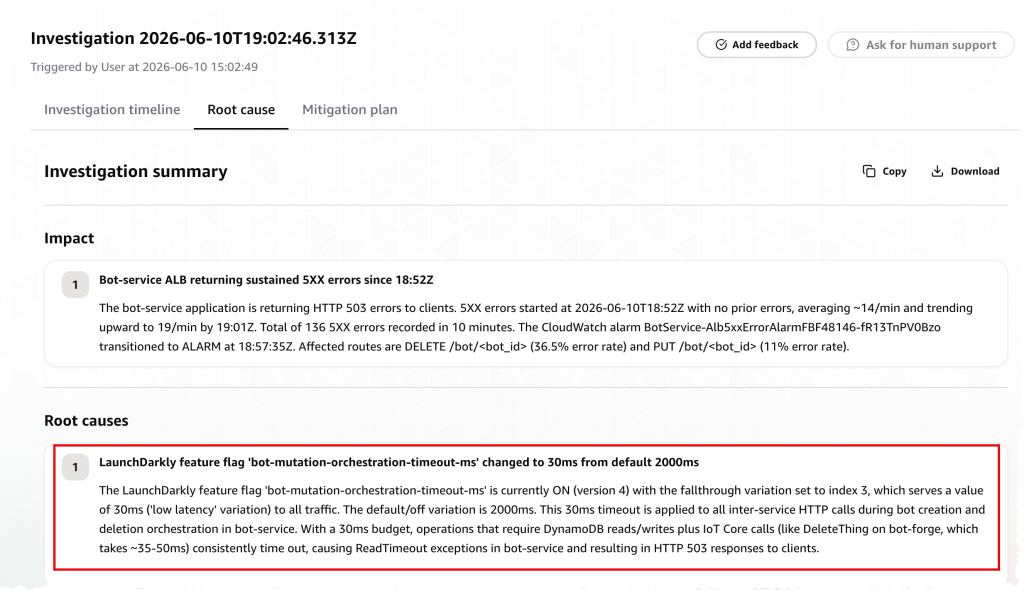
Imagine an alert indicating sustained 5XX errors on a critical bot-service. The on-call engineer engages DevOps Agent, which initiates an automated investigation:
- Correlates Incident Data: DevOps Agent quickly correlates the
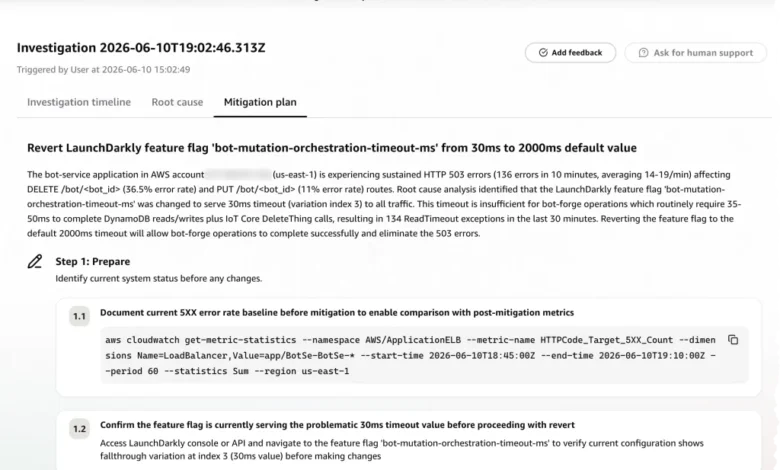
bot-serviceoutage with recent activity, identifying a recent change to a LaunchDarkly feature flag namedbot-mutation-orchestration-timeout-ms. - Queries Flag State: The agent queries LaunchDarkly via MCP to determine the current and previous states of this flag. It discovers that the timeout value was recently changed from a default of 2000ms to a much shorter 30ms.
- Identifies Root Cause and Recommends Action: Based on this information, DevOps Agent identifies the flag change as the probable root cause, leading to
ReadTimeoutexceptions within thebot-service. It then recommends reverting thebot-mutation-orchestration-timeout-msflag to its default 2000ms value.
The engineer reviews the recommendation, updates the flag variation in LaunchDarkly, and observes the error rate returning to baseline within minutes, demonstrating the speed and efficiency of flag-based containment.
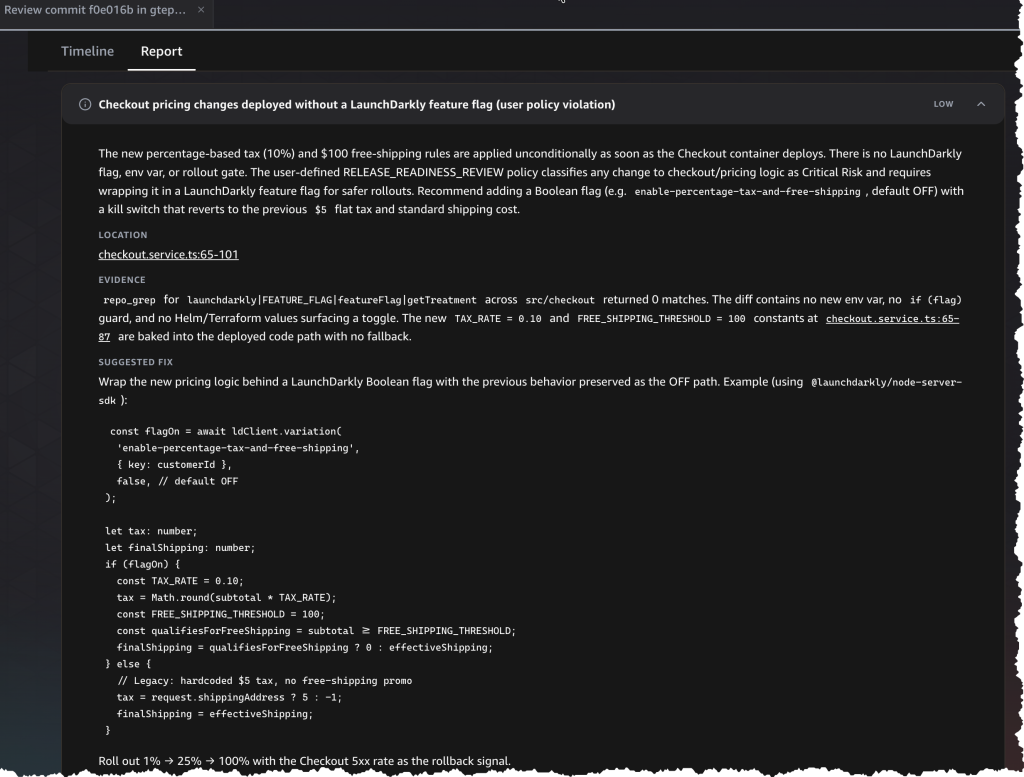
Figure 5: AWS DevOps Agent investigation summary identifying a LaunchDarkly feature flag timeout change as the root cause of sustained 5XX errors.
Step-by-Step Mitigation Plans: An Auditable Runbook for Incident Responders
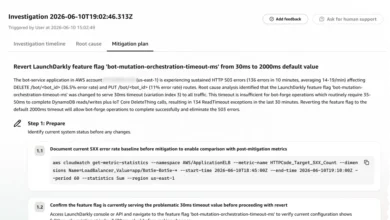
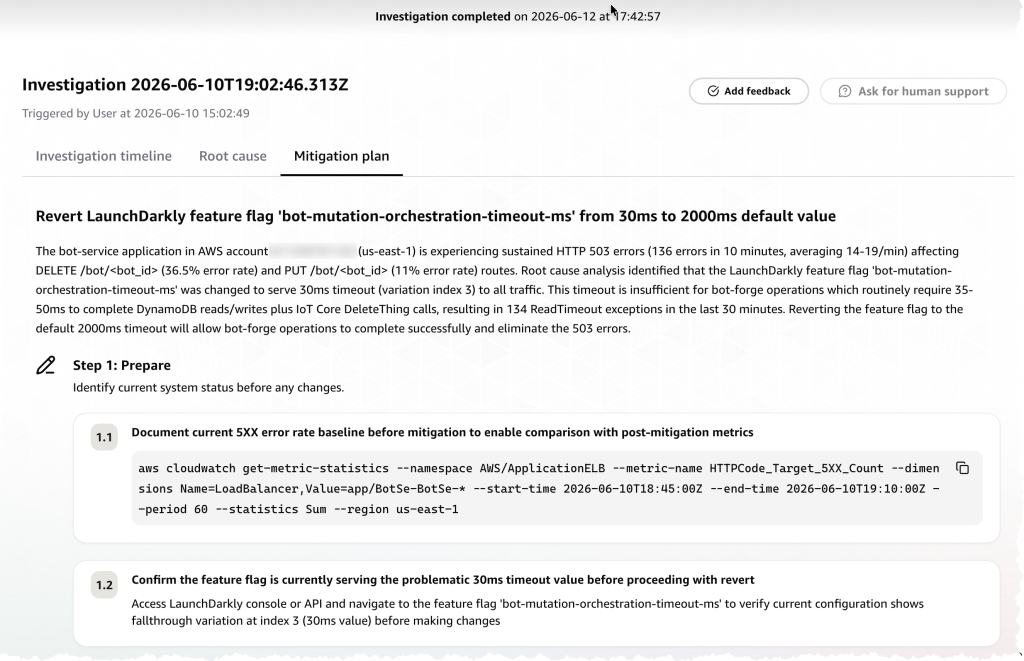
Beyond simply identifying a root cause and recommending an action, DevOps Agent takes incident response a step further by generating structured mitigation plans. These plans provide concrete, executable steps rather than vague suggestions, acting as an auditable runbook for the on-call engineer. Each plan includes:
- Specific actions: Clearly outlining what needs to be done (e.g., "Revert LaunchDarkly feature flag ‘bot-mutation-orchestration-timeout-ms’").
- Required tools and commands: Providing the exact API paths, CLI commands, or UI navigation steps needed to perform the action (e.g., "Use the LaunchDarkly API to update the flag variation…").
- Success criteria and verification steps: Defining how to confirm that the mitigation has been successful (e.g., "Monitor CloudWatch metrics for ‘bot-service’ 5XX errors; verify error rate returns to baseline").
Each step is further broken down into sub-steps with specific instructions, ensuring that the on-call engineer has a clear, unambiguous path to resolution, significantly reducing cognitive load during high-stress situations.
Figure 6: Structured mitigation plan generated by AWS DevOps Agent with executable steps to revert the feature flag and verify resolution.
During the bot-service incident, the engineer leveraged this plan to revert the bot-mutation-orchestration-timeout-ms flag from the problematic "low latency" variation (30ms) back to the stable "default" variation (2000ms) within the LaunchDarkly console.
Figure 7: LaunchDarkly targeting configuration for the bot-mutation-orchestration-timeout-ms flag showing available variations including the default and low latency values.
Connecting to LaunchDarkly via MCP: The Technical Backbone
The seamless integration between AWS DevOps Agent and LaunchDarkly is made possible by DevOps Agent’s MCP server feature, which connects to LaunchDarkly’s hosted MCP server. The Model Context Protocol (MCP) is a standardized way for agents to interact with management plane operations, exposing flag management actions as agent-callable tools. This means DevOps Agent can query flag state, read targeting rules, and list flags by project or environment without requiring custom, brittle integration code.
The connection flow is as follows:
- Request Initiation: An engineer or an automated workflow (e.g., a CI/CD pipeline, an incident response playbook) triggers an action or query in AWS DevOps Agent that requires feature flag context.
- Skill Execution: A DevOps Agent Skill, such as the "High-Risk Feature Flag Recommendations" Skill or an incident response Skill, determines that it needs to interact with LaunchDarkly.
- MCP Communication: DevOps Agent, acting as an MCP client, sends a standardized MCP request to LaunchDarkly’s hosted MCP server. This request could be to fetch flag definitions, query the state of a specific flag, or retrieve targeting rules.
- LaunchDarkly Response: LaunchDarkly’s MCP server processes the request, retrieves the relevant feature flag data, and returns it to DevOps Agent in a standardized MCP format.
- Recommendation/Action: DevOps Agent processes the received data and, based on the logic defined in its Skills, surfaces recommendations (e.g., "add flag
x") or takes automated actions (e.g., "disable flagy").
Registration and Configuration
Setting up this powerful connection involves a few straightforward steps:
- Generate LaunchDarkly API Key: Create a dedicated API key in LaunchDarkly with the necessary read and write permissions for the environments and projects that DevOps Agent will manage.
- Configure DevOps Agent Integration: In the AWS DevOps Agent console, register LaunchDarkly as an MCP server integration, providing the LaunchDarkly API key and endpoint.
- Define Skills: Implement or activate the relevant DevOps Agent Skills (like the "High-Risk Feature Flag Recommendations" Skill) that leverage this LaunchDarkly connection for proactive or reactive workflows.
For a comprehensive setup walkthrough, including detailed configuration steps and precise permissions requirements, refer to the companion blog post from LaunchDarkly (link placeholder). It is noteworthy that the same LaunchDarkly MCP server connection is also utilized by Kiro IDE for flag-aware code generation during development, as detailed in the "Defense" section, completing the end-to-end pre-deployment workflow.
Activating the Skill: Ensuring Consistent Application
AWS DevOps Agent Skills are modular instruction sets that infuse the agent with specialized domain knowledge and investigation methodologies, tailored to an organization’s unique infrastructure and operational workflows. The agent loads Skill metadata at the beginning of each workflow and retrieves the full Skill content when it determines relevance. To ensure the feature flag Skill is consistently applied during all release readiness reviews, a specific directive should be added to the organization’s DevOps Agent Instructions (Agent.md), which is loaded in full at the start of every session:
When performing release readiness reviews, always load and apply the high-risk-feature-flag-recommendations skill to evaluate code changes for risk and recommend LaunchDarkly feature flags where appropriate.
This directive guarantees that the agent consistently loads and applies the Skill for every release readiness review, removing reliance on dynamic relevance detection and ensuring comprehensive coverage.
Strategic Implications and Broader Impact
This integration represents more than just a technical convenience; it signifies a strategic shift in how organizations approach software delivery and operational resilience.
- Enhanced Operational Excellence: By automating the assessment and recommendation of feature flags, organizations can significantly reduce the risk associated with deployments, leading to fewer incidents and improved system stability.
- Accelerated Incident Resolution: The ability to quickly identify and act on problematic feature flags during an incident dramatically cuts down MTTR, minimizing downtime and its associated financial and reputational costs.
- Improved Developer Experience: Developers are empowered with intelligent recommendations directly within their workflow, reducing cognitive load and context-switching. This fosters a culture where reliability and safety are baked into the development process, rather than being an afterthought.
- Stronger Governance and Compliance: Automated tracking and auditable mitigation plans provide a clear record of risk assessments and actions taken, supporting compliance efforts and post-incident reviews.
- Future-Proofing DevOps: As DevOps practices continue to evolve, integrating intelligent agents like AWS DevOps Agent with specialized tools like LaunchDarkly positions organizations to leverage advanced capabilities, potentially integrating with AI/ML-driven insights for even more sophisticated proactive and reactive strategies.
Getting Started
To begin leveraging the power of feature flag orchestration with AWS DevOps Agent and LaunchDarkly:
- Set up AWS DevOps Agent: Ensure your AWS environment is configured for AWS DevOps Agent and its release management capabilities.
- Configure LaunchDarkly MCP Integration: Follow the steps to connect AWS DevOps Agent to LaunchDarkly’s hosted MCP server.
- Activate Feature Flag Skills: Deploy and activate the "High-Risk Feature Flag Recommendations" Skill and any other relevant Skills to integrate flag recommendations into your workflows.
Conclusion
The integration of AWS DevOps Agent and LaunchDarkly through the Model Context Protocol significantly reduces the manual coordination and latency inherent in managing feature flags across the software development lifecycle. The DevOps Agent’s ability to surface intelligent flag recommendations before high-risk changes ship proactively fortifies release management. Simultaneously, during active incidents, the agent’s capacity to query LaunchDarkly for real-time flag state and recommend flag-based containment actions offers a faster, less disruptive resolution path compared to traditional full rollbacks.
For developers utilizing Kiro IDE, the same LaunchDarkly MCP server connection enables flag-aware code generation at the point of authorship, effectively shifting flag coverage "left" in the development process. This creates a powerful, layered defense mechanism: individual developers build with flags from the start, AWS DevOps Agent’s release management capabilities validate this coverage at deployment time, and during incidents, the DevOps Agent leverages flag state for rapid, intelligent response. This holistic approach promises to enhance operational reliability, accelerate development cycles, and empower engineering teams with unparalleled control over their software releases.
Authors