Taming the Digital Deluge: How Modern Cloud Object Storage Platforms Are Redefining Enterprise Asset Management

As the digital economy continues to expand at an exponential rate, web applications have grown commensurately in both scale and complexity. Modern web architectures are tasked with processing, serving, and archiving an unprecedented volume of digital assets, ranging from high-resolution imagery and video streams to complex application binaries and user-generated data. This relentless data accumulation has triggered a corresponding rise in file sizes, transforming asset management from a routine backend maintenance task into a critical operational expense. Consequently, organizations across industries are increasingly forced to grapple with escalating infrastructure costs, hidden fees associated with data egress, and the mounting architectural complexity of multi-vendor cloud environments.
For years, the market for scalable cloud storage has been dominated by a handful of hyperscalers—namely Amazon Web Services (AWS) with its Simple Storage Service (S3), Google Cloud Storage, and Microsoft Azure Blob Storage. While these platforms established the gold standard for durability, availability, and global reach, their pricing models have frequently drawn scrutiny from cost-conscious engineering teams. Complex tiered pricing, unpredictable data retrieval fees, and costly cross-region data transfers can quickly turn routine storage operations into significant financial liabilities, particularly for bootstrapped startups, mid-sized enterprises, and high-growth SaaS providers.
Enter STRG, a modern cloud object storage platform designed to address these systemic industry pain points. Positioned as an affordable, S3-compatible alternative to the incumbent hyperscalers, STRG aims to democratize enterprise-grade object storage by offering competitive pricing structures without sacrificing the robust feature sets that modern developers demand. By leveraging full S3 API compatibility, the platform allows organizations to migrate existing workloads seamlessly without requiring extensive codebase rewrites or architectural overhauls.
The Genesis of S3 Compatibility and the Shift Toward Specialized Storage
To understand the strategic positioning of platforms like STRG, one must examine the evolution of cloud storage standards over the past two decades. When Amazon Web Services introduced S3 in 2006, it fundamentally transformed how software engineers approached data persistence. By abstracting away the physical realities of hard drives, SANs, and tape backups, S3 established an HTTP-based REST API that quickly became the de facto lingua franca of cloud infrastructure.
Over subsequent years, competing major cloud providers developed their own proprietary storage APIs, leading to vendor lock-in and significant friction when organizations attempted to migrate data between providers. However, the developer ecosystem strongly favored standardization. This preference fueled the rise of S3-compatible storage solutions—independent cloud providers that implemented the exact same API signatures as Amazon S3, allowing developers to use existing tools, SDKs, and configurations with minimal modification.
Industry analysts note that the demand for S3-compatible alternatives has accelerated significantly amid broader macroeconomic pressures. As corporate IT budgets tighten, Chief Technology Officers (CTOs) and VP of Engineering roles are under intense pressure to optimize cloud expenditures. While hyperscalers offer comprehensive ecosystems spanning artificial intelligence, managed databases, and serverless compute, their standalone storage costs often subsidize other services, leaving room for specialized, cost-effective alternatives to capture market share in pure-play object storage.
Technical Architecture and Implementation: Getting Started with STRG
A key differentiator for modern alternative storage providers is the friction-reduction of onboarding. For an engineering team accustomed to the AWS ecosystem, adopting a new storage backend can often be an administrative hurdle involving complex identity and access management (IAM) policies, unfamiliar command-line interfaces, and steep learning curves.
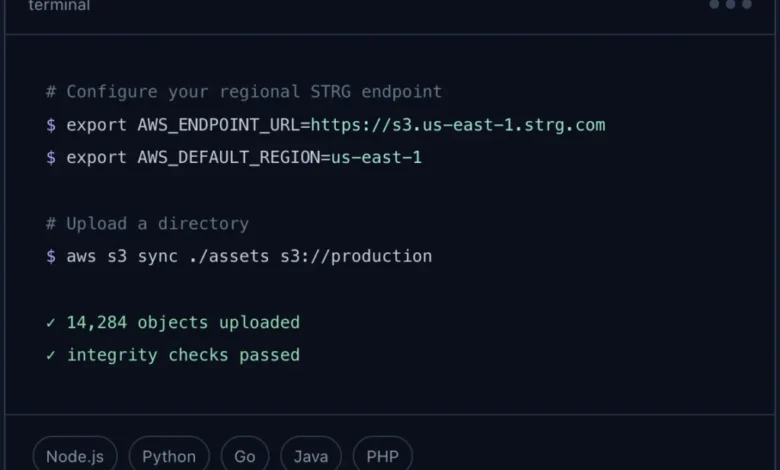
STRG mitigates this friction by adhering strictly to established developer workflows. Integration with the platform begins with a straightforward administrative setup: creating an account, generating API keys, and provisioning a storage bucket. Because the service is fully compatible with the Amazon S3 specification, developers do not need to learn a proprietary command-line utility. Instead, standard tools such as the AWS Command Line Interface (CLI) can be reconfigured simply by pointing them to STRG’s regional endpoints.
For instance, configuring the AWS CLI to interact with STRG involves setting up a dedicated profile and designating the custom endpoint URL, such as https://s3.eu-central-1.strg.com:
# Configure your STRG upload settings
aws configure --profile strg

# Manage some assets!
aws s3 ls --profile strg --endpoint-url https://s3.eu-central-1.strg.com
aws s3 cp ./hello.txt s3://my-first-bucket/hello.txt --profile strg --endpoint-url https://s3.eu-central-1.strg.com
aws s3 ls s3://my-first-bucket/ --profile strg --endpoint-url https://s3.eu-central-1.strg.com
aws s3 cp s3://my-first-bucket/hello.txt ./hello-copy.txt --profile strg --endpoint-url https://s3.eu-central-1.strg.com
Beyond command-line administration, programmatic integration remains a cornerstone of modern web development. STRG supports standard software development kits (SDKs) across multiple programming languages. In JavaScript and TypeScript environments—which power a vast share of modern web applications—developers can utilize the official AWS SDK packages without modification, merely by overriding the endpoint configuration in the client initialization phase.
import
  S3Client,
  PutObjectCommand,
  ListObjectsV2Command,
  GetObjectCommand,
 from "@aws-sdk/client-s3";

const s3 = new S3Client(
  endpoint: "https://s3.eu-central-1.strg.com",
  region: "eu-central-1",
);

await s3.send(
  new PutObjectCommand( Bucket: "my-first-bucket", Key: "hello.txt", Body: "Hello, STRG!" ),
);

const listing = await s3.send(new ListObjectsV2Command( Bucket: "my-first-bucket" ));
for (const object of listing.Contents ?? []) console.log(object.Key, object.Size);

const object = await s3.send(new GetObjectCommand( Bucket: "my-first-bucket", Key: "hello.txt" ));
console.log(await object.Body.transformToString());
This level of API parity ensures that development teams can transition their workloads seamlessly, preserving existing CI/CD pipelines, automated backup scripts, and application microservices without rewriting core data access logic.
Advanced Capabilities: Beyond Basic File Hosting
While simple file upload and retrieval capabilities are table stakes for cloud storage, enterprise-grade applications require sophisticated governance, security, and lifecycle management tools. Historically, alternative storage providers often sacrificed these advanced features in exchange for lower price points, forcing large organizations to choose between cost savings and operational necessity.
STRG seeks to bridge this gap by incorporating a comprehensive suite of storage management primitives traditionally reserved for Tier-1 hyperscalers. These include:
- Customizable Lifecycle Policies: Allowing automated transitions of data across storage tiers or deletion of obsolete files based on age or prefix tags, thereby preventing runaway storage accumulation.
- Granular Asset Access Controls: Ensuring that bucket and object-level permissions can be locked down to adhere to principles of least privilege.
- Cross-Origin Resource Sharing (CORS) Rules: Facilitating secure client-side uploads and asset delivery across disparate web domains without triggering browser security violations.
- Object Locks: Providing Write-Once-Read-Many (WORM) capabilities to protect critical records from accidental deletion or malicious tampering, supporting regulatory compliance frameworks.
These features are crucial for industries bound by strict data governance standards, such as fintech, healthcare, and legal tech, where storage cannot simply be a passive bucket of bits, but must be an actively managed, secure repository.
The Integration of Artificial Intelligence and Model Context Protocols
As the software engineering landscape undergoes a paradigm shift driven by artificial intelligence and autonomous coding agents, cloud infrastructure platforms are rapidly adapting to accommodate AI-driven workflows. Modern development teams increasingly rely on Large Language Models (LLMs) and autonomous agents to audit codebases, generate infrastructure scripts, and manage routine cloud operations.
Recognizing this transformation, STRG has integrated support for Model Context Protocols (MCP), an emerging standard designed to securely connect AI models with data sources and developer tools. Through this implementation, AI assistants can directly interact with a developer’s STRG account to inspect, organize, and manage digital assets.
Integration via the command line or agent configuration is designed to be frictionless:
claude mcp add --transport http strg https://mcp.strg.com/mcpCrucially, the operational scope of these AI agents is strictly governed by traditional access control paradigms. The capabilities of an AI agent interacting with STRG are permanently bounded by the explicit permissions assigned to the underlying access key. If an API key is restricted to read-only operations on a specific bucket, any AI agent utilizing that key is mathematically incapable of executing destructive commands, such as deleting assets or modifying global bucket configurations. This security-first approach mitigates common enterprise anxieties regarding the autonomy of AI agents in production environments.
Economic Implications and Market Outlook for Cloud Storage
The emergence of cost-effective, feature-rich object storage platforms arrives at a pivotal juncture for the global technology sector. According to recent market research data from major cloud industry analysts, global spending on public cloud infrastructure services continues to grow at a compound annual growth rate exceeding 15%. Within this expenditure, data storage accounts for a disproportionate share of enterprise IT budgets, driven primarily by the proliferation of unstructured data, high-definition media, and mandatory compliance archiving.
For Chief Financial Officers and infrastructure architects, the arithmetic is clear: reducing unit storage costs yields immediate, compounding benefits across the balance sheet. However, cost reduction alone is insufficient if it introduces architectural brittleness, performance degradation, or security vulnerabilities.
Platforms that successfully combine S3 API compatibility, low-latency multi-region delivery, enterprise governance features, and forward-looking capabilities like MCP integration are well-positioned to disrupt legacy market dynamics. By lowering the barrier to entry for robust asset management, these platforms enable smaller organizations to scale their digital infrastructure competitively without incurring the prohibitive overhead historically associated with enterprise-tier cloud architectures.
As application complexity continues to accelerate, the foundational choices made regarding storage architecture will remain paramount. Organizations that implement flexible, cost-effective storage solutions from inception are better equipped to weather unpredictable growth spikes, optimize operational expenditures, and adapt to the rapidly evolving demands of modern web engineering. In this evolving ecosystem, platforms like STRG demonstrate that economic efficiency and technical sophistication are no longer mutually exclusive, signaling a maturation in how the web manages its most precious digital commodities.