Sophos Launches Standalone Network Detection and Response Solution to Counter AI-Driven Cyber Threats


In an era where cyber adversaries are increasingly leveraging artificial intelligence to accelerate attack vectors, organizations are facing a critical inflection point in network security. The perimeter has effectively dissolved, replaced by a complex, distributed environment of hybrid clouds, unmanaged IoT devices, and agentless assets. To address these vulnerabilities, Sophos has announced the transition of its Network Detection and Response (NDR) technology from a component of its managed security suite to a standalone solution, designed to provide comprehensive visibility and active blocking capabilities for the modern enterprise.
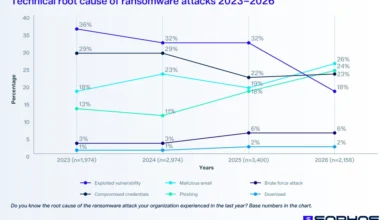
This strategic shift arrives at a time when the fundamental nature of cyberattacks is undergoing a rapid transformation. According to the 2026 Verizon Data Breach Investigations Report, the landscape of initial access has fundamentally shifted: for the first time, the exploitation of vulnerabilities has overtaken credential abuse and phishing as the primary vector for breaches. This change is directly attributed to the speed at which attackers can identify and weaponize flaws in software and hardware using AI-enabled reconnaissance tools.
The Evolution of the Network Perimeter
The traditional "fortress" model of network security, which relied heavily on static firewalls and endpoint protection, is no longer sufficient to secure the modern, fragmented infrastructure. Today’s threat actors capitalize on the gaps between security controls. When assets go unmanaged or lack the ability to host security agents, they become blind spots where malicious activity can persist undetected.
The necessity of NDR lies in its ability to act as a centralized vantage point. While endpoint detection and response (EDR) tools are limited to what they can see on a device, NDR monitors the "connective tissue" of the network—the traffic flowing between devices, servers, and cloud environments. By analyzing this traffic for anomalous behavior rather than relying solely on known threat signatures, security teams can identify lateral movement, command-and-control (C2) beaconing, and unauthorized data exfiltration in real time.
Strategic Timeline and Industry Context
The development of the Sophos NDR solution follows a multi-year trend toward more aggressive network-level defense. In 2024, Sophos initially introduced NDR as an add-on module for its Managed Detection and Response (MDR) and Extended Detection and Response (XDR) customers. The decision to elevate it to a standalone product in late 2026 reflects a growing market demand for flexible security architecture.
Industry analysts have long signaled this trajectory. As noted in the May 2026 Gartner Magic Quadrant for Network Detection and Response, the market is evolving from a collection of niche, specialized tools into a core pillar of the security stack. Gartner researchers emphasize that as encryption increasingly obscures user behavior and attackers embrace "living off the land" (LotL) techniques—whereby they use legitimate administrative tools to conduct malicious activity—the ability to inspect network traffic for subtle, non-malicious-looking behavioral patterns has become non-negotiable for identifying insider threats and internal compromises.
Technical Architecture and New Capabilities
The new standalone Sophos NDR offers a significant upgrade in both deployment versatility and defensive mechanics. The solution is built around a centralized management framework, Sophos Fusion, which allows the network telemetry to be correlated with data from endpoint, firewall, email, and cloud security platforms.
Key technical enhancements include:
- Converged Protection: The integration of behavioral detection and Intrusion Detection and Prevention Systems (IDS/IPS) allows the system to address both known threats (via signatures) and zero-day threats (via behavioral analytics).
- Dedicated Hardware and Virtual Options: Sophos has introduced purpose-built hardware for high-performance NDR workloads, while maintaining support for virtual and third-party hardware deployments. This allows organizations to choose between passive monitoring and active, inline enforcement.
- Active Inline Response: This is perhaps the most significant departure from traditional passive NDR tools. When deployed on dedicated Sophos hardware with the optional IDS/IPS add-on, the solution can inspect packets in real time and automatically block malicious traffic before it reaches its intended destination.
Chris Kissel, Research Vice President at IDC, commented on the strategic importance of this architecture: "Network visibility provides an important layer of defense, particularly for devices and activity that preventive controls alone may not see. Sophos NDR builds on that visibility by combining behavioral network detection with active prevention and connecting network intelligence with context from across the Sophos Fusion defense system. This approach gives security teams greater context to investigate suspicious activity and coordinate response across the broader security environment."
Addressing the AI-Driven Threat Gap
The rise of AI in cybercrime has created a "machine-speed" challenge for defenders. Adversaries are using AI to automate the discovery of vulnerabilities and to create polymorphic malware that can evade traditional signature-based detection. The 2026 Sophos AI Security Report highlights that defenders can no longer rely on human intervention as the primary reaction mechanism.
By incorporating behavioral analytics, Sophos NDR aims to identify the "tells" of an AI-driven attack—such as unusual patterns of data movement or rapid, systematic port scanning—that would be invisible to standard security monitoring. The system’s ability to "see" unmanaged and agentless assets is particularly crucial here; in many modern breaches, attackers use an unmanaged IoT device or a transient virtual machine as a pivot point to move laterally through the network. Without the network-level visibility provided by an NDR solution, these assets often remain invisible to security operations centers (SOCs) until a breach has already been executed.
Operational Flexibility and Deployment Models
Recognizing that no two enterprise networks are identical, Sophos has structured the deployment of its NDR solution to accommodate various architectural requirements. Customers can opt for:
- Passive Inspection: Ideal for organizations that prioritize monitoring and analysis without interrupting traffic flow, often used in sensitive environments or where network topology is particularly complex.
- Active Inline Blocking: Designed for high-risk segments of the network where automated prevention is required to mitigate threats before they can cause damage.
- Hybrid Approaches: Allowing for different configurations across distributed sites, which is essential for organizations managing a mix of on-premises, cloud, and remote branch office environments.
This flexibility is intended to reduce the "friction" that often prevents security teams from deploying comprehensive network monitoring. By offering the solution as a standalone product, Sophos aims to capture the mid-market and enterprise segments that may already have endpoint protection but lack the network-level visibility required to combat modern, persistent threats.
Implications for the Future of Enterprise Defense
The shift toward standalone NDR as a critical security layer indicates a broader trend in the cybersecurity industry: the move toward "hyper-contextualized" defense. In the coming years, industry experts anticipate that standalone security products will become increasingly rare, replaced by integrated ecosystems where every control—from the email gateway to the network core—shares intelligence in real time.
Sophos’s use of the "Fusion" framework serves as a case study for this transition. By feeding network detections into the broader context of endpoint and identity management, the organization is effectively closing the "visibility gap" that attackers have exploited for years.
As organizations look toward the 2027 fiscal year, the emphasis on network performance and security planning will likely become a primary board-level concern. To facilitate this dialogue, Sophos is hosting a virtual roundtable, the "Securing the AI-Era Network," on November 17, 2026. The event will feature Sophos CEO Joe Levy, SVP of Product Management Dan Cole, and 451 Research Chief Analyst Eric Hanselman, focusing on the convergence of network architecture and security in an environment dominated by machine-speed threats.
Ultimately, the launch of the standalone Sophos NDR signifies an industry-wide recognition that visibility is the precursor to security. In a landscape where the adversary is using AI to find the smallest cracks in a security posture, the ability to monitor the entire network flow—and to act on those observations instantly—has moved from being a luxury to a fundamental requirement for operational resilience. As the boundaries between internal and external networks continue to blur, the network will remain the ultimate arbiter of truth for security teams, providing the evidence needed to distinguish between legitimate user activity and a sophisticated, automated intrusion.