GitHub Engineering Monthly Availability Report Detailing October Infrastructure Incidents and Migration Milestones


GitHub experienced a challenging month in October, registering eight distinct service-degrading incidents that tested the resilience of its global platform infrastructure. Despite aggressive modernization efforts, cloud-migration milestones, and capacity expansions, the platform faced persistent reliability hurdles driven by localized network disruptions, database orchestration errors, and cascading retry storms.
The engineering team continues to operate under a strict core principle prioritizing service availability ahead of raw capacity expansion, which in turn precedes the deployment of new product features. As the platform scales to accommodate surging developer activity, October’s operational data underscores the absolute necessity of pairing infrastructure growth with robust safety mechanisms, rigorous dependency isolation, and fully validated regional disaster recovery protocols.
Infrastructure Expansion and Cloud Migration Status
Throughout October, GitHub advanced its multi-phase transition into Microsoft Azure, adding substantial, independently scalable cloud capacity designed to absorb heavy platform traffic without overtaxing legacy architecture. As of November 9, structural progress was visible across core production environments: 140 of 151 production services and 32 of 50 MySQL primary databases were successfully operating within the Azure Central US region.
Azure infrastructure now handles a substantial share of global developer traffic, absorbing 63% of migrated-service reads, 66% of monolithic reads, and 52% of Git-related read operations. To support this influx, GitHub completed a comprehensive compute expansion across all nine Central US Kubernetes clusters, effectively doubling baseline compute capacity.
This newfound headroom is proving critical for organic growth. Migrated-service traffic has surged by 82% since March. The Central US region has successfully absorbed all organic traffic growth exceeding the peak weekly-average load previously handled by the legacy datacenter.

Targeted reliability engineering efforts also yielded measurable performance gains. Modifications to GitHub Actions improved capacity thresholds for critical Azure control-plane requests. A separate network address translation (NAT) gateway mitigation reduced resource usage by 85%, successfully lowering expected job failures from roughly 800 down to just four during the transition. Furthermore, tighter connection limits and client-side improvements significantly reduced the probability that an isolated dependency interruption could blossom into a widespread reconnection storm.
Database load was optimized by redirecting a high-traffic GitHub Actions endpoint handling over 250 million daily requests onto a more efficient service path, cutting peak database read operations by 85%. Additionally, a new validation requirement enforcing at least three characters before searching repository topics eliminated roughly 98% of slow or terminated query patterns.
Despite these optimization milestones, overall platform reliability fell short of internal benchmarks. The month was marred by persistent database write outages, monitoring blind spots during data migrations, and a regional Azure network disruption that impacted availability zones across the Central US.
Chronology of October Incidents
The eight service-degrading incidents recorded in October exposed vulnerabilities in database orchestration, upstream credential validation, and event-streaming resource limits. A detailed examination of the most disruptive events illustrates the systemic challenges faced by the engineering organization.
October 5: Actions Runner Scheduling Failures
At 19:11 UTC, GitHub Actions experienced a severe service disruption lasting approximately 3 hours and 45 minutes. Developers encountered heavily delayed workflow runs and prolonged queue times for GitHub-hosted runners. During the peak 90-minute window, the vast majority of jobs failed to initialize within the five-minute threshold. Secondary impacts manifested as intermittent errors across repository lists, billing interfaces, and Copilot features.
The root cause stemmed from a partial networking failure within the cloud provider’s infrastructure, which severed connections between a primary datacenter region and backend cloud-hosted databases. Rather than failing fast, the job-assignment service waited for connections to time out. The accumulation of stalled requests exhausted available memory, forcing the service to restart.
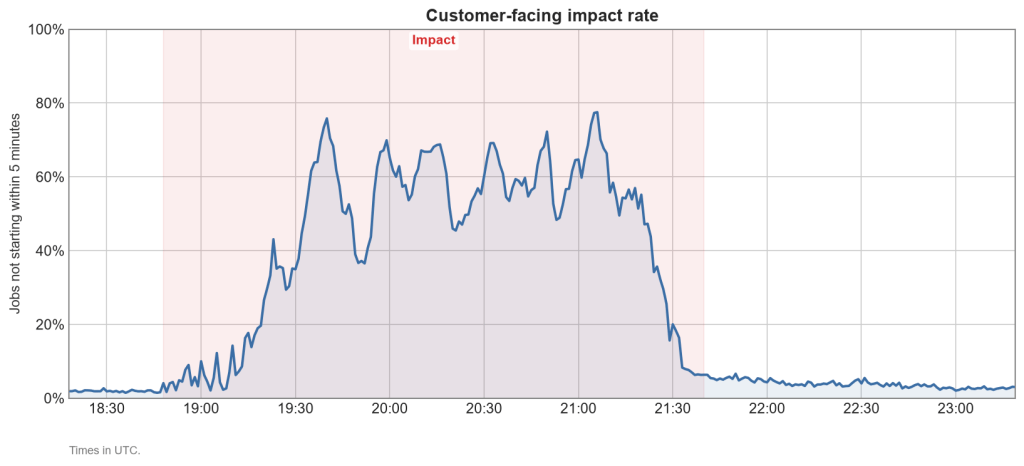
Traffic subsequently flooded the redundant service in a healthy region, which lacked sufficient capacity and began failing under the load. Compounding the issue, inactive runners that spent several minutes waiting for tasks shut down automatically and experienced slow replacement rates. Mitigation was achieved by failing over to healthy regions and manually scaling up runner capacity.
October 6: Enterprise Importer Database Exhaustion
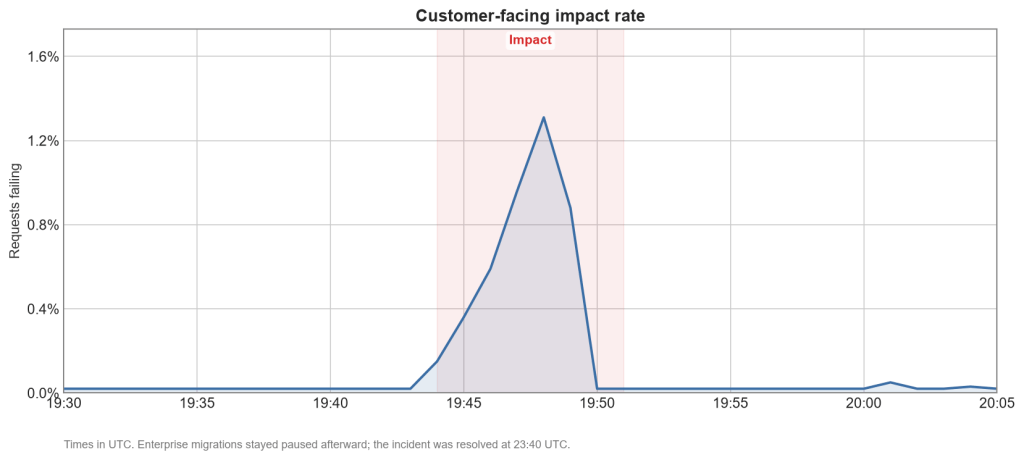
Starting at 19:57 UTC, GitHub.com users experienced brief API latency and elevated server error rates, followed by a three-and-a-half-hour suspension of enterprise migrations. Roughly 1.3% of platform requests failed or timed out at the peak, impacting approximately 6,400 organizations.
An unmitigated surge in migration activity from the GitHub Enterprise Importer triggered a flood of massive, unoptimized queries directed at a shared database. These queries monopolized available database connections, starving core GitHub.com features of the resources required to complete standard web and API requests. Migrations were immediately paused while engineers deployed a targeted mitigation that restructured large queries into smaller, throttled batches.
October 7: Core Database Write Outages
GitHub experienced two separate database write outages on October 7—the first beginning at 15:14 UTC for 11 minutes, and a recurrence starting at 17:17 UTC lasting 9 minutes. Together, the incidents caused roughly 19 minutes of degraded write capability, triggering error rates of 8.9% and 9.3% respectively, and impacting over 12,000 organizations. Core functions including code pushes, authentication, pull request updates, webhooks, and Copilot integrations were temporarily disrupted, though read operations and previously saved data remained secure.
The outages were traced to a database routing maintenance procedure. During routine machine replacements, a newly provisioned orchestration server initialized with stale records referencing decommissioned database servers. Upon assuming leadership via automated election, the server broadcasted incorrect routing configurations that directed core database writes to retired infrastructure.
The erroneous settings bypassed existing validation frameworks. Compounding the error, a subsequent automated maintenance routine triggered a secondary leadership election before the faulty machine could be decommissioned, causing it to regain leadership and replicate the outage.
October 19: Log Storage Service Network Saturation
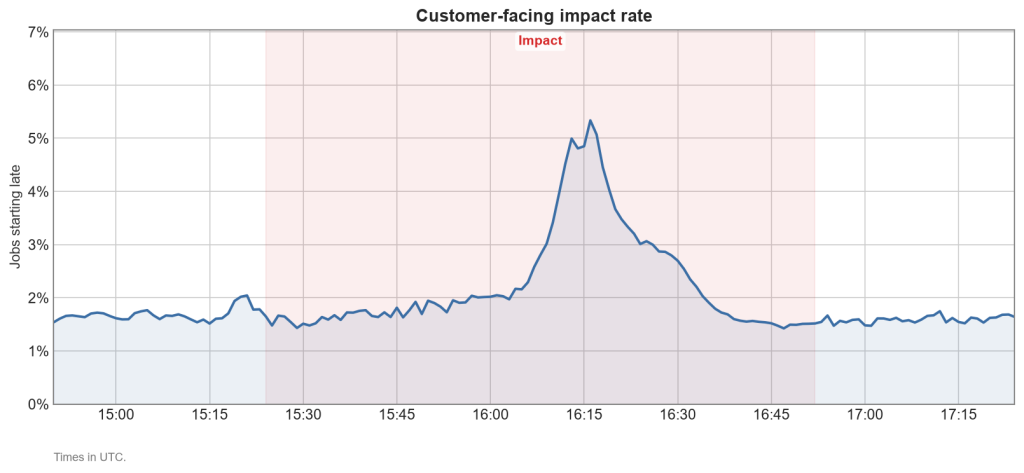
Beginning at 15:49 UTC, an incident lasting 1 hour and 28 minutes impacted GitHub Actions logs, workflow status updates, and associated webhooks. Approximately 5% of GitHub-hosted runner jobs experienced delayed initialization alongside minor API errors and sluggish code search functionality.
An internal service responsible for storing workflow logs and execution states lost connectivity to regional cache servers. In response, every active instance of the service simultaneously initiated reconnection attempts. The aggregate retry volume saturated network links between GitHub’s datacenter and the affected cloud region, inducing collateral degradation across auxiliary services sharing the same network path.
October 21: Event Streaming Platform Memory Saturation
An extended incident began at 14:52 UTC, causing intermittent delays in pull request updates, webhook deliveries, and Actions status checks for over six hours. Audit log search functionality suffered the longest recovery timeline, experiencing delays of up to one hour and fifty minutes before full synchronization was achieved.
The disruption originated within the platform’s event streaming architecture, where several brokers approached memory thresholds. Because memory consumption scales dynamically with client connection counts, initial request failures prompted immediate reconnection attempts. This cyclical connection storm accelerated memory exhaustion across the cluster.
As overloaded brokers were taken offline, incoming traffic shifted to remaining nodes, triggering cascading failures across the cluster. Engineers stabilized the platform by actively rebalancing overloaded partitions onto brokers with verified processing headroom.
October 28: Upstream Copilot Credential Invalidation
At 14:12 UTC, a 92-minute outage disrupted specific GPT-family models utilized within GitHub Copilot, affecting approximately 10% of requests routed through IDE chat interfaces, the Copilot CLI, and automated code review agents.
The disruption was precipitated by the expiration of an authentication credential used to communicate with an upstream model provider. The provider consequently rejected inbound authentication tokens, forcing GitHub’s API gateway to return authentication errors to end-user clients. Alternative models unaffected by the credential failure continued operating normally, and automated model-routing logic successfully absorbed a portion of the traffic.
October 30: Connection Pool Depletion and Request Stalling
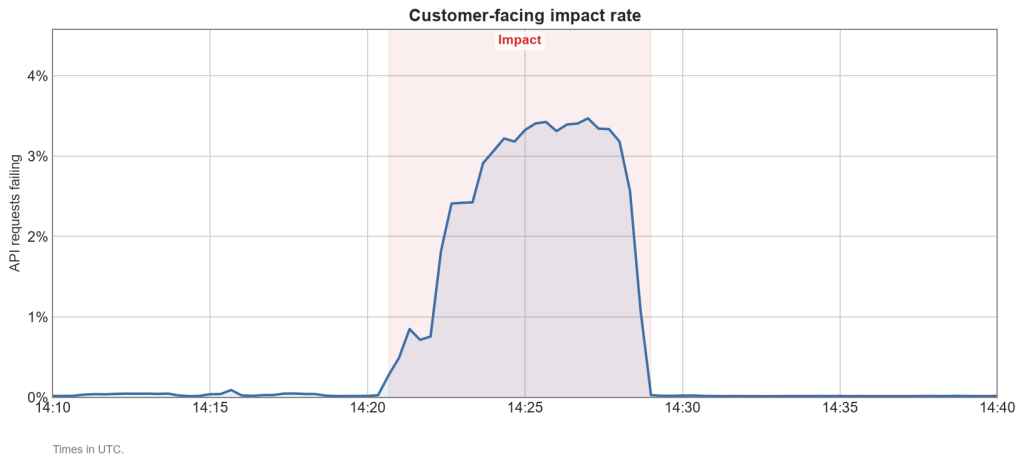
On October 30 at 14:31 UTC, GitHub suffered a 31-minute incident characterized by hanging web requests and server errors. Pull request merges and Git operations executed over SSH and Git LFS experienced severe degradation, with merge failure rates peaking at 43%.
The outage occurred when a shared database connection pool reached maximum capacity. The exhaustion was accelerated by a subset of update requests that initiated database write transactions before executing secondary, multi-second lookup queries. By holding connections open while waiting for secondary lookups to resolve, these queries depleted available connection headroom, causing incoming requests to queue until connection timeouts were reached.
Broader Implications and Strategic Outlook
October’s performance metrics highlight the complex engineering realities of operating a hyper-scale developer platform during a major cloud migration. While the technical transition to Microsoft Azure has successfully expanded GitHub’s capacity ceiling and absorbed significant organic traffic growth, the incidents demonstrate that cloud elasticity alone cannot substitute for defensive software design.
The recurrence of cascading failures—where localized database timeouts, DNS drops, or credential expirations trigger massive retry storms—indicates that upstream and downstream dependencies require stricter circuit-breaking mechanisms, accelerated fail-fast logic, and rigorous rate-limiting protocols. Furthermore, the routing failures observed on October 7 emphasize the absolute requirement for enhanced validation pipelines during infrastructure orchestration and automated maintenance cycles.
Looking ahead, GitHub’s engineering leadership remains committed to its foundational operational philosophy. The buildout of the East US 3 region—currently running approximately one week behind schedule, with initial traffic ramps slated for early December—will proceed under heightened scrutiny. Engineers will dedicate upcoming sprints to hardening migration safety protocols, isolating regional dependencies, and validating disaster recovery procedures.
By systematically addressing these architectural vulnerabilities, GitHub aims to ensure that future capacity expansions align seamlessly with platform reliability, safeguarding the continuous workflows of millions of global developers.