When confronted with the academic definition of the Factory Method design pattern—"Define an interface for creating an object, but let subclasses decide which class to instantiate"—many developers, particularly those new to design patterns, find themselves adrift in a sea of abstraction. This initial bewilderment is common, as the language often used to describe these foundational software engineering concepts can obscure their practical elegance and profound utility. The true power of the Factory Method, and indeed many design patterns, lies not in its formal definition but in its intuitive application, which simplifies complex object creation processes and enhances the maintainability and extensibility of software systems.
The core challenge for any aspiring software architect is to bridge the gap between theoretical constructs and tangible solutions. Design patterns are, at their heart, blueprints for solving recurring problems in software design. They offer a shared vocabulary and a set of proven strategies that enable developers to build more robust, flexible, and scalable applications. The Factory Method, one of the foundational "Gang of Four" (GoF) creational patterns, addresses the critical issue of how objects are instantiated within an application, ensuring that this process is both controlled and adaptable. This article aims to demystify the Factory Method by providing a clear, practical explanation, shedding light on its underlying principles and demonstrating its indispensable role in modern software development.
The Culinary Analogy: Ordering, Not Cooking
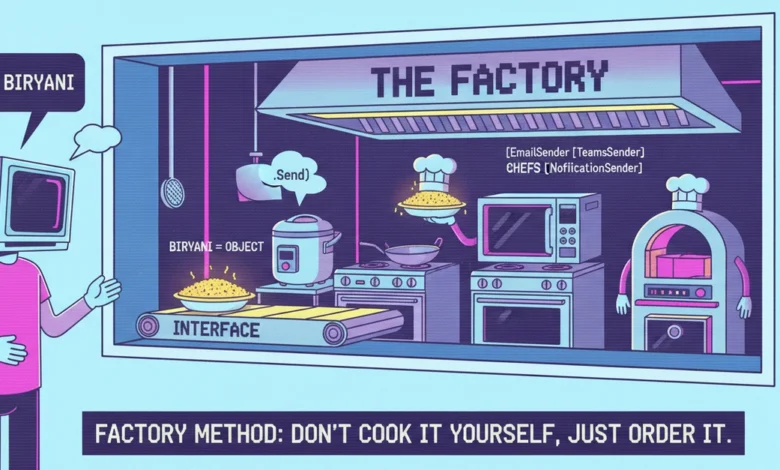
To truly grasp the Factory Method, consider a universal experience: dining at a restaurant. When you enter a restaurant and state, "One biryani, please," your interaction is simple and direct. You communicate what you desire, but you are deliberately abstracted from how that desire is fulfilled. You do not, for instance, walk into the kitchen, gather ingredients, ignite the stove, and prepare the biryani yourself. That intricate process is the sole responsibility of the kitchen staff. The kitchen, acting as a dedicated production unit, decides the precise steps, ingredients, and techniques required to produce your order, ultimately presenting you with the finished dish.
This common scenario perfectly encapsulates the essence of the Factory Method pattern. In this analogy:
- You (the customer) represent the client code—the part of the application that needs an object.
- The biryani represents the object you need to use (e.g., an
EmailSender,TeamsSender, orSmsSender). - The restaurant kitchen represents the Factory Method—a dedicated component responsible for creating objects.
The separation of concerns is paramount here. The customer cares about the end product, not the intricacies of its creation. Similarly, in software, client code should ideally only know what type of object it needs (e.g., a notification sender) and how to use it (e.g., call its Send() method), without being burdened by the details of its instantiation. This decoupling is a cornerstone of flexible and maintainable software design, preventing client code from becoming tightly bound to specific implementation details.
The Pre-Factory Predicament: A Recipe for Code Duplication
Imagine a software application that needs to send various types of notifications—email, Microsoft Teams messages, or SMS texts. In a system developed without the Factory Method, the code responsible for sending these notifications might look something like this:
// This if-else logic gets copy-pasted in dozens of different files
INotificationSender sender;
if (type == "email") sender = new EmailSender();
else if (type == "teams") sender = new new TeamsSender();
else sender = new SmsSender();

sender.Send("Hello!");
This snippet, seemingly innocuous at first glance, hides a significant architectural flaw. If this if-else block is duplicated across twenty, fifty, or even a hundred different files within the application, it creates a massive technical debt. Each instance of this code block represents a direct dependency on the concrete EmailSender, TeamsSender, and SmsSender classes. This tightly coupled approach leads to several critical issues:
- Code Duplication (Violation of DRY Principle): The same logic for instantiating objects is scattered throughout the codebase. This makes the code harder to read, understand, and review.
- Maintenance Nightmares: If the constructor for
EmailSenderchanges (e.g., it now requires a configuration object), every single location wherenew EmailSender()is called must be updated. This is a tedious, error-prone, and time-consuming task. - Lack of Extensibility: Introducing a new notification type, such as WhatsApp, requires hunting down and modifying every single
if-elseblock in the application. Missing even one instance can lead to production bugs or inconsistent behavior. - Tight Coupling: Client code is directly dependent on specific concrete classes (
EmailSender,TeamsSender,SmsSender). This means changes in these concrete classes can ripple through the entire application, making independent development and testing challenging. - Violation of the Open/Closed Principle: The system is not "open for extension, but closed for modification." Adding new functionality (like a new notification type) requires modifying existing, tested code, which increases the risk of introducing new bugs.
In essence, without a factory, every part of the application that needs a notification sender becomes its own mini-kitchen, responsible for knowing the "recipes" (constructor calls) for all possible sender types. This distributed responsibility leads to inefficiency, inconsistency, and fragility.
The Factory Solution: Centralizing the Kitchen
The Factory Method pattern offers an elegant solution to this problem by centralizing the object creation logic. Instead of every client file "cooking its own meal," they simply "place an order" with a dedicated factory. The client code transforms from a complex creation process to a simple request:
var sender = NotificationFactory.Create(type);
sender.Send("Hello!");
This transformation is profound. The twenty, fifty, or one hundred files that previously contained the sprawling if-else logic now contain just two concise lines of code. This dramatically reduces boilerplate, improves readability, and most importantly, centralizes control over object instantiation. The client code no longer needs to know how to create a sender; it just trusts the NotificationFactory to provide an appropriate INotificationSender instance based on the requested type.
Demystifying the Factory’s Inner Workings: It’s Just Organized new
For beginners, one of the most common misconceptions about design patterns is that they involve some form of "magic" that avoids the fundamental act of object creation. The "secret" that often goes unsaid in initial explanations is that the Factory Method doesn’t eliminate the new keyword; it merely encapsulates and centralizes it.
Inside the NotificationFactory.Create() method, the logic is surprisingly straightforward:
public static class NotificationFactory

    public static INotificationSender Create(string type)

        if (type == "email") return new EmailSender();   // just new!
        if (type == "teams") return new TeamsSender();   // just new!
        if (type == "sms")   return new SmsSender();     // just new!
        throw new ArgumentException("Unknown type");
As evident, the Create() method is essentially an if-else block (or a switch statement, or even a dictionary lookup) that contains the very new keyword calls that were previously scattered throughout the application. The magic isn’t in avoiding new, but in controlling where the new happens. The restaurant analogy holds true: the restaurant didn’t eliminate cooking; it merely ensured that all cooking happens in a designated, controlled environment (the kitchen) rather than allowing every customer to cook at their own table.
This centralization provides immense benefits. When changes are required, or new types need to be added, only this single Create() method needs to be modified. This significantly reduces the risk of errors, simplifies maintenance, and ensures consistency across the application. Furthermore, the factory can implement more sophisticated logic than a simple if-else, such as reading configuration from a database or a settings file, integrating with dependency injection containers, or even applying caching mechanisms for frequently created objects.
The Three Pillars of the Factory Method Pattern
For the Factory Method to function effectively, three key "ingredients" or components are essential:
-
Many Concrete Product Classes (The Chefs): These are the individual implementations of the functionality, such as
EmailSender,TeamsSender, andSmsSender. Each of these classes performs a specific task and knows how to send a notification via its particular medium. They represent the specialized chefs in our restaurant kitchen, each skilled in preparing a particular dish. -
One Common Product Interface (The Menu): This is the abstract contract that all concrete product classes must adhere to. In our example,
INotificationSenderdefines theSend()method. This interface is crucial because it allows the client code to interact with any concrete sender class in a uniform manner, without needing to know its specific type. It’s the menu that lists the available dishes, ensuring that regardless of what’s ordered, it can be consumed using a standard utensil (calling theSend()method).public interface INotificationSender void Send(string message); public class EmailSender : INotificationSender public void Send(string message) /* SMTP call */ public class TeamsSender : INotificationSender public void Send(string message) /* webhook call */The interface is the foundation of polymorphism, allowing objects of different concrete types to be treated as objects of a common type. This is what enables the client to receive any
INotificationSenderand confidently call itsSend()method, irrespective of whether it’s anEmailSenderor aTeamsSender. -
One Creator (Factory) Class (The Kitchen): This is the
NotificationFactoryclass itself. Its sole responsibility is to provide a method (e.g.,Create()) for instantiating and returning instances of the product interface. It acts as the centralized point of creation, encapsulating the logic for deciding which concrete class to instantiate based on input parameters. The factory effectively isolates the client code from the complexities of object creation.
The Strategic Advantage: Why the Factory Method Matters
The true payoff of implementing the Factory Method pattern becomes overwhelmingly clear when faced with evolving requirements—a common scenario in software development. Consider the "WhatsApp test":
Your project manager approaches you with a new requirement: "We need to add WhatsApp notifications by Friday."
-
Without the Factory Method: You would be forced to embark on a tedious and risky expedition through the entire codebase. You’d have to locate every single
if-elseblock where notification senders are instantiated and manually add a newelse if (type == "whatsapp") sender = new WhatsAppSender();line. This process is highly prone to errors; missing even one instance could lead to production bugs, inconsistent behavior, or a partial implementation. The effort involved scales directly with the number of places where notification objects are created. -
With the Factory Method: The task becomes remarkably simple and localized.
- You create a new
WhatsAppSenderclass that implements theINotificationSenderinterface. - You add a single line to the
NotificationFactory.Create()method:if (type == "whatsapp") return new WhatsAppSender();. - Crucially, the twenty, fifty, or one hundred client files that rely on the factory remain completely untouched. They don’t even need to be recompiled or redeployed, assuming a dynamic configuration. They simply request a "whatsapp" sender, and the factory intelligently provides it.
- You create a new
This stark contrast highlights the immense benefits of the Factory Method:
- Enhanced Extensibility: New product types can be introduced with minimal impact on existing client code. The system is "open for extension" (new senders can be added) but "closed for modification" (existing client code doesn’t need to change).
- Simplified Maintenance: All object creation logic is consolidated in one place. Debugging, updating, or refactoring this logic becomes significantly easier and less risky.
- Reduced Coupling: Client code depends only on the
INotificationSenderinterface, not on specific concrete implementations. This loose coupling makes the system more modular, allowing components to evolve independently. - Improved Testability: Factories can be easily mocked or replaced with test doubles in unit tests, allowing developers to isolate and test client code without needing to instantiate real, potentially resource-intensive, concrete objects.
- Clear Separation of Concerns: The pattern cleanly separates the responsibility of using an object from the responsibility of creating it. This leads to cleaner, more organized codebases.
Beyond Simple Notifications: Real-World Applications
The Factory Method pattern is not confined to simple notification systems; its principles are widely applicable across various domains of software development:
- Database Connectors: A common use case involves creating database connection objects. A
DbProviderFactorycan produceSqlConnection,OracleConnection, orMySqlConnectionobjects based on a configuration string, allowing the application to switch databases without changing the core data access logic. - UI Component Rendering: In graphical user interfaces, a factory might create different types of buttons, text fields, or windows based on the operating system or selected theme (e.g., a
UIFactorycreatingWindowsButton,MacButton, orLinuxButton). - Document Parsers: An application that processes various document formats (XML, JSON, CSV) could use a
DocumentParserFactoryto return the appropriate parser based on the file extension or content type. - Game Development: In game engines, factories are often used to create game objects like enemies, power-ups, or projectiles, allowing for easy expansion of game elements without modifying core game logic.
- Payment Gateways: An e-commerce platform might use a
PaymentGatewayFactoryto instantiate different payment processing clients (e.g., Stripe, PayPal, Square) based on merchant configuration or user preference.
These examples underscore the versatility and ubiquity of the Factory Method in building flexible and scalable software architectures.
Considerations and When to Opt for Alternatives
While the Factory Method offers significant advantages, it’s important to consider its trade-offs and when its application might be overkill:
- Increased Abstraction and Initial Complexity: For very small projects with only one or two concrete product types, the overhead of setting up an interface and a factory might seem excessive. Simple
newcalls might be sufficient in such limited scenarios. - Maintenance of the Factory: As the number of product types grows, the
Create()method (if implemented with a largeif-elseorswitchblock) can become unwieldy. Strategies like using reflection, configuration-driven factories, or dependency injection containers can help manage this complexity. - When to Use: The Factory Method shines brightest when:
- You have multiple related classes that share a common interface.
- You anticipate future extensions with new product types.
- You need to centralize and encapsulate object creation logic.
- Client code should be decoupled from the concrete classes it uses.
It’s also worth noting that the Factory Method is often a stepping stone to more complex creational patterns like the Abstract Factory. An Abstract Factory is essentially a "factory of factories," used when you need to create families of related objects (e.g., a factory that produces both a WindowsButton and a WindowsScrollbar, ensuring consistency across a UI toolkit).
Industry Perspective and Evolution
The Factory Method pattern was formalized by the "Gang of Four" (Erich Gamma, Richard Helm, Ralph Johnson, and John Vlissides) in their seminal 1994 book, "Design Patterns: Elements of Reusable Object-Oriented Software." Its enduring relevance speaks volumes about its effectiveness in addressing fundamental software design challenges.
In modern software development, especially within ecosystems that leverage frameworks like .NET Core, Spring, or Angular, the concept of centralized object creation and dependency management has evolved further with the widespread adoption of Dependency Injection (DI) containers (also known as Inversion of Control containers). While DI containers often abstract away the explicit new calls and if-else logic, they internally employ patterns similar to the Factory Method to resolve and instantiate dependencies. A DI container can be thought of as a highly sophisticated, automated factory that intelligently creates and manages objects based on configuration and requested types, offering an even higher level of abstraction and flexibility. However, understanding the Factory Method remains crucial, as it underpins many of the principles that make DI containers so powerful.
Conclusion: A Cornerstone of Robust Software Design
The Factory Method pattern, despite its initial intimidating definition, is a fundamentally simple yet incredibly powerful tool in a developer’s arsenal. Its core principle—"don’t cook it yourself, just order it"—translates directly into a highly maintainable, extensible, and loosely coupled software architecture. By centralizing object creation within a dedicated factory, developers can insulate client code from the complexities of instantiation, making systems more adaptable to change and easier to evolve.
Embracing the Factory Method means designing software that is not only functional today but also resilient and flexible enough to meet the demands of tomorrow. It’s a testament to the power of abstraction and separation of concerns, proving that sometimes, the simplest solutions to complex problems are found by merely organizing where the work gets done. As developers continue to build increasingly intricate systems, mastering foundational patterns like the Factory Method becomes less of an academic exercise and more of a practical necessity for crafting truly robust and scalable applications.