React Native Officially Lands on Meta Quest Headsets to Revolutionize Spatial Computing Development

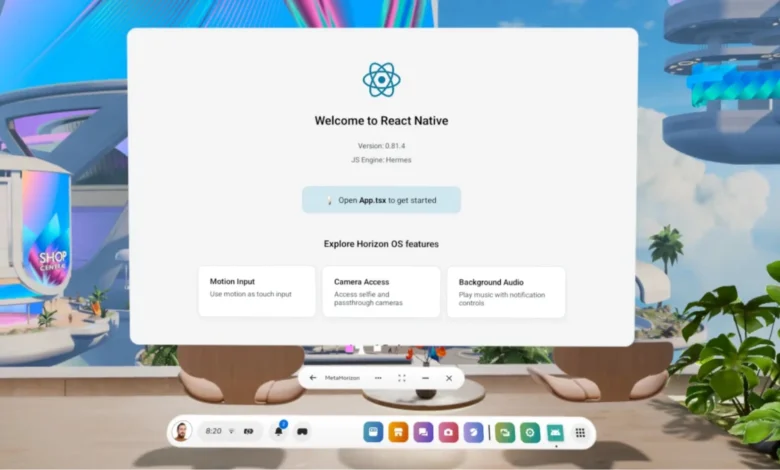
The cross-platform software development ecosystem achieved a significant milestone as official support for React Native on Meta Quest devices was unveiled at React Conf. This major integration bridges the gap between conventional mobile application development and spatial computing, enabling millions of JavaScript and TypeScript developers to leverage their existing skill sets to build immersive virtual and mixed-reality applications. By expanding the framework’s reach to Meta’s dominant line of standalone headsets, the development community can now target head-mounted displays without learning proprietary graphics pipelines or fragmenting their codebases.
Building upon a multi-year strategy to unify device architectures, the announcement represents a logical continuation of the Many Platform Vision first outlined by core maintainers in 2021. Over the past several years, React Native has systematically evolved from a mobile-centric framework tailored exclusively for Android and iOS into a ubiquitous abstraction layer capable of rendering interfaces on Apple TV, Windows, macOS, and web browsers via initiatives like react-strict-dom. The inclusion of Meta Quest devices into this expanding ecosystem marks the framework’s official entry into the burgeoning spatial computing hardware market.
The technical foundation for this compatibility relies on Meta Horizon OS, the underlying operating system powering Quest headsets, which is built upon the Android Open Source Project (AOSP). Because Horizon OS shares its foundational architecture with standard Android environments, the existing tooling, build pipelines, and debugging workflows familiar to millions of mobile developers carry over with remarkably few modifications. Rather than introducing an isolated runtime or a completely separate development paradigm, the integration extends React Native’s established abstractions to accommodate spatial hardware specifications seamlessly.
Engineering teams aiming to deploy applications to Meta Quest can utilize either standard Expo configurations or traditional native Android project structures. For developers leveraging Expo, the initial setup process closely mirrors standard mobile workflows. By launching a local development server and accessing the project through Expo Go on the headset, developers can instantly iterate on user interfaces and application logic. For more advanced use cases requiring custom native modules or deep hardware integrations, Expo development builds provide a direct pathway to compile and execute specialized code directly on the physical Quest hardware.
Configuring a project for Meta Horizon OS involves specific platform adjustments to ensure compliance with store submission guidelines and hardware parameters. Developers utilizing Expo can integrate the specialized expo-horizon-core plugin within their project manifests. This build-time configuration tool automatically applies necessary platform requirements—such as defining unique Horizon application identifiers, establishing default window resolutions in device-independent pixels, and specifying targeted hardware variations including Quest 2, Quest 3, and Quest 3S. Additionally, developers must adapt their build scripts to handle distinct mobile and virtual reality variants, ensuring that compilation targets remain optimized for the target device class.
Transitioning applications from traditional mobile operating systems to AOSP-based virtual reality hardware introduces distinct technical hurdles, most notably the absence of Google Mobile Services (GMS). Because Meta Horizon OS operates independently of Google’s proprietary ecosystem, applications must be carefully audited to remove direct dependencies on Google Play Services, the Google Play Store, and associated mobile-specific APIs. Certain hardware assumptions inherent to smartphones—such as cellular connectivity, continuous GPS tracking, and specific telephony permissions—are entirely absent in head-mounted displays. Consequently, developers must rely on platform-aware code paths and specialized libraries to handle location services, notifications, and device capabilities gracefully.

To mitigate compatibility gaps, specialized drop-in replacements have been developed by community contributors and framework maintainers. Libraries such as expo-horizon-location and expo-horizon-notifications provide functional equivalents tailored specifically to Horizon OS. Furthermore, developers can utilize runtime utility functions provided by the core integration package, such as checking runtime flags like ExpoHorizon.isHorizonDevice or verifying build variations via ExpoHorizon.isHorizonBuild, enabling dynamic feature degradation or platform-specific adaptations within unified codebase repositories.
Designing user interfaces for virtual reality environments demands a fundamental shift in product design principles. Unlike traditional touchscreens where user interactions rely on direct physical contact, Meta Quest applications are primarily controlled through spatial hand-tracking, ergonomic hand controllers, or supplementary mouse and keyboard peripherals. Because virtual elements are projected into a three-dimensional stereoscopic space and viewed across varying physical distances, UI components must be engineered with significantly larger hit targets, generous spacing, and robust typography designed to maintain legibility in diverse lighting and depth conditions.
Moreover, the reliance on pointer-based hardware introduces interaction models that mirror desktop and web environments rather than mobile operating systems. Elements must support hover states, clear visual focus indicators, and predictable navigational flows when manipulated via raycasting controllers or direct pinch gestures. These UI design challenges closely parallel those encountered when building responsive applications for foldable devices, tablets, and desktop monitors, where software must dynamically adapt to resizable windows and non-traditional input vectors.
The broader market implications of this integration are substantial for the enterprise and consumer software sectors. By lowering the barrier to entry for spatial application development, Meta and the open-source community are effectively addressing one of the most persistent bottlenecks in the XR industry: the scarcity of native, high-quality productivity and entertainment software. Historically, building immersive VR applications required specialized proficiency in game engines like Unity or Unreal Engine, as well as fluency in low-level graphics APIs like Vulkan or OpenGL. By introducing React Native to Meta Quest, millions of web and mobile developers can now enter the spatial computing market without undergoing extensive retraining.
Industry analysts suggest that this move could accelerate the enterprise adoption of mixed reality headsets. Enterprises seeking to deploy cross-platform visualization tools, remote collaboration software, and training simulations can now maintain a single codebase across desktop, mobile, web, and spatial headsets. This architectural consolidation drastically reduces engineering overhead, maintenance costs, and time-to-market for organizations investing in spatial computing hardware.
The successful realization of this cross-platform vision required extensive collaboration between framework maintainers, independent contributors, and platform engineers. Core contributors have expressed deep gratitude to the developer community for providing rigorous feedback, testing early builds, and contributing necessary patches during the experimental phases of the integration. As spatial computing hardware continues to mature and consumer adoption broadens, the ability to build unified applications using ubiquitous web technologies will likely serve as a foundational pillar for the next generation of digital experiences.