Google Play Enhances Subscription Ecosystem with Advanced Monetization and Retention Tools for Developers

The digital economy is undergoing a fundamental shift as generative artificial intelligence and sophisticated mobile application ecosystems redefine the standards of recurring revenue. Recognizing this transformation, Google Play has announced a comprehensive suite of updates designed to provide developers with greater flexibility in monetization, user acquisition, and long-term retention. These enhancements address the needs of a diverse app economy, ranging from productivity software and educational platforms to high-compute AI services, by introducing advanced billing structures and automated retention strategies.
The Evolution of the Subscription Landscape
Over the past decade, the subscription model has transitioned from a niche method of accessing content to the primary engine for software monetization. According to industry data from Sensor Tower and Data.ai, subscription-based apps have consistently outperformed one-time purchase applications in consumer spending growth, with global subscription revenue across mobile platforms surpassing $20 billion annually. However, as user preferences evolve, developers have increasingly faced challenges with rigid billing frameworks that fail to account for usage-based costs or complex collaborative needs.
The current update from Google Play arrives at a critical juncture. Developers working with large language models (LLMs) and cloud-heavy applications face variable infrastructure costs that traditional, fixed-rate monthly subscriptions struggle to cover. By providing tools that bridge the gap between static billing and dynamic consumption, Google is attempting to align platform infrastructure with the realities of modern software engineering.
Expanding Monetization Flexibility
The newly introduced capabilities prioritize adaptability, allowing developers to move beyond the binary choice of a monthly or annual subscription. Among the most notable updates is the introduction of Multi-Quantity Subscription Purchases. This feature addresses a long-standing demand from B2B and educational developers who require team-based access. By allowing a single user to purchase multiple seats in one transaction, developers can effectively lower the friction associated with enterprise and group adoption, thereby increasing the average cart value per session.
Furthermore, the platform is addressing the unique cost structures of the AI era through Usage-Based Billing. This system allows developers to implement a prepaid model where credits are automatically replenished when a user’s balance falls below a specific threshold. This ensures that service continuity is maintained without requiring constant manual intervention from the user, while simultaneously protecting the developer’s profit margins against the unpredictable costs of server-side computation.
Streamlining the Checkout Experience
Google Play is also optimizing the conversion funnel through the implementation of Mixed Carts. Historically, the process of purchasing a base subscription alongside auxiliary in-app items—such as bonus credits or digital currency—required separate checkout procedures. The fragmentation of the checkout flow often led to cart abandonment and lower conversion rates. By enabling a unified checkout experience, developers can now process auto-renewing subscriptions and one-time products in a single API call. This consolidation not only simplifies the user journey but also provides developers with a strategic opportunity to bundle products, offering targeted discounts to incentivize higher spending at the point of sale.
Complementing this is the concept of Cross-Developer Bundling. This feature empowers developers to create shared packages with partner apps, allowing for the cross-pollination of user bases. A language learning application, for instance, might bundle its premium service with a partner’s travel guide app, creating a value proposition that is greater than the sum of its parts. This strategic partnership model is intended to assist developers in customer acquisition by leveraging the existing trust and user base of established collaborators.
Data-Driven Retention and Churn Mitigation
Acquisition costs for mobile applications have seen a steady rise, with some categories reporting a 20% year-over-year increase in cost-per-install (CPI). Consequently, retention has become the primary focus for sustainable growth. Google Play’s recent updates focus heavily on minimizing involuntary churn—the loss of subscribers due to payment failures—and voluntary churn—the conscious decision by users to cancel their memberships.
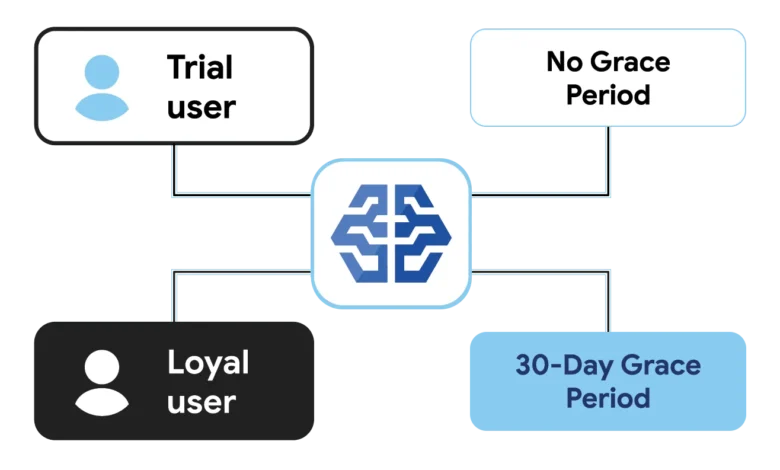
To combat involuntary churn, Google has introduced the Dynamic Grace Period. By utilizing machine learning models, the platform now assesses the likelihood of a user successfully updating their payment method. Rather than applying a blanket grace period, the system intelligently tailors the duration of service access, balancing the need for payment recovery with the costs associated with providing unpaid service. This predictive approach is expected to reduce the friction often associated with payment declines, which are frequently caused by expired cards or temporary bank issues rather than a desire to cancel.
For voluntary churn, the platform is introducing sophisticated in-app messaging and retention incentives. The In-App Messaging API allows developers to communicate directly with users during critical lifecycle moments, such as when a payment is declined or a price update occurs. By resolving these issues within the app context, developers can avoid the disruption of redirecting users to external settings menus. Additionally, the new Retention Offers and Plan Change features enable developers to present personalized discounts or alternative, lower-priced subscription tiers during the cancellation flow. This "save" strategy provides a final opportunity to maintain a relationship with the user before they leave the platform.
Automated Revenue Protection
Beyond the tools available to developers, Google Play has implemented a series of "zero-lift" optimizations designed to operate behind the scenes. These include automated smart payment retries and the proactive cycling of backup payment methods for users who have opted into the system. Furthermore, the platform has strengthened its fraud detection capabilities. By utilizing advanced heuristics to identify bad actors attempting to abuse promotional offers or exploit billing cycles, Google is securing the integrity of the ecosystem. This ensures that promotional budgets are directed toward legitimate subscribers, thereby maximizing the return on investment for developers.
Implications for the Future of Mobile Commerce
The integration of these tools suggests a broader trend in the digital marketplace: the move toward hyper-personalized, flexible subscription management. As competition for consumer attention intensifies, the ability to tailor pricing and access to the individual user’s behavior will become a competitive advantage.
Industry analysts suggest that these developments by Google Play reflect an attempt to retain market share against alternative payment methods and direct-to-consumer billing strategies. By providing a comprehensive, platform-level solution, Google is positioning its billing system not merely as a transaction layer, but as a holistic growth partner. For developers, the challenge remains in implementation; those who successfully leverage these features to build more personalized and resilient billing strategies are likely to see significant improvements in lifetime value (LTV).
The rollout of these features—many of which are currently in the Early Access Program—marks a shift toward a more sophisticated era of mobile monetization. As the ecosystem continues to mature, the focus will undoubtedly remain on reducing friction and maximizing the value exchange between developers and users. With the ongoing integration of machine learning into billing infrastructure, the next phase of subscription management promises to be as much about predictive intelligence as it is about transactional efficiency. Developers are encouraged to review their current subscription architecture to determine which of these new modules will best serve their specific growth objectives in the coming fiscal year.
Related posts: