Oracle and Microsoft Unveil Agentic AI Integrations to Transform Enterprise Operations at Microsoft Ignite 2026


At the 2026 Microsoft Ignite conference, Oracle and Microsoft announced a significant expansion of their strategic partnership, unveiling a suite of agentic AI integrations designed to bridge the gap between enterprise data and automated decision-making. The initiative, co-authored by Arpan Shah, SVP of Oracle Databases, and Muneer Mirza, VP of Multicloud at Oracle Cloud Infrastructure (OCI), marks a shift in how large-scale organizations manage business-critical information by embedding AI agents directly into the fabric of daily enterprise workflows.
By leveraging the Oracle AI Database@Azure framework, the collaboration aims to provide businesses with a secure, performant environment where AI agents can reason across both structured enterprise data—such as finance, HR, and supply chain records—and the unstructured context provided by Microsoft Work IQ. This context encompasses the breadth of modern office activity, including email threads, internal documents, Teams communications, and meeting transcripts.
A Chronology of the Oracle-Microsoft Cloud Alliance
The integration announced at Ignite 2026 is the latest milestone in a multi-year effort to modernize enterprise IT through multicloud architecture. The journey began with a focus on simple interoperability but has evolved into a deeply integrated service model.
In 2023, the two companies surprised the industry by announcing a partnership that allowed Oracle database services to run directly within Microsoft Azure data centers. This was designed to eliminate the latency and data egress challenges that historically hampered multicloud deployments. By 2024, the partnership expanded to include broader availability, with the service reaching major regions globally.
At Oracle AI World 2026, the companies introduced critical technical enhancements, including Proximity Placement Groups (PPGs). These groups were engineered to minimize network round-trip latency by placing database instances in physical proximity to application servers, achieving a reported 50% reduction in latency compared to standard deployments. Furthermore, the commitment to the public sector was solidified with the announcement of FedRAMP Class D certification, paving the way for government entities to adopt the architecture. Today’s announcement at Microsoft Ignite 2026 represents the "application layer" phase of this roadmap, moving from raw infrastructure performance to intelligent, agent-driven operations.
Strengthening IT Operations: The Azure Workload Center for Oracle
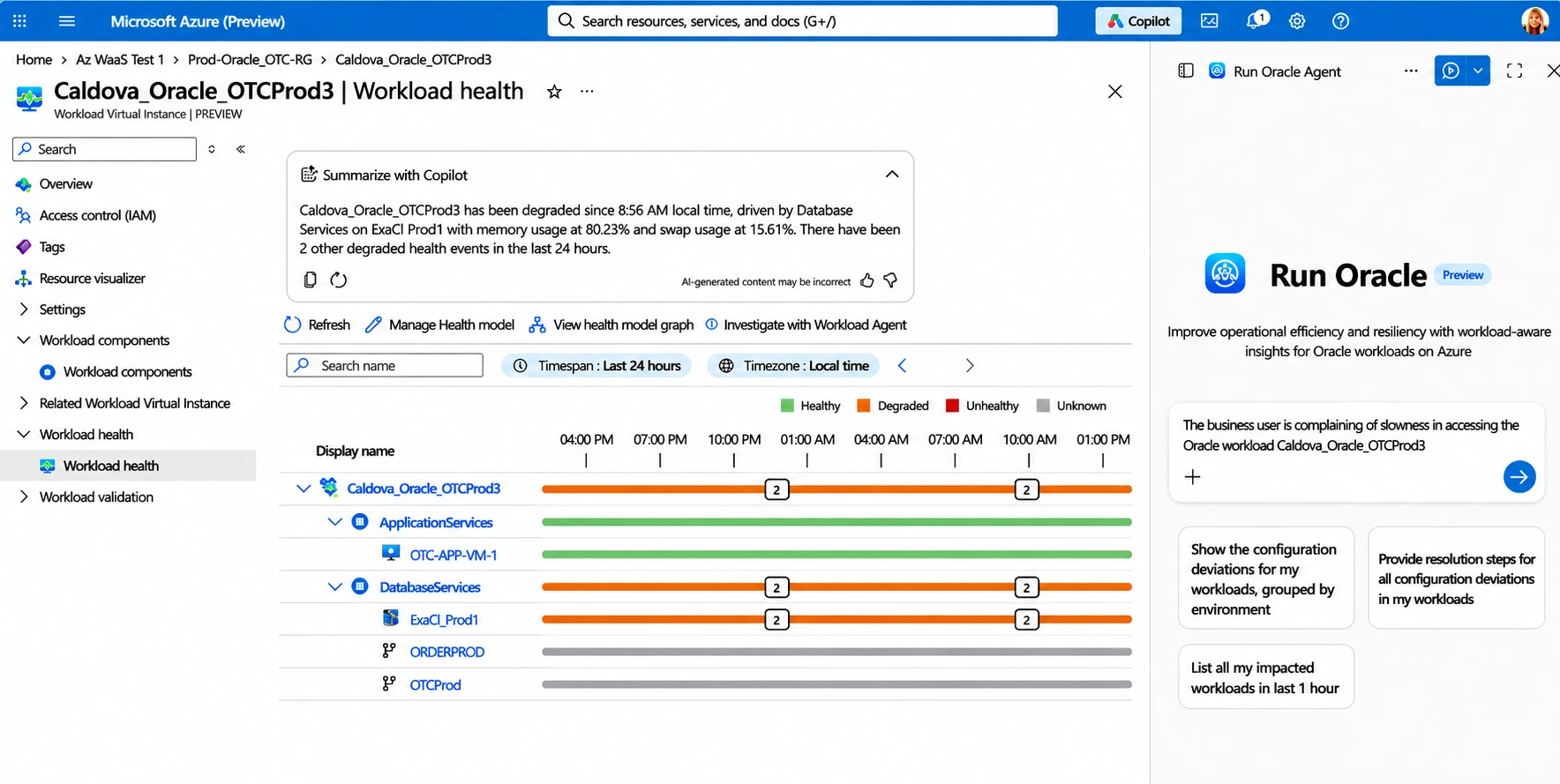
A major pain point for IT administrators in hybrid environments has been the fragmentation of monitoring tools. To address this, the companies introduced the limited preview of the Azure Workload Center for Oracle. This tool utilizes a construct known as the Workload Virtual Instance (WVI), which encapsulates the entire lifecycle of a database-driven application, including its underlying resources and dependencies.
By unifying the view across the application, database, and infrastructure layers, the Workload Center allows for a more cohesive troubleshooting experience. When a performance degradation occurs—for instance, in an order processing system—the integration with the Microsoft Azure Copilot Run Oracle agent allows administrators to diagnose issues using natural language. Rather than navigating separate consoles for Azure and Oracle, the administrator receives a synthesized summary of the health of the entire WVI, significantly reducing the "mean time to repair" (MTTR) for complex enterprise systems.
The security of these operations is maintained through a strict governance model. Oracle AI Database@Azure supports Microsoft Entra authentication, ensuring that the agents acting on behalf of a user are bound by the same permission sets as the user themselves. All database interactions are routed through a managed Model Context Protocol (MCP) server, ensuring that every query is auditable and compliant with enterprise security standards.
Data in the Flow of Work: The Excel Integration
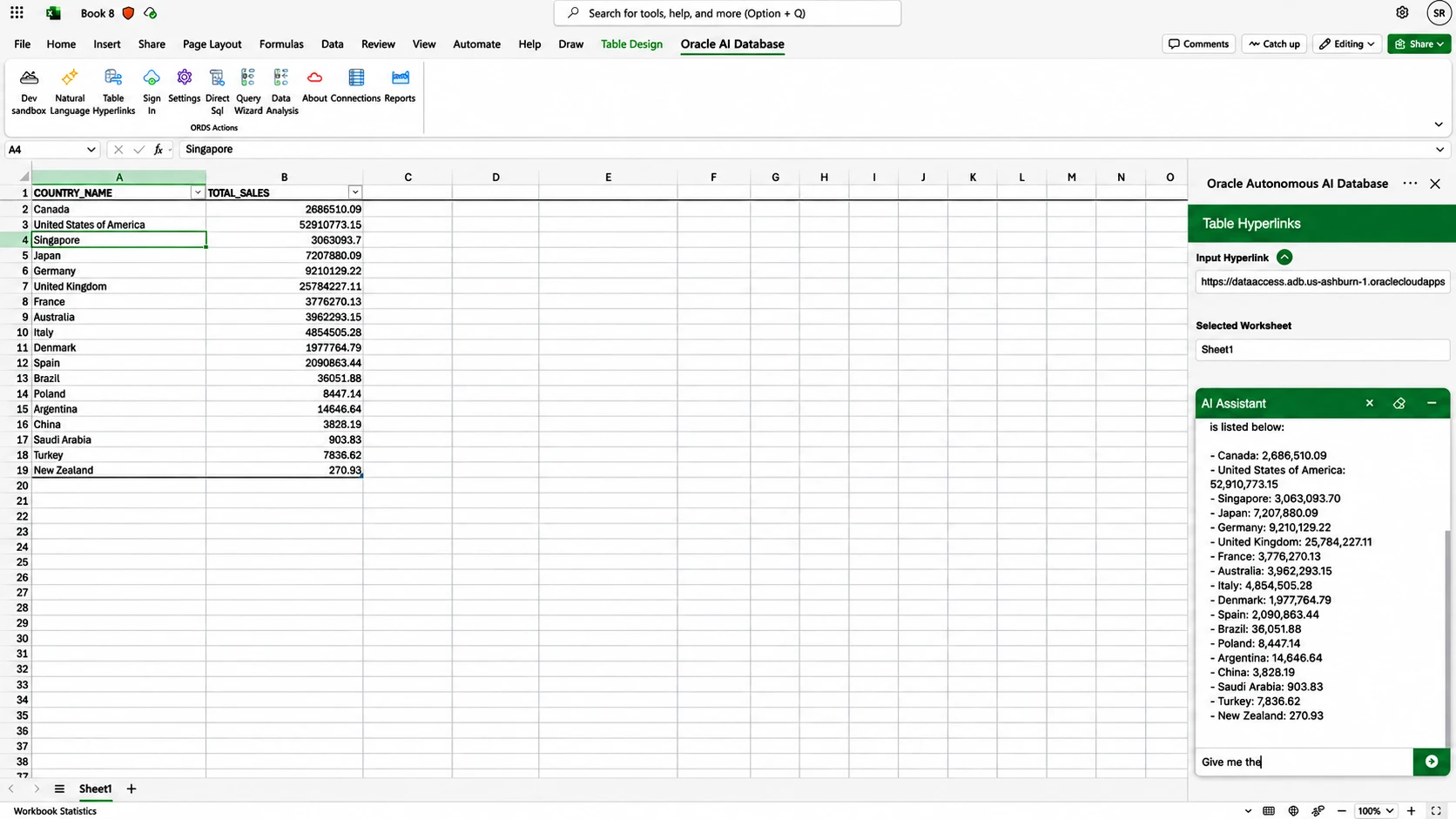
For end-users, the barrier to data-driven decision-making has historically been the technical expertise required to extract and clean data from backend systems. The introduction of the Oracle AI Database plug-in for Excel is a direct attempt to democratize this process.
By connecting Excel directly to the Oracle Database, business users can pull trusted, real-time data into a spreadsheet. With Microsoft Copilot enabled, users can perform complex queries or request trend analyses without ever leaving the interface. This removes the "ticket-to-IT" bottleneck, where analysts are forced to wait for database administrators to run custom reports.
The implications for business productivity are substantial. Analysts responsible for margin management or supply chain reconciliations can now use Copilot to analyze transaction data in the context of broader organizational data pulled from Microsoft Work IQ. This allows for a more holistic view of the business, where an AI can identify an anomaly in supply chain data and instantly cross-reference it with relevant email or Teams communications to provide a context-rich explanation.
Empowering Developers with Microsoft Foundry
For the developer community, the challenge of building production-ready AI agents is often the integration of disparate data sources. Through the use of Microsoft Foundry and the Managed Model Context Protocol (MCP), developers can now build agents that interact with Oracle AI Database as a "first-class" source of knowledge.
The A2A (Agent-to-Agent) protocol allows for sophisticated, multi-agent workflows. For example, a developer can build an application where a sales agent, a finance agent, and a product agent collaborate to generate a sales brief. The sales agent pulls account history from the Oracle database, the product agent analyzes cross-sell potential, and the finance agent assesses account risk. Each agent is governed by the same security profiles, ensuring that data is never copied or leaked outside of approved parameters. This shift—bringing the AI to the data rather than the data to the AI—is a fundamental change in how enterprise software architecture is being designed for the era of generative AI.
Broader Implications for the Enterprise
The collaboration between Oracle and Microsoft underscores a broader trend in the enterprise software industry: the move away from "all-in-one" single-vendor stacks toward "best-of-breed" integrated ecosystems. By enabling the Oracle database to function seamlessly within the Microsoft AI ecosystem, the two companies are positioning themselves as the backbone of the "agentic enterprise."
From an analytical standpoint, this integration provides a hedge against the fragmentation of AI adoption. Companies that have invested heavily in Microsoft’s productivity suite but rely on Oracle for their system of record (the "source of truth") no longer have to choose between convenience and data integrity. The performance metrics, such as the 50% reduction in latency via PPGs, suggest that the technical barriers to this integration are rapidly dissolving.
However, the success of these integrations will hinge on the quality of data governance. As agents are granted the ability to "reason" over enterprise data, organizations must ensure that their underlying data quality is high. If an AI agent is grounded in legacy data that is inconsistent or siloed, the intelligence produced will be similarly flawed.
Official Responses and Future Outlook
The launch at Ignite 2026 highlights the intensity of the competition among cloud hyperscalers. By spanning 33 Azure regions, the Oracle AI Database@Azure initiative now boasts a wider geographic footprint than any other comparable cross-cloud service.
Industry analysts observe that this move is a strategic win for both parties. Microsoft gains deeper access to the massive volume of mission-critical data currently stored in Oracle databases—data that is essential for training high-value enterprise AI. Oracle, meanwhile, retains its status as the premier database provider for the world’s largest companies while gaining the reach of the Azure distribution network.
For organizations looking to adopt these new capabilities, the companies have provided a roadmap for implementation. IT leaders are encouraged to review the sessions from Microsoft Ignite, specifically BRK435 on workload intelligence and THRSP1082 on the Azure Workload Center for Oracle. As these tools exit their preview stages, the focus will likely shift toward measuring the measurable ROI of agent-led workflows, particularly in sectors with high transactional volume such as retail, banking, and global manufacturing.
As the enterprise landscape shifts toward autonomous and agentic operations, the integration of the Oracle database—the bedrock of the global economy—with the cognitive capabilities of Microsoft’s AI suite, represents one of the most consequential developments in enterprise cloud computing this decade. The technology is no longer just about storage and retrieval; it is about providing the context and security necessary for machines to act on behalf of the enterprise.