Microsoft’s July Patch Tuesday Unleashes a Torrent of 575 Fixes, Highlighting Evolving Bug Hunting Landscape

Microsoft’s July Patch Tuesday delivered a substantial update, deploying 575 patches across 29 product families. This significant release addressed a broad spectrum of vulnerabilities, with 63 identified as "Critical" severity. The sheer volume underscores the ongoing cybersecurity challenges faced by organizations worldwide and provides critical insights into the evolving methods of vulnerability discovery.
The monthly patch cycle, a cornerstone of digital security, saw Microsoft tackle a wide array of issues. Of the 575 patches, a notable 63 were classified by Microsoft as Critical. Further underscoring the potential threat landscape, 44 Common Vulnerabilities and Exposures (CVEs) were flagged as likely to be exploited within the next 30 days. Two of these, CVE-2026-56155 and CVE-2026-56164, were already reportedly under active exploit, although neither was categorized as Critical. The severity of the vulnerabilities addressed this month is further emphasized by the fact that 103 CVEs received a CVSS Base score of 8.0 or higher, indicating a significant potential impact. Only one vulnerability had been publicly disclosed as of the release day, while two were acknowledged to be under active exploitation in the wild, highlighting the critical importance of timely patching.
Beyond the core security patches, Microsoft also issued an elevated number of advisories. In addition to the routine Servicing Stack update, 479 advisories were released, all pertaining to Microsoft Edge. While the vast majority of these Edge-related issues were patched in advance of Patch Tuesday, users are consistently advised to ensure their browsers are updated promptly. Notably, there were no Adobe-related patches released by Microsoft this month. The bulk of the advisories, 435 to be exact, originated from Chromium, the open-source project underpinning Edge, with the remaining CVEs and the Servicing Stack update originating from Microsoft.
The implications of this large-scale patching event are far-reaching. Organizations globally must prioritize the deployment of these updates to fortify their systems against potential attacks. The sheer number of Critical vulnerabilities necessitates a strategic approach to patching, focusing on the most severe threats first. Sophos, a prominent cybersecurity firm, has indicated that various issues addressed in this month’s release are amenable to direct detection by their protections, providing users with additional layers of defense.
The AI Era of Bug Hunting: Trends and Observations
Stepping back from the immediate task of patching, the July release offers a compelling snapshot of the evolving bug hunting landscape, particularly the growing influence of Artificial Intelligence (AI). Approximately four months into what is being termed the "AI-finder era," distinct patterns are emerging from the deluge of vulnerability disclosures.
One of the most striking trends is the apparent surge in simultaneous discoveries or the formation of large, coordinated bug-hunting groups. In previous years, it was uncommon for a single vulnerability to be credited to more than a handful of researchers. This July, however, at least four CVEs were attributed to ten or more finders. A particularly noteworthy example is CVE-2026-40400, a PowerShell Remote Code Execution (RCE) bug, which boasts an astonishing fifteen credits. This collaborative or coincidental discovery phenomenon is reshaping the traditional model of individual researchers uncovering and reporting vulnerabilities.
In a related vein, the sheer volume of bugs attributed to specific entities, whether individual researchers or coordinated teams, is remarkable. It has become increasingly common for a single entity to be credited with a dozen or more CVEs in a single month. The top CVE submitter for July, identified by the handle 0ccbbf129444eb66344ccafb92b00df4, secured an impressive 47 credits for the month, with a staggering 44 of those related to Microsoft Office vulnerabilities, representing over half of the total Office vulnerabilities patched this month.
The ‘Quiet’ Storm: AI-Generated Bugs in the Lab, Not the Wild
Despite the overwhelming volume of disclosed vulnerabilities, a reassuring observation from the July Patch Tuesday is that these AI-assisted discoveries are largely appearing in testing environments rather than actively being exploited in the wild. This provides a welcome respite for cybersecurity professionals, as it suggests that the rapid identification of bugs via AI is not yet translating into widespread, immediate threats.
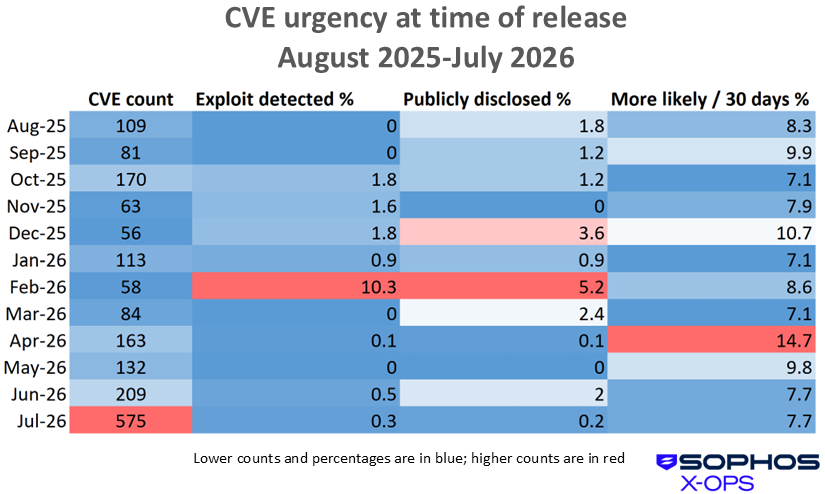
None of the vulnerabilities attributed to the top submitter, 0ccbbf129444eb66344ccafb92b00df4, have been observed in active exploitation. Furthermore, only seven of their disclosed vulnerabilities were classified as Critical severity. Analysis of vulnerability trends over the past year, as depicted in Figure 1, indicates a declining percentage of bugs that have either been publicly disclosed or found actively exploited in the wild. Even the proportion of CVEs that Microsoft predicts are more likely to be exploited within the next 30 days remains relatively low.
This trend raises an intriguing question: could AI bug hunting represent a proactive "code cleanup" initiative that, once completed, will lead to a significant reduction in exploitable vulnerabilities? While it is too early to draw definitive conclusions, the sustained output of high-volume, lab-tested vulnerabilities warrants continued observation. The cybersecurity community will be keenly watching to see if this pattern holds and what its long-term implications may be for threat landscapes.
Adapting to the New Normal: Evolving Patch Management Routines
The sheer volume of CVEs disclosed each month is compelling many security professionals to adapt their Patch Tuesday routines. This blog, in its effort to keep readers informed, is also evolving its approach to data presentation. For those who rely on the appendices for guidance, a transition to a new, spreadsheet-based system is underway, designed to cater to readers who appreciate detailed data in a more accessible format.
By the Numbers: A Statistical Overview
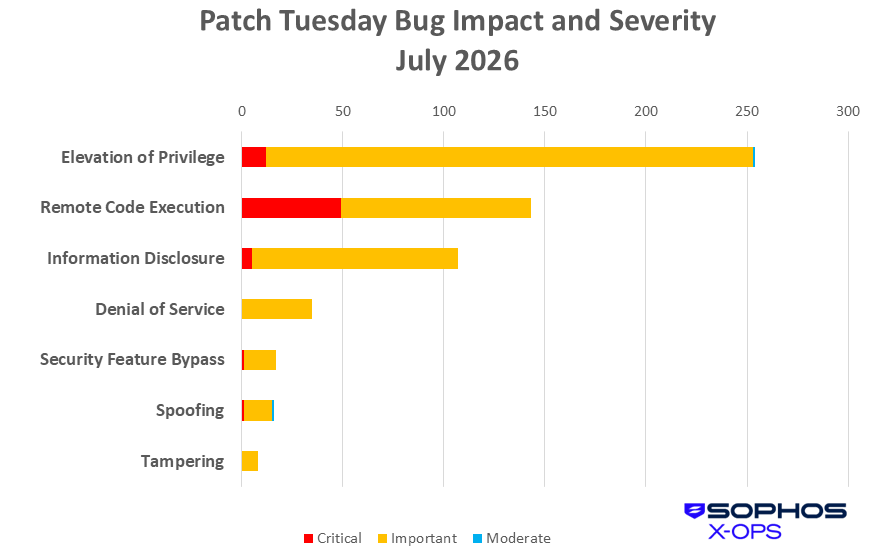
The July Patch Tuesday’s statistics reveal several key insights into the types and prevalence of vulnerabilities. While overall CVE counts remain high, a closer examination of specific vulnerability categories shows interesting shifts. As illustrated in Figure 2, the counts for Security Feature Bypass and Spoofing vulnerabilities actually saw a decrease in July. This could potentially indicate that certain types of bugs are more readily identifiable through AI-driven discovery methods than others.
Product-Specific Vulnerabilities
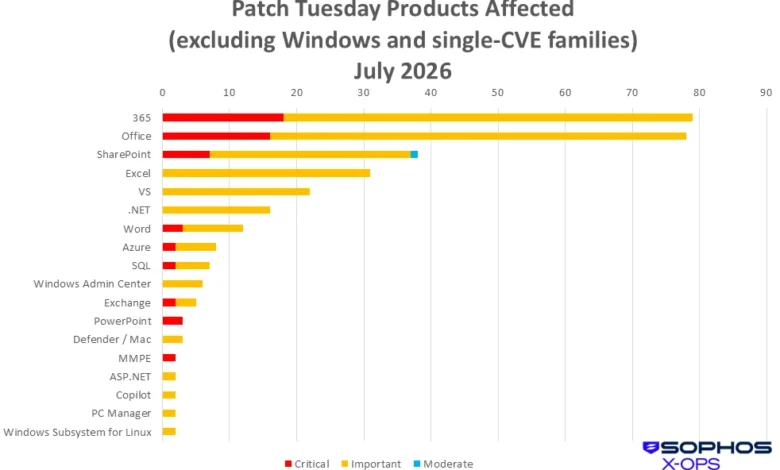
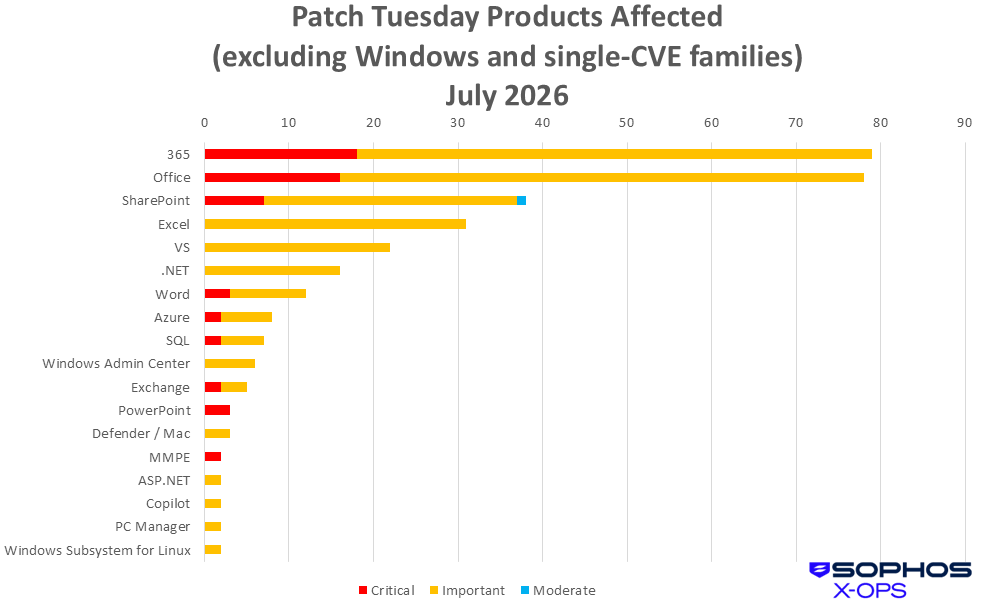
Microsoft’s patching efforts this month spanned a wide array of its product families. Customarily, CVEs affecting multiple product families are counted individually for each family they impact. This approach ensures a comprehensive understanding of the reach of each vulnerability.
As depicted in Figure 3, Windows, as is often the case, was a significant focus of this month’s patching. A total of 407 CVEs affected Windows, categorized as 31 Critical, 375 Important, and one Moderate severity. This underscores the ongoing need for robust security measures and timely updates for the Windows operating system. In addition to Windows, ten other product families received only a single patch apiece this month. Detailed information on these less affected product families can be found in the accompanying Excel workbook.
Figure 4 provides a comparative view of vulnerability types over the past seven months. Elevation of Privilege issues have consistently been more prevalent than Remote Code Execution (RCE) flaws, appearing twice as often. This month also saw the first Critical-severity patch for a Security Feature Bypass vulnerability, specifically for a SharePoint issue identified as CVE-2026-55040.
Notable July Updates: Prioritizing Critical Threats
Beyond the overall statistics, several specific vulnerabilities warrant particular attention due to their potential impact and likelihood of exploitation.
High-Priority Vulnerabilities for Immediate Action:
Several CVEs stand out due to their high CVSS Base scores (above 9.0) and Critical severity ratings, coupled with a higher probability of exploitation within the next 30 days. These are prime candidates for immediate patching efforts.
- CVE-2026-50518 – Windows DHCP Server Remote Code Execution Vulnerability
- CVE-2026-50522 – Microsoft SharePoint Remote Code Execution Vulnerability
- CVE-2026-55008 – Microsoft Exchange Server Spoofing Vulnerability
- CVE-2026-55944 – Microsoft Dynamics NAV and Microsoft Dynamics 365 Business Central (On Premises) Remote Code Execution Vulnerability
- CVE-2026-56188 – Windows Server Network Driver Remote Code Execution Vulnerability
- CVE-2026-58644 – Microsoft SharePoint Remote Code Execution Vulnerability
These vulnerabilities represent a clear and present danger, and organizations are strongly advised to prioritize their remediation.
Microsoft Office Vulnerabilities:
A significant cluster of 16 vulnerabilities affecting Microsoft Office (CVE-2026-50301, CVE-2026-50314, CVE-2026-50467, CVE-2026-55018, CVE-2026-55022, CVE-2026-55033, CVE-2026-55045, CVE-2026-55049, CVE-2026-55056, CVE-2026-55057, CVE-2026-55127, CVE-2026-55129, CVE-2026-55132, CVE-2026-55140, CVE-2026-56193, CVE-2026-56195) were addressed this month. The Preview Pane serves as a common attack vector for all 16 of these vulnerabilities. While all but three (CVE-2026-55057, CVE-2026-56193, CVE-2026-56195) are classified as Critical severity, Microsoft has assessed them as being less likely to be exploited within the next 30 days. This classification highlights the nuanced approach Microsoft takes in assessing exploitability, balancing severity with real-world threat likelihood.
Microsoft Edge Advisories:
Continuing the trend of highly productive vulnerability finders, Microsoft’s own Kugelblitz is credited with discovering 38 Important-severity bugs in Microsoft Edge this month, with 37 of these being solo credits. Notably, 31 of these bugs require a very specific user interaction, such as two sequential taps, similar to how one might use autofill features on a webpage. While automated bug hunting is likely prevalent, this specific interaction vector for a significant number of vulnerabilities is an interesting detail.
Vulnerabilities in Gaming Platforms:
Even seemingly less critical areas of software are not immune to security vulnerabilities. This month’s patches included fixes for:
- CVE-2026-55010 – Minecraft Bedrock Dedicated Server Remote Code Execution Vulnerability
- CVE-2026-50663 – Game: Age of Empires II: Definitive Edition Remote Code Execution Vulnerability
These patches underscore that no software is inherently secure and that comprehensive security practices must extend to all applications within an organization’s environment.
Sophos Protections: Real-Time Defense Against Emerging Threats
Sophos has implemented protections to detect and mitigate many of the vulnerabilities addressed in this month’s Patch Tuesday. The table below outlines specific CVEs and the corresponding Sophos Intercept X/Endpoint IPS and Sophos XGS Firewall protections available.
| CVE | Sophos Intercept X/Endpoint IPS | Sophos XGS Firewall |
|---|---|---|
| CVE-2026-49170 | Exp/2649170-A | Exp/2649170-A |
| CVE-2026-49795 | Exp/2649795-A | Exp/2649795-A |
| CVE-2026-49798 | Exp/2649798-A | Exp/2649798-A |
| CVE-2026-49800 | Exp/2649800-A | Exp/2649800-A |
| CVE-2026-50329 | Exp/2650329-A | Exp/2650329-A |
| CVE-2026-50332 | Exp/2650332-A | Exp/2650332-A |
| CVE-2026-50343 | Exp/2650343-A | Exp/2650343-A |
| CVE-2026-50351 | Exp/2650351-A | Exp/2650351-A |
| CVE-2026-50375 | Exp/2650375-A | Exp/2650375-A |
| CVE-2026-50387 | Exp/2650387-A | Exp/2650387-A |
| CVE-2026-50390 | Exp/2650390-A | Exp/2650390-A |
| CVE-2026-50420 | Exp/2650420-A | Exp/2650420-A |
| CVE-2026-50423 | Exp/2650423-A | Exp/2650423-A |
| CVE-2026-50433 | Exp/2650433-A | Exp/2650433-A |
| CVE-2026-50436 | Exp/2650436-A | Exp/2650436-A |
| CVE-2026-50454 | Exp/2650454-A | Exp/2650454-A |
| CVE-2026-50475 | Exp/2650475-A | Exp/2650475-A |
| CVE-2026-50476 | Exp/2650476-A | Exp/2650476-A |
| CVE-2026-50518 | sid:2312733 | sid:2312734 |
| CVE-2026-50522 | sid:2312729 | sid:2312729 |
| CVE-2026-50667 | Exp/2650667-A | Exp/2650667-A |
| CVE-2026-50688 | Exp/2650688-A | Exp/2650688-A |
| CVE-2026-54114 | Exp/2654114-A | Exp/2654114-A |
| CVE-2026-54986 | Exp/2654986-A | Exp/2654986-A |
| CVE-2026-54992 | sid:2312741 | sid:2312741 |
| CVE-2026-56164 | sid:2312731, sid:2312732 | sid:2312731, sid:2312732 |
| CVE-2026-57091 | Exp/2657091-A | Exp/2657091-A |
| CVE-2026-58536 | Exp/2658536-A | Exp/2658536-A |
For organizations that prefer to manage their updates manually, patches can be downloaded from the Windows Update Catalog website. Running the winver.exe tool will help determine the specific build of Windows in use, allowing for the download of the appropriate Cumulative Update package for the system’s architecture and build number.
Comprehensive Data Access: The Patch Tuesday Workbook
To provide readers with a more digestible and interactive experience, all detailed data related to this month’s Patch Tuesday is available in an Excel workbook. This resource offers multiple sheets, each designed for specific analytical needs:
- PT_Summary: Key monthly metrics presented in a concise, single-screen format.
- PT_PriSevImp: Facilitates sorting by impact, Microsoft-assigned severity, CVSS scores, and exploitability prospects.
- PT_ByProduct: Offers a granular breakdown by product family, useful for managing CVEs with multi-family applicability.
- PT_Windows: Details which Windows versions are affected by each patched CVE, now expanded to include currently supported client versions.
- PT_Protections: A comprehensive list of Sophos-issued protections applicable to this month’s patches, replicating the chart presented in the blog post for easy reference.
- PT_Advisories: Contains information on third-party advisories, servicing stack updates, and all Edge-related CVEs.
- PT_CWE: Breaks down vulnerabilities by their Common Weakness Enumeration (CWE) classification, highlighting the most frequently discovered weaknesses in the patched products.
This comprehensive approach to data dissemination empowers security professionals with the information they need to effectively manage their organization’s cybersecurity posture in the face of an ever-evolving threat landscape.