The home appliance giant LG Electronics USA announced this week its intention to suspend any applications built for its smart TVs that transform the television into an always-on residential proxy node. This decisive action follows closely on the heels of research revealing that a significant portion of apps available on LG’s webOS store – over 42 percent – permit unknown third parties to route their internet traffic through users’ televisions without explicit, ongoing consent. The move signifies a critical juncture in the ongoing debate surrounding data privacy and the hidden functionalities of internet-connected devices.
Escalating Concerns Over Residential Proxy SDKs in Smart TV Ecosystem
The revelation stems from comprehensive research conducted by the cybersecurity firm Spur, which meticulously examined the prevalence of residential proxy software development kits (SDKs) within smart TV applications. Published on July 2nd, Spur’s findings indicated a widespread integration of these SDKs, particularly within the LG webOS ecosystem. The study highlighted that more than 42 percent of apps accessible through LG’s smart TV platform incorporated SDKs designed to perpetually convert a user’s television into a proxy node. This means that the user’s internet connection could be rerouted through their television for various purposes, often unbeknownst to the end-user.
Further analysis by Spur extended to Samsung’s Tizen operating system, revealing a similar, albeit less pervasive, trend. More than a quarter of the applications developed for Samsung’s Tizen OS were found to contain comparable residential proxy components. This dual discovery underscored a broader industry challenge: the integration of potentially privacy-compromising technologies into consumer electronics that are increasingly becoming central hubs of household internet activity.
LG Electronics Responds with Policy Change and Developer Mandates
In direct response to Spur’s findings and subsequent inquiries from KrebsOnSecurity, John Taylor, Senior Vice President at LG Electronics, communicated the company’s commitment to addressing the issue. Taylor stated that LG is actively engaging with application developers to ensure the removal of residential proxy capabilities from their apps on the webOS platform. He issued a clear ultimatum: developers who fail to comply with this directive will face the suspension of their applications.
"A residential proxy network is not an intended use for LG smart TVs, and LG Electronics is working with developers to remove the residential proxy option from their apps on the webOS platform," Taylor stated. "If this option is not removed, these apps will be suspended." This statement signals a significant shift in LG’s platform governance, moving from a potentially passive acceptance of third-party SDK integrations to an active enforcement of its platform’s intended use and user privacy standards.
Taylor further emphasized LG’s ongoing dedication to preventing the recurrence of such issues, assuring that the company’s review process for existing applications is "well underway." He elaborated on LG’s commitment to platform integrity and user experience, stating, "As part of our ongoing efforts to enhance platform quality and the user experience, LG will continue to strengthen our evaluation process for developer-submitted apps, including those that incorporate residential proxy SDKs." This proactive stance suggests a more rigorous vetting process for future app submissions and a commitment to ongoing monitoring of the app ecosystem.
The Monetization Model and its Privacy Implications
The integration of residential proxy SDKs into smart TV applications is primarily driven by a monetization strategy. App developers can partner with residential proxy service providers, who, in turn, compensate developers for embedding SDKs that transform users’ devices into proxy nodes. These nodes are then rented out to paying customers, often businesses or individuals seeking to access the internet through a different IP address. This practice, while potentially lucrative for developers, raises significant privacy concerns for end-users.
Spur’s research uncovered that these residential proxy SDKs were not confined to niche applications but were embedded in a wide array of software, ranging from popular games like Pac-Man to seemingly innocuous utilities such as screensavers and file managers. This broad integration meant that a vast number of LG and Samsung smart TV users could have unknowingly been participating in these proxy networks.
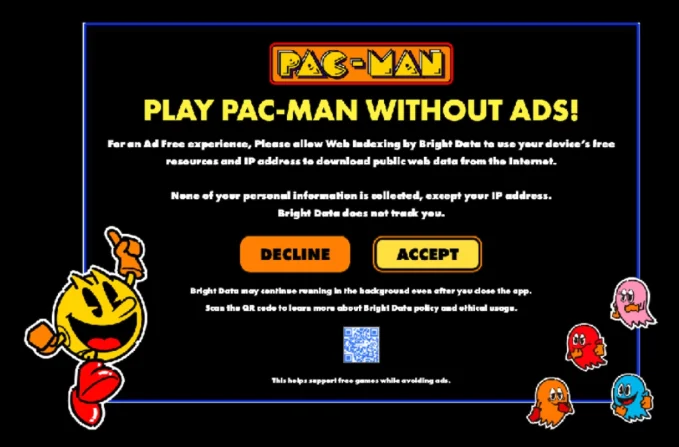
One striking example highlighted in Spur’s report involved a Pac-Man smart TV app offered by Bright Data. Users of this app were presented with a choice: either view advertisements within the game or consent to allowing their television to function as a residential proxy node. This binary choice, often presented within the context of enjoying a familiar game, underscores the subtle and potentially deceptive methods employed to gain user consent for such functionality.

Key Players and Their Positions
Bright Data, a prominent residential proxy network provider, was identified by Spur as the majority provider of these proxy SDKs across both LG and Samsung smart TV platforms. In a statement provided to KrebsOnSecurity, Bright Data defended its practices, asserting that its network operates on principles of consent and responsibility, in accordance with the terms set by LG and Samsung.
"Every peer opts in through a dedicated screen and receives value in return; every customer is vetted, and our practices have now undergone a second independent audit by PwC," a Bright Data spokesperson stated. "We remain committed to an open, transparent internet where legitimate businesses, researchers, and institutions can responsibly access data that lives in the public domain." The company’s emphasis on user consent and independent audits aims to assuage privacy concerns and highlight its adherence to industry best practices.
The proxy providers, including Bright Data, maintain that they implement stringent "know-your-customer" (KYC) processes to verify the legitimacy of their service users. These processes are often linked to content scraping activities, where customers utilize proxy networks to gather publicly available data from websites. Furthermore, these providers claim to incorporate technological safeguards designed to prevent their proxy service customers from interacting with or controlling other devices on the proxy user’s local network, a critical security measure given the potential for malicious exploitation.
The Debate Over Consent and Transparency
Despite the assurances from proxy providers, critics argue that the core issue lies not in the existence of residential proxy networks themselves, but in their pervasive and often opaque integration into consumer devices. Trevor Sutter, representing Spur, articulated this concern: "A one-time consent prompt buried in a TV app is not a substitute for meaningful transparency, ongoing control, and platform oversight." The argument posits that the convenience of a smart TV, coupled with the technical jargon or buried consent mechanisms, can lead to users inadvertently agreeing to functionalities they do not fully understand or desire.
Sutter further highlighted the amplified risk when consent is granted by individuals within a household who may not fully grasp the implications of their actions, such as minors. The ease with which such consent can be granted by a child playing a game or using a smart TV feature raises ethical questions about the responsibility of both app developers and device manufacturers in safeguarding user data and privacy.
Broader Implications for the Smart Home Ecosystem
LG’s decision to ban residential proxy SDKs from its app store is a significant step towards greater user privacy and security in the smart home. It sets a precedent for other manufacturers and platform operators to scrutinize the SDKs integrated into their devices. The incident underscores the growing need for robust platform oversight and a more transparent approach to data handling within the Internet of Things (IoT) landscape.
The implications extend beyond just smart TVs. As more household devices become internet-connected, the potential for similar privacy vulnerabilities increases. Consumers are increasingly relying on these devices for entertainment, information, and convenience, and they expect a reasonable level of privacy and security in return. The hidden functionalities of apps, especially those that leverage a user’s internet connection, can erode trust and create significant security risks.
A Chronology of Events: From Discovery to Action
- Early July 2026: Cybersecurity firm Spur publishes research detailing the widespread integration of residential proxy SDKs in smart TV apps, specifically highlighting a significant presence on LG’s webOS platform.
- July 2, 2026: KrebsOnSecurity features Spur’s research, bringing wider public attention to the issue.
- Following weeks: LG Electronics USA, in response to inquiries, confirms its awareness of the issue and initiates discussions with developers.
- Present Week (Late July 2026): LG Electronics USA announces its official policy to suspend apps that do not remove residential proxy functionality from their webOS offerings.
- Ongoing: LG Electronics USA begins its review process for existing applications and strengthens its evaluation protocols for future app submissions.
Looking Ahead: The Future of Smart Device Privacy
The LG Electronics USA announcement marks a crucial moment in the ongoing dialogue about privacy and security in the smart home. While the company’s decisive action is commendable, the underlying issue of how third-party SDKs are integrated and disclosed remains a significant challenge for the entire tech industry. The incident serves as a stark reminder that the convenience and features offered by smart devices come with a responsibility for manufacturers to ensure that user privacy is not compromised.
The broader implications of this situation extend to the development of new standards and regulations for IoT devices. Consumers and privacy advocates will likely continue to push for greater transparency, more granular control over device functionalities, and stronger enforcement mechanisms to protect personal data. As the smart home ecosystem continues to evolve, the balance between innovation, monetization, and user privacy will remain a critical area of focus. The proactive stance taken by LG, while addressing a specific vulnerability, also signals a potential shift towards a more responsible and user-centric approach in the smart device market. The company’s commitment to enhancing its evaluation process suggests a long-term strategy to safeguard its users from undisclosed and potentially intrusive functionalities embedded within its extensive product line.