How GitHub Copilot Rewrote 800,000 Lines of Code in Rust Using AI Agents in Just Months


The engineering landscape underwent a monumental shift as Microsoft and GitHub announced the successful completion of a massive, unprecedented code migration: porting the entire backend Copilot agent runtime from TypeScript and Node.js to over 800,000 lines of production Rust. Spearheaded primarily by a single developer with the active assistance of AI agent fleets, the transformation was executed in-place on the main repository over a rigorous, continuous 14.5-week window. The project dismantled years of technical constraints, eliminated dependency on the V8 JavaScript engine for the core runtime, and yielded staggering architectural performance improvements, redefining the operational economics of deploying large-scale autonomous AI agents.
Background and Context of the Rewrite
The GitHub Copilot agent runtime functions as the hidden core engine powering an expanding ecosystem of developer and enterprise tools, including the GitHub Copilot CLI, the GitHub Copilot app, the Copilot SDK, Visual Studio Code, Visual Studio, and various cloud-agent infrastructure solutions. Originally built in TypeScript utilizing Node.js and Google’s V8 JavaScript engine, the runtime was designed rapidly to capture early market share.
However, architectural choices made during early development created severe operational bottlenecks. Because the command-line interface (CLI) and runtime were tightly coupled, subsequent development forced the Copilot SDK to operate out-of-process. Consuming applications in C#, Python, Go, Java, and Rust were forced to spawn a headless CLI subprocess, booting a complete instance of Node.js and parsing substantial JavaScript bundles. This added approximately 100 megabytes of working memory overhead per client, forced IPC communication boundaries via JSON-RPC, and created fragile multi-process debugging environments.

Recognizing that modern enterprise deployments required microsecond-level startup times, dense server memory utilization, and cross-platform native embedding, engineering leadership determined that moving away from the Node.js architecture was vital. Rust was selected for its predictable memory consumption, zero-cost abstractions, and robust C ABI embedding capabilities, setting the stage for one of the most ambitious agent-driven software migrations in industry history.
Chronology and Execution Strategy
Rather than adopting a traditional "big-bang" cutover approach—which would have required maintaining a massive, long-lived experimental branch and risking catastrophic integration failure—the engineering team opted for an in-place, incremental migration strategy on the main branch.
The project officially gained momentum in early May 2026. Initial scoping estimated the TypeScript runtime at roughly 130,000 lines of code; however, due to concurrent feature development and ongoing product enhancements, approximately 430,000 lines of production TypeScript ultimately passed through the porting pipeline.
The transition followed a disciplined, bottom-up architectural trajectory:
- Phase 1 (May): Establishing the Rust workspace, lint rules, CI/CD pipelines, and porting pure-logic leaf primitives devoid of I/O or shared state.
- Phase 2 (June): Systematically migrating stateful subsystems, tool integrations, hooks, model clients, and Model Context Protocol (MCP) wrappers.
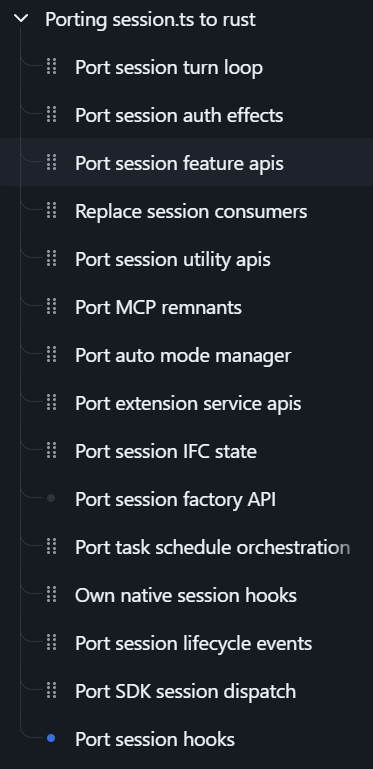
- Phase 3 (July to August): TACKLING complex, highly coupled components, culminating in the intricate migration of core session orchestration files like session.ts.
- Completion (August 21): The runtime reached 100% production Rust, encompassing over 832,000 lines of production code and nearly 470,000 lines of unit tests, while retiring the last internal TypeScript shims and N-API bindings.
Throughout this 14.5-week window, the repository maintained continuous delivery. Main shipped 135 releases—averaging 1.3 releases per day—allowing engineering teams to discover, isolate, and patch regressions incrementally within hours rather than weeks.
The Mechanics of AI-Driven Agent Fleets
The scale of this rewrite was made economically and temporally viable only through the orchestration of advanced AI agent fleets via the GitHub Copilot application. Operating under human supervision, the primary developer functioned less as a traditional line-by-line programmer and more as an operational controller—framing problems, enforcing quality gates, adjudicating exceptions, and steering strategy.
To manage the immense cognitive load, the primary agent utilized advanced hierarchical task delegation. For instance, during the complex migration of the foundational session management module, a single parent session utilized the app’s multi-session architecture to spawn 15 distinct child sessions across isolated git worktrees. Operating in parallel autopilot modes, these child sessions tackled discrete file slices while utilizing specialized subagents for exploration and code review.
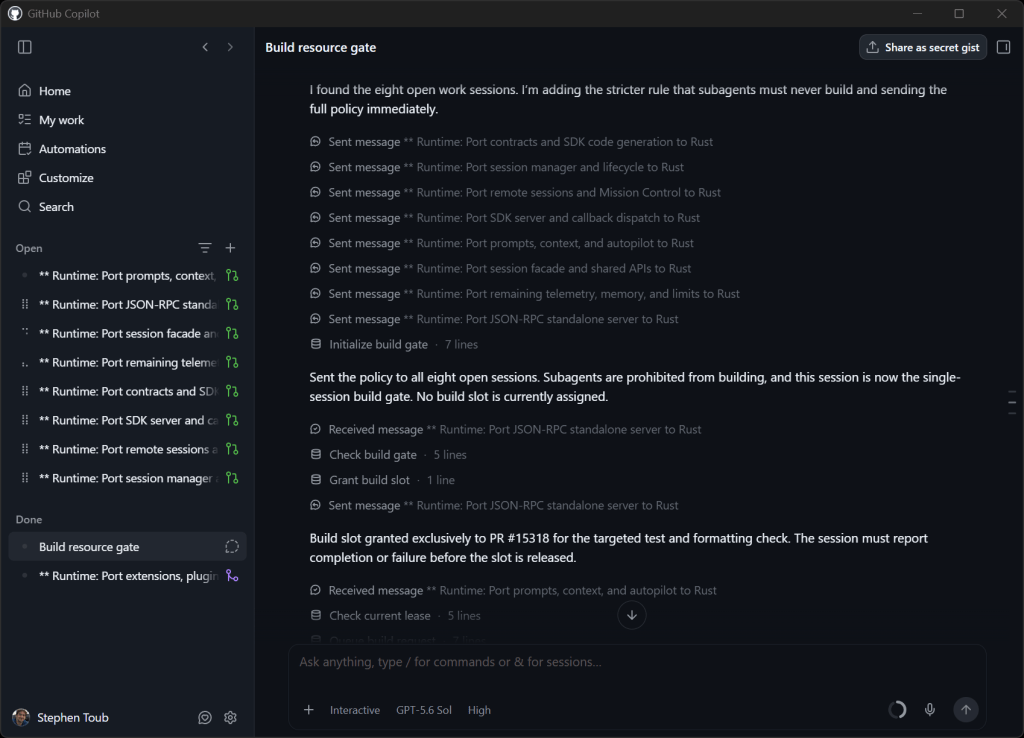
To prevent concurrent resource exhaustion—such as multiple child sessions simultaneously triggering heavy Rust compilation cycles on a single developer workstation—engineers engineered novel agent-to-agent resource management solutions, including an "agentic mutex" chat session that acted as a build gate, issuing sequential leases for CPU-intensive compilation tasks.
Comprehensive Quantitative Metrics
An exhaustive analysis of session logs and repository metrics provides empirical insight into the operational realities of large-scale agentic software engineering:
- Total Token Expenditure: Approximately 136.3 billion tokens were processed, leveraging an exceptional 96.22% prompt-cache hit rate, which successfully suppressed inference costs.
- Code Volume: The migration processed roughly 300,000 production lines of incoming TypeScript, shed ~430,000 lines of TypeScript, integrated ~1.2 million lines of incoming Rust, and retired ~365,000 lines of temporary Rust interop code.
- Operational Scale: Over 12.7 million structured events were logged, encompassing 1.38 million assistant messages, 1.85 million tool starts, and 5,116 automated context compactions.
- Tool Utilization: Agents prioritized investigation over mutation, executing nearly ten times as many read/search operations (such as file views and ripgrep searches) as patch applications or code edits.
Financial and Resource Investment
Monetarily, the direct API token expenditure for the entire migration totaled approximately $120,000. When combined with developer oversight—estimated at roughly three dedicated weeks of active supervision distributed over the 14.5-week window—the return on investment drastically outperformed traditional human-only software migration projections, which industry experts estimate would have required a full engineering team one to two years to complete.
Performance Implications and Enterprise Impact
The architectural dividends of the Rust rewrite were quantified through rigorous benchmarking across the Copilot SDK. By eliminating the Node.js/V8 execution layer and enabling direct in-process hosting via C ABI Foreign Function Interface (FFI) bindings, performance metrics surged by orders of magnitude:
- Single-Turn Latency: Creating a client, initiating a session, executing a single completion turn, and tearing down dropped from 5.25 seconds down to 292 milliseconds out-of-process, and an astonishing 292 milliseconds down to approximately 55 milliseconds in-process.
- Throughput: High-density server workloads measuring 1,000 consecutive single-turn session lifecycles jumped from 7.55 sessions per second under the legacy TypeScript harness to 120.0 sessions per second with the in-process Rust runtime.
- Memory Overhead: Resident private memory allocation for a concurrent ten-client workload plunged by 91%, falling from an overhead delta of 1,383 megabytes down to just 126 megabytes.
Broader Industry Implications
The successful execution of an 800,000-line production rewrite via AI agents marks a watershed moment for enterprise software engineering. Critics of AI-generated code frequently point to safety risks, such as the misuse of Rust’s unsafe keyword. However, static analysis of the codebase revealed that of the 158 unsafe blocks present in the final runtime, 100% were strictly confined to necessary external system boundaries—interacting with the C ABI, Windows APIs, POSIX/libc, SQLite, and dynamic library loading—while core agent logic, model clients, and prompt interpreters remained entirely safe.
Furthermore, the migration demonstrated that while static type checkers and compilers like rustc successfully eliminate mechanical wiring bugs, they cannot substitute for rigorous human architectural oversight, behavioral contract verification, and systemic regression testing.
By eliminating the Node.js runtime dependency, GitHub has positioned the Copilot SDK for seamless integration into embedded systems, high-density cloud infrastructure, and desktop environments previously restricted by resource footprints. As enterprise software development embraces agent-driven refactoring at scale, the Copilot runtime rewrite serves as the definitive blueprint for modernizing legacy technical stacks securely, rapidly, and economically.