GPT-6 Astra’s First Choice Batch Demonstrates Advanced Autonomous Agent Collaboration and Iterative Refinement

The landscape of artificial intelligence development reached a notable milestone with the release of the inaugural Choice batch powered by GPT-6 Astra, highlighting a sophisticated leap in how autonomous agents collaborate, self-correct, and execute complex multi-disciplinary tasks. Published on September 4, this initial deployment featured three independent Astra agents operating at maximum reasoning capacity. Each agent was given the autonomy to select its own subject matter across three distinct operational mandates: play, explore, and use. The resulting projects—a string-based spatial puzzle titled Loose End, a supply-chain dynamics simulation named The Order Echo, and a desktop publishing tool designated Pocket Press—offered a rare, transparent look into the mechanics of AI-driven creation, rigorous prototype review, and iterative refinement.
The Evolution of Autonomous Agent Evaluation
For years, the evaluation of large language models has relied heavily on benchmark tests, static datasets, and head-to-head model comparisons. However, the GPT-6 Astra Choice batch represents a paradigm shift toward qualitative, production-grade autonomy. Rather than competing against rival models in a closed environment, these agents were subjected to an operational framework that mirrors human software development pipelines: initial conceptualization, automated prototype review, critical feedback integration, and final curation.
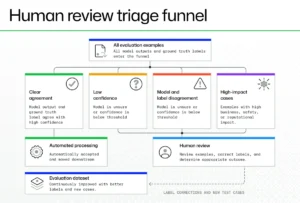
According to project documentation, the experimental framework required a mandatory prototype review phase before any project could be considered polished. Coordinating agents acted as quality assurance gatekeepers, identifying logic flaws, UI discrepancies, and functional limitations in the early builds, and subsequently returning them to the builder agents for remediation. This multi-agent workflow underscores a growing trend in software engineering: leveraging specialized AI personas to audit and enhance the outputs of other generative models, thereby minimizing hallucinations and structural errors before human intervention even occurs.

Loose End: Algorithmic Rigor in Spatial Puzzles
The first project, Loose End, originated as a rudimentary prototype consisting of a single string, three pegs, and four bells, controlled via arrow keys that infamously ignored short presses. During the initial review phase, a coordinating agent flagged the input latency and navigation bugs, sending the build back for fundamental repairs before the game’s logic could be finalized.
In its refined state, Loose End challenges players to maneuver the brass end of a finite string across a digital board. As the string catches on various pegs, players must carefully chart their routes to ring all four bells without running out of string length. Crucially, the puzzle mechanics dictate that ringing the bells is insufficient to secure a victory; the string must also successfully retrace its steps and return to its home starting point.
Subsequent automated testing of Loose End went far beyond basic functionality checks. Instead of merely confirming that a player could reach a single bell, the testing suite exercised two distinct winning strategies and meticulously verified long move sequences back to their origins. Despite these complex verification steps, developers noted that the game’s underlying physics remain strictly rule-based rather than physically simulated. The application does not attempt to model friction, elasticity, or complex rope dynamics; instead, it remains a tightly controlled, authored course designed to test spatial logic and pathfinding constraints.
The Order Echo: Visualizing Supply Chain Bullwhip Effects
Moving from recreational puzzles to analytical exploration, the second project, The Order Echo, tackled a classic economic concept: the bullwhip effect in supply chains. The interactive model simulates how retail shops, wholesalers, depots, and factories react to fluctuating consumer demand under varying ordering policies.

The primary challenge identified during the review phase of The Order Echo was the lack of comparative visibility. The initial interface made it difficult to observe how different ordering rules impacted the various stages of the supply chain on a shared scale, obscuring the precise arithmetic driving order volumes. The reviewer mandated that all traces be visualized on a single comparative metric, with the underlying ingredients of each order explicitly exposed.
The resulting interface allows users to select specific weeks and supply chain tiers to inspect the mathematical calculations in real-time. For instance, in a simulated scenario featuring a sharp demand spike—twelve retail crates requested instead of the baseline four—the traditional starting chain policy drives factory orders to a dramatic peak of 76.8 crates by week twelve.
However, introducing a policy that actively counts outstanding orders—such as shipments already awaiting delivery and supplier backlogs—fundamentally alters the simulation’s trajectory. When the shop factors in goods already in transit, its initial order increases slightly from 12.5 to 14.5 crates to account for the perceived gap in the desired pipeline. Yet, as the simulation progresses, this proactive buffering prevents catastrophic overproduction upstream. Consequently, the factory order peak drops significantly to 38.1 crates, occurring earlier in week nine.
While these findings offer valuable insights into inventory management and systemic feedback loops, researchers emphasize that The Order Echo is a teaching model rather than a predictive business forecasting tool. Operating within a strict 48-week window and assuming unlimited production capacity upstream of the factory, the model serves as an educational sandbox to demonstrate the profound impact of information transparency and backlog accounting in industrial logistics.

Pocket Press: Bridging Digital Design and Physical Assembly
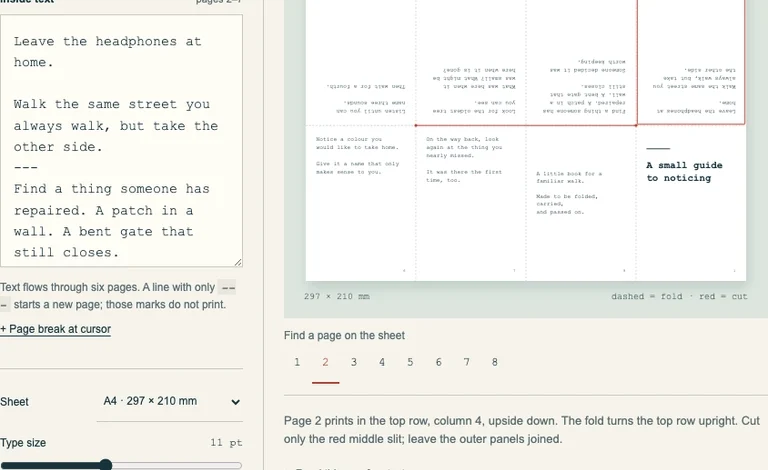
The third experiment, Pocket Press, focused on utility by addressing the perennial challenges of desktop publishing and booklet creation. Designed to take a user-supplied cover, manuscript, and back cover, the application automatically formats and arranges an eight-page booklet onto a single standard A4 or US Letter sheet of paper. Furthermore, the tool maintains a simultaneous reading view alongside the print arrangement, while providing options to save printable outputs, editable source files, and vector-based SVG sheets.
During the prototype review, the supervising agent requested significant usability enhancements, including more discoverable save actions, integrated folding instructions, and a robust mechanism for reopening and editing saved source files. Automated browser checks subsequently verified that the application successfully downloaded the target files, parsed their geometry and text accurately, and restored the original manuscript state from the saved source. The system was also programmed to restrict printable exports dynamically if text overflow errors were detected, ensuring that incomplete documents could not be mistakenly sent to print.
The visual layout generated by Pocket Press is intentionally unconventional. To enable a user to produce an eight-page booklet from a single sheet of paper using only a central slit cut and a series of folds, the print arrangement positions pages 5, 4, 3, and 2 upside down directly above pages 6, 7, 8, and 1.
However, rigorous end-to-end testing revealed unforeseen interface anomalies. During an automated inspection on September 9 at a browser width of 1,280 pixels, the digital print sheet extended beyond its designated preview boundaries, resulting in noticeable cropping at the top and bottom margins. This layout bug had gone unnoticed during evaluations conducted at a narrower 900-pixel width, demonstrating a critical blind spot in the model’s initial responsive design logic.

Additionally, researchers noted that the physical viability of Pocket Press remains entirely theoretical. All validation checks described in the September 4 release were executed exclusively by autonomous agents or headless browser automation scripts; no physical paper was printed, cut, or folded during the testing phase. To bridge this gap, Pocket Press automatically generates a standardized, numbered test sheet, leaving the physical validation step ready for human end-users.
Implications for the Future of AI Development
The successful deployment and public curation of the GPT-6 Astra Choice batch offer a compelling glimpse into the future trajectory of artificial intelligence engineering. By shifting the focus from isolated text generation to autonomous, multi-step project execution accompanied by rigorous self-correction, developers are moving closer to truly reliable AI collaborators.
The transparency provided by public curation records—detailing exactly what faults were identified by reviewing agents and how builder agents rectified them—establishes a valuable benchmark for accountability in software development. As these autonomous validation loops become more sophisticated, the boundary between human-led coding and AI-driven prototyping continues to blur. Whether applied to spatial puzzles, economic simulations, or desktop publishing utilities, the Astra experiment demonstrates that the true potential of advanced language models lies not just in their ability to generate initial ideas, but in their capacity to evaluate, refine, and deliver coherent, functional outputs across diverse domains.
Related posts: