React 17 Release Candidate Marks a Strategic Shift Toward Gradual Framework Upgrades

The release of the first Release Candidate for React 17 represents a significant departure from the traditional trajectory of major software framework updates. Breaking a silence that has lasted two and a half years—the longest period between major versions since the library’s inception—the Facebook React team has introduced an update that is uniquely defined by what it lacks: new developer-facing features. Instead, this release serves as a foundational architectural bridge designed to solve a persistent, industry-wide challenge known as the "all-or-nothing" upgrade dilemma. By prioritizing infrastructure over feature expansion, React 17 aims to modernize the library’s internal mechanisms to support a future of modular, incremental updates for large-scale enterprise applications.
A New Philosophy for Long-Term Maintenance
For the past seven years, the React ecosystem has operated on a binary upgrade path. Organizations were effectively forced to either remain on outdated versions, potentially sacrificing security and performance, or undertake the Herculean task of upgrading an entire codebase in one synchronized effort. For massive applications with millions of lines of code—often spanning multiple years of development and shifting teams—the latter approach was frequently deemed too risky or prohibitively expensive.
This upgrade cycle reached its limit as the React team looked toward future innovations. Certain deprecated APIs, such as the legacy context API, presented a paradox: the team could either support them indefinitely, bloating the framework’s footprint, or force breaking changes that would orphan thousands of legacy applications. React 17 is the engineered response to this deadlock. It functions as a "stepping stone" release, meticulously crafted to ensure that future versions, such as React 18, can be adopted in a piecemeal fashion rather than through a monolithic migration.
The Technical Evolution of Event Delegation
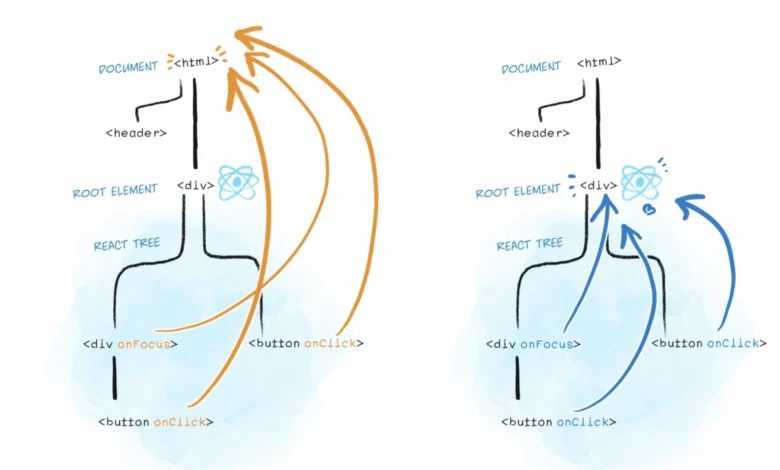
The primary mechanism enabling this shift is a fundamental change in how React handles event delegation. Historically, React attached event handlers directly to the document node of the browser, regardless of where the component tree was rendered. While this approach provided performance benefits and enabled advanced features like event replaying, it created a structural conflict when multiple versions of React attempted to coexist on the same page. Specifically, if a nested React tree attempted to stop the propagation of an event, the outer tree would often receive the signal anyway, leading to inconsistent application behavior and complex debugging scenarios.
In React 17, this behavior has been re-architected. The framework will now attach event handlers to the specific root DOM container where the application is rendered, rather than the document level. This change aligns React more closely with standard browser event behavior, effectively insulating different versions of the library from one another. Consequently, developers can now safely embed a component tree managed by React 17 inside an application that uses a different version of the framework—or even a completely different technology stack, such as jQuery or vanilla JavaScript—without the risk of event collisions.
Historical Context and Industry Impact
The pressure for this change has been mounting for years. The React issue tracker contains numerous reports from developers at major organizations struggling to integrate React into existing legacy systems or complex micro-frontend architectures. The Atom editor, for example, highlighted these limitations as early as 2016, noting that the global event delegation strategy made it nearly impossible to maintain strict boundaries between distinct application modules.
By resolving these issues, the React team is effectively acknowledging the maturation of the web ecosystem. Modern applications are rarely built from a single monolithic file; they are increasingly composed of diverse modules, lazy-loaded components, and distributed micro-frontends. React 17 provides the necessary plumbing to ensure that these distributed systems can evolve at different rates, allowing companies to modernize their tech stacks incrementally without halting feature development or risking total system failure.
Additional Structural Refinements
Beyond the core event delegation shift, React 17 includes several smaller, yet impactful, adjustments that bring the framework into tighter alignment with modern browser standards.

One significant change is the removal of "event pooling." In the framework’s earlier years, event pooling was a critical optimization technique that reused event objects across different events to minimize memory allocation. However, as modern JavaScript engines and browser performance have improved, this optimization has become largely redundant. More importantly, it was a frequent source of confusion, as developers would often find event properties unexpectedly nullified when accessed asynchronously. By removing this, React 17 simplifies the development experience, allowing developers to treat event objects as standard, stable JavaScript objects.
Additionally, the timing of useEffect cleanup functions has been standardized. Previously, cleanup functions for unmounting components executed synchronously, which could potentially cause performance bottlenecks during complex transitions. In React 17, these cleanups are moved to an asynchronous execution model, ensuring that they do not block the browser’s main thread during screen updates. This adjustment brings useEffect behavior into better consistency with the rest of the React lifecycle.
Improving Diagnostic Capabilities
Debugging remains a critical pain point in front-end development, particularly in production environments where source maps may be obscured or unavailable. React 17 introduces a new, more robust mechanism for generating component stack traces. By reconstructing these stacks through native JavaScript errors, the framework now provides developers with clickable, symbolicated traces even when the application is running in production. While this introduces a minor performance cost during the rare event of a crash, it drastically improves the ability of engineering teams to diagnose and resolve errors in real-time, reducing the mean time to repair (MTTR) for critical bugs.
Assessing the Risk of Breaking Changes
Despite being labeled as a "major" release, the React team has emphasized that the migration path is expected to be remarkably smooth. The team conducted internal testing across its own massive codebase at Facebook—which comprises over 100,000 components—and reported that fewer than 20 components required adjustments to function correctly under the new architecture.
This low failure rate is a testament to the team’s conservative approach to breaking changes. By postponing other experimental features and focusing exclusively on infrastructure, the team has minimized the surface area for potential regressions. However, the release does include stricter enforcement regarding return values for forwardRef and memo components. In previous versions, returning undefined from these components might have been ignored; in React 17, it will be treated as an explicit error. This consistency ensures that components behave predictably, forcing developers to return null if they intend to render nothing.
Future Outlook and Implementation
The React 17 Release Candidate serves as an open invitation for the developer community to stress-test the new architecture. While the team cautions against using this version in production environments until the final release, the availability of the RC allows for immediate testing of existing build pipelines and legacy integrations.
For developers utilizing tools like Create React App, the transition should be largely seamless. The team has provided an example repository demonstrating how to implement a gradual upgrade path, illustrating how one might load a legacy version of React for a specific, isolated section of an application while keeping the rest of the site on the latest version.
As the industry moves toward increasingly modular and complex front-end architectures, the release of React 17 marks a pivotal moment in the framework’s history. By prioritizing interoperability and long-term maintainability over immediate feature parity, the React team is ensuring that the library remains a viable and robust choice for the next generation of web applications. The "stepping stone" provided by this release will likely define the development strategies of large-scale enterprises for years to come, turning the once-daunting prospect of a framework upgrade into a manageable, routine operational task.