Android Bench 2.0 Launches to Revolutionize AI Development Evaluation with Long-Horizon Task Benchmarking

The landscape of software development is undergoing a seismic shift as artificial intelligence transitions from simple code-completion tools to autonomous, multi-step agents. To navigate this evolution, the Android development team has officially launched Android Bench 2.0, a significant update to its industry-standard benchmarking framework. This new iteration marks a departure from the superficial metrics of the past, shifting focus toward "long-horizon tasks" (LHTs)—complex, multi-day engineering projects that mirror the reality of enterprise-grade software development.
The Evolution of AI Benchmarking
In the early days of AI-assisted coding, benchmarks were primarily restricted to isolated bug fixes, single-function generation, or small-scale feature requests. These tests, while useful for measuring basic syntax and logic, failed to capture the nuances of professional Android development, which often involves architectural refactoring, complex dependency management, and maintaining visual fidelity across hundreds of screens.
The first iteration of Android Bench set the stage by establishing a rigorous foundation for how LLMs interact with Android-specific codebases. However, as models grew more capable, the gap between "toy" benchmarks and real-world utility widened. By aligning with the Harbor framework, the developers behind Android Bench have sought to standardize how the industry measures model reliability. Android Bench 2.0 represents the next logical step in this journey, introducing a suite of metrics designed to handle the scale, ambiguity, and high-stakes nature of modern app development.
A New Standard: Long-Horizon Tasks
The core innovation in version 2.0 is the introduction of Long-Horizon Tasks. Unlike previous benchmarks that evaluated models on tasks solvable in minutes, LHTs are designed to test a model’s persistence and architectural depth over several days or even a full work week. These tasks include significant undertakings such as:
- Dependency Upgrades: Systematically updating core libraries across an entire application without breaking existing functionality.
- Architectural Migrations: Converting legacy architectures to modern standards, such as migrating from traditional View-based systems to Jetpack Compose.
- Greenfield Development: Building robust, functional applications from the ground up based on high-level requirements.
- Cross-Platform Porting: Translating complex logic from non-Android frameworks to the Android ecosystem.
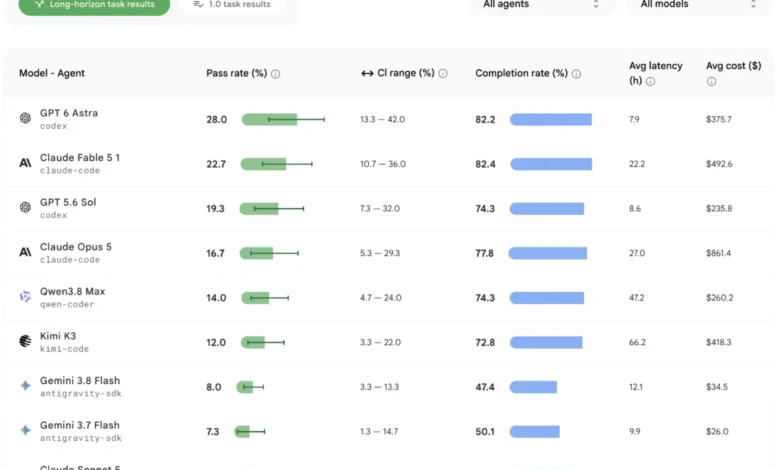
The data from these new tests is sobering. While previous benchmarks often reported high success rates—some as high as 91% for simple tasks—the LHT results reveal the true difficulty of these operations. The highest pass rate for the new LHT suite currently sits at approximately 28%, highlighting a significant performance gap that developers must consider when delegating complex work to AI.

Redefining Success Through Continuous Scoring
A major point of contention in AI evaluation has been the "binary trap"—the practice of grading a project as either a total success or a total failure. In the context of a 40-screen refactor, a model that completes 95% of the work but fails a single edge-case assertion is not a 0% failure; it is an incredibly valuable assistant that has saved an engineer hours of manual labor.
Android Bench 2.0 moves away from binary grading in favor of continuous scoring. This methodology evaluates performance across multiple dimensions, including functional accuracy, visual fidelity, and the absence of regressions. Furthermore, the framework applies objective penalties for deviations from architectural constraints or structural requirements. This nuanced approach provides a more granular signal for model developers, allowing them to pinpoint exactly where their systems fail—whether in architectural planning, code implementation, or final integration.
Agentic Evaluation: The Human-in-the-Loop Paradigm
Beyond the models themselves, Android Bench 2.0 introduces evaluations for "agents." An agent is a sophisticated wrapper around an LLM that allows it to interact with files, run build commands, and iterate based on compiler feedback. By testing these agents alongside the models that power them, the research team is providing a clearer picture of how these systems perform in a real-world developer workflow.
The results have already yielded interesting insights into the synergy between model architecture and agent design. For instance, the use of prompt caching and compact tool windowing has been shown to reduce token consumption significantly, which directly impacts cost-efficiency for teams. By pairing specific models, such as OpenAI’s GPT-6 with its native agent or Google’s Gemini 3.8 Flash with its proprietary harness, the benchmark demonstrates that the "agentic layer" is just as critical as the underlying model intelligence.
Performance Insights and Model Comparison
The latest leaderboard update provides a comprehensive snapshot of the current state of the industry. The newly added models—Gemini 3.8 Flash, Gemini 3.7 Flash, GPT-6, Fable 5.1, Kimi K3, and Qwen 3.8 Max—undergo rigorous testing to ensure developers have the most current data for their procurement decisions.
The data suggests a clear trend: AI models are currently far more adept at creating new code than they are at refactoring legacy systems. While models demonstrate a high level of consistency when executing well-established, deterministic transformations—such as converting Java to Kotlin or swapping networking libraries—they frequently falter when faced with architectural ambiguity. Runtime validation, missing dependency injection graphs, and knowledge gaps regarding unreleased libraries remain the primary "bottleneck" areas for current frontier models.
.png)
Implications for the Developer Ecosystem
For the individual software engineer and the enterprise CTO, the implications of these findings are profound. The current reality is that no single model has achieved a 100% pass rate on the LHT suite, with the top-tier models topping out at roughly an 80% completion rate for complex tasks. This confirms that while AI is an increasingly powerful force, it remains an augmentative tool rather than a replacement for human engineering oversight.
The transparency provided by Android Bench 2.0 is expected to drive competition among model providers. By highlighting "strengths and pitfalls"—such as a model’s tendency to hallucinate dependency injection structures or its proficiency in writing unit tests—the benchmark forces model builders to address specific pain points in the developer journey. This creates a virtuous cycle: as benchmarks become more challenging, model performance improves, which in turn leads to more sophisticated benchmarks.
Looking Ahead
The launch of Android Bench 2.0 is not a static milestone but an ongoing commitment. The development team has indicated that they will continue to iterate on the framework, with future updates likely to include more diverse task types and deeper integration with evolving development environments.
For those interested in the specific methodology, the Android developer portal now hosts detailed documentation on the scoring criteria, ensuring that the industry remains aligned on what "quality" means in the age of AI. Furthermore, the team has encouraged community engagement via GitHub, where developers can contribute to the dataset or provide feedback on the real-world utility of these benchmarks.
As the industry moves toward a future where AI agents are integrated into the core of the IDE, the need for objective, high-bar metrics becomes paramount. Android Bench 2.0 provides the necessary roadmap for this transition, offering the data, structure, and clarity required to build the next generation of software with confidence. By setting the bar high, the Android team is not only measuring the progress of AI but actively guiding its development toward the most useful and reliable outcomes for developers worldwide.