Scaling Incident Response: Centralizing Tool Security for AWS DevOps Agent through Amazon Bedrock AgentCore

The operational complexity inherent in modern cloud environments often forces engineering teams to adopt a fragmented approach to incident management. As organizations increasingly rely on autonomous AI teammates like AWS DevOps Agent to navigate multicloud and on-premises infrastructure, the need to integrate proprietary databases, internal runbooks, and custom APIs becomes a critical bottleneck. While the Model Context Protocol (MCP) provides a standardized framework for connecting these disparate data sources, the proliferation of individual MCP servers introduces significant security, observability, and management overhead. By leveraging Amazon Bedrock AgentCore’s Gateway, organizations can now transition from siloed tool management to a unified, policy-driven architecture that ensures consistent security posture and operational visibility.
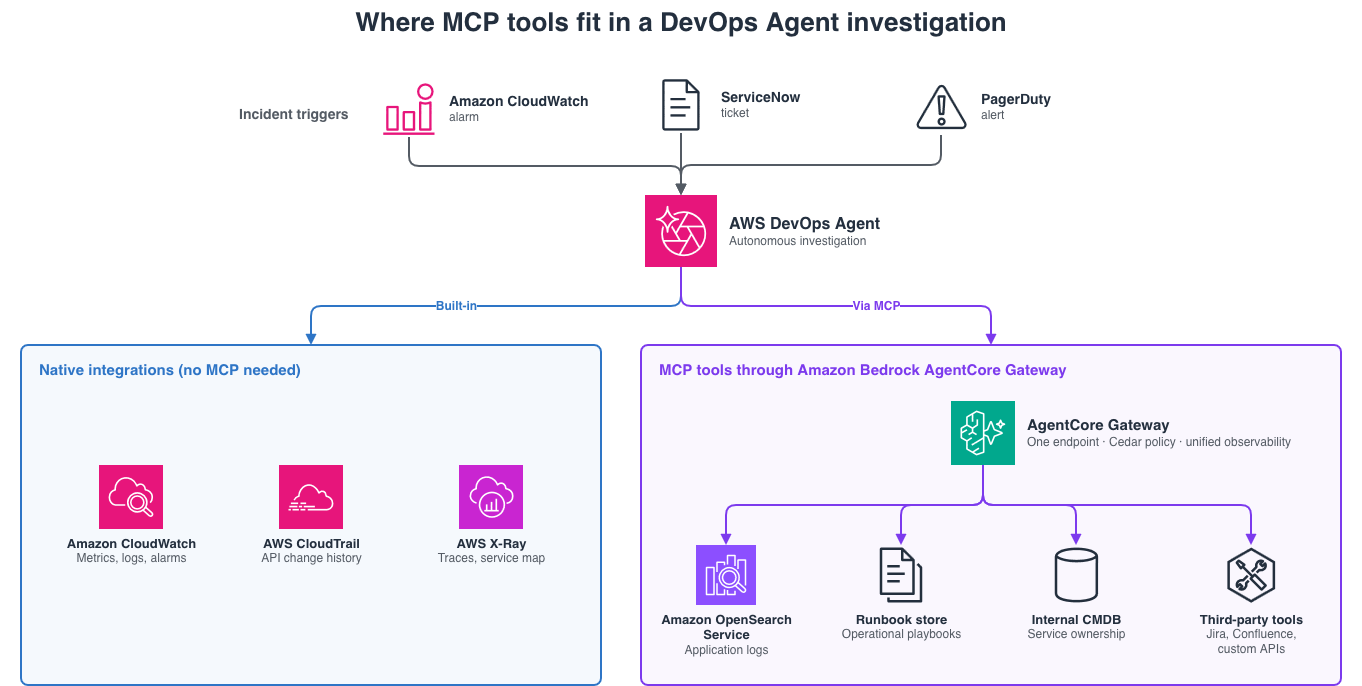
The evolution of autonomous DevOps tools has reached a pivotal juncture. Since the general availability of AWS DevOps Agent, organizations have reported substantial performance gains, with average mean time to resolution (MTTR) reductions of up to 75 percent and investigation speeds accelerating by 80 percent. These metrics reflect a shift toward agent-centric operations, where AI is no longer a peripheral assistant but a core component of the incident response lifecycle. However, the efficacy of these agents is strictly limited by their "field of vision." When an incident occurs—triggered by an Amazon CloudWatch alarm, a PagerDuty alert, or a ServiceNow ticket—the agent must synthesize data from diverse, often disconnected, sources.
The Management Burden of Fragmented Integration
Before the implementation of centralized gateways, teams were tasked with the manual, repetitive labor of maintaining individual MCP servers. Each new tool added to an agent’s repertoire required a dedicated authentication scheme, a specific credential rotation schedule, and a tailored audit procedure. This creates a "management debt" that scales linearly with the number of tools deployed.
In a typical large-scale environment, an agent might need access to an OpenSearch cluster, a legacy configuration management database (CMDB), and a custom deployment tracking system. Under the traditional decentralized model, the security team must oversee the lifecycle of three distinct sets of credentials. If a security policy changes, the team must manually update each configuration, increasing the likelihood of human error and creating gaps in the organization’s audit trail. Furthermore, the lack of cross-tool policy enforcement means that an agent could theoretically perform a destructive action on one system while being restricted on another, leading to an unpredictable operational profile.
Architectural Shift: The Role of AgentCore Gateway
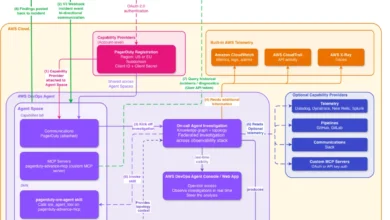
The introduction of the AgentCore Gateway marks a transition toward a hub-and-spoke model for AI-driven operations. By acting as a secure intermediary, the Gateway enables AWS DevOps Agent to interact with a single, hardened endpoint rather than managing a web of disparate connections.
This architecture provides several fundamental advantages. First, authentication is consolidated. The agent connects to the Gateway using standard AWS SigV4 signatures, effectively offloading the complexity of identity management. Second, the Gateway serves as a centralized policy enforcement point. By utilizing Cedar—a policy-as-code language designed for fine-grained authorization—security teams can define global constraints that apply to every tool behind the Gateway. For instance, an organization can implement a policy that prevents any tool from executing a "delete" command on production databases, providing a robust safeguard that operates independently of the agent’s own internal logic.
Strategic Decision Framework for Tool Integration
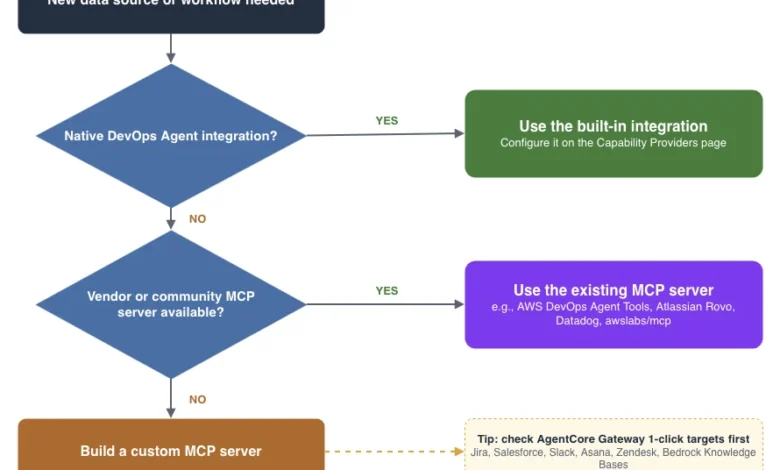
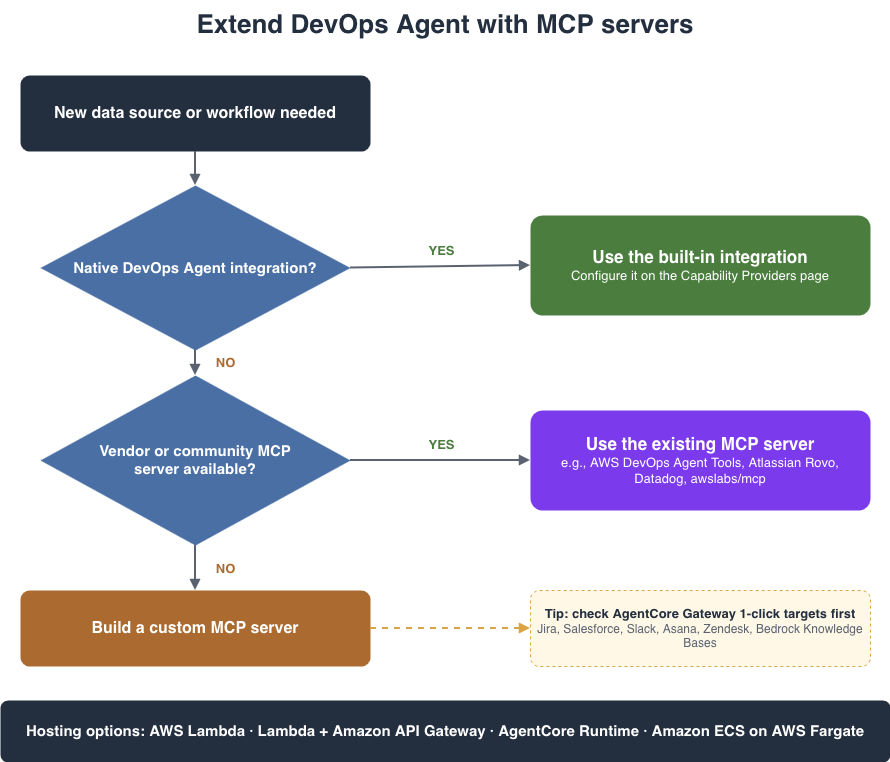
Choosing the right path for extending agent capabilities requires a methodical evaluation of the tool’s nature and the organization’s operational requirements. The decision tree begins with existing native integrations. If a service—such as a major CI/CD platform or a common observability suite—is already supported by the AWS DevOps Agent’s native capabilities, no custom development is required.
If the requirement falls outside native support, the next step is to evaluate the availability of vendor-published MCP servers. Organizations like Atlassian, Datadog, and PagerDuty have already released standardized MCP servers that offer plug-and-play functionality. Building a custom MCP server should be considered a "last mile" effort, reserved for proprietary internal tools or highly specialized workflows that no existing integration can fulfill.
When a custom tool is required, the hosting strategy becomes the primary determinant of latency and reliability. For simple, stateless, read-heavy operations, AWS Lambda offers an efficient, serverless approach with no infrastructure overhead. For more complex requirements involving persistent connections or multi-turn sessions, the Amazon Bedrock AgentCore runtime or Amazon ECS on AWS Fargate provides the necessary compute stability.
Enhancing Security through Directed Actions and Policy
One of the most critical aspects of integrating custom MCP tools is the classification of tool safety. AWS DevOps Agent categorizes tools as read-only, mutating, or destructive. Read-only tools function autonomously, whereas mutating tools—those capable of changing system states—require explicit operator approval through a "directed action" workflow.
This classification system acts as a primary defense against the risks of prompt injection and unauthorized state changes. By restricting an agent’s capability to only what is strictly necessary for a given task, teams can limit the potential blast radius of an AI-led investigation. Furthermore, the use of Cedar policy within the AgentCore Gateway adds a secondary layer of protection. Because the Gateway operates at the network level, it can block requests that violate security policies even if the agent itself attempts to call a tool that has been misclassified by a human operator.
Observability and the Unified Audit Trail
Perhaps the most significant benefit for security and operations teams is the consolidation of observability data. In the fragmented model, logs were scattered across individual servers, making root-cause analysis of the agent’s own behavior nearly impossible. With the Gateway, all tool calls are routed through a single pipe, resulting in a unified log group in Amazon CloudWatch.
This centralization provides granular visibility, including the tool name, the identity of the caller, specific request arguments, and the resulting latency and status codes. When combined with AWS X-Ray, teams gain end-to-end distributed tracing that tracks the request from the agent, through the Gateway, and down to the backend compute layer. This level of transparency is essential for high-stakes environments where compliance and auditability are non-negotiable.
Implications for Future DevOps Operations
The shift toward centralized, policy-governed agent architectures is not merely a technical improvement; it is a fundamental change in how DevOps teams maintain control over increasingly autonomous systems. As agents become more capable, the boundary between "human-led" and "agent-led" work will continue to blur. By standardizing the way these agents access information, organizations can ensure that their security posture keeps pace with their operational velocity.
The ability to manage, monitor, and secure hundreds of tools through a single control plane allows engineering organizations to focus on the quality of their services rather than the plumbing of their internal integrations. As the ecosystem of MCP-compliant tools continues to expand, the importance of a secure, scalable gateway will only grow, cementing the role of Amazon Bedrock AgentCore as a foundational component in the future of autonomous cloud management. The path forward is clear: as incident investigation becomes increasingly automated, the infrastructure supporting those investigations must be equally systematic, transparent, and resilient.