React Native 0.85 Officially Released With a New Animation Backend, Metro TLS Support, and Crucial Breaking Changes

The core development team behind React Native has officially announced the rollout of version 0.85, marking another major milestone in the framework’s evolution. Powered by a collaborative effort involving Software Mansion, the latest version introduces a fundamentally redesigned Shared Animation Backend, expanded capabilities for the Metro development server, and significant improvements to React Native DevTools. Alongside these forward-looking feature additions, the release also implements vital foundational changes, including the migration of the Jest testing preset to an independent package and the deprecation of older Node.js runtimes. As the framework continues to cement its status as a premier choice for cross-platform mobile development, version 0.85 arrives with over 604 commits contributed by 58 developers worldwide, solidifying its place as the new stable release while moving version 0.82.x into end-of-life territory.
The Evolution of Mobile Architecture and Background Context
For years, building fluid, high-performance animations in React Native required navigating a delicate balance between JavaScript execution threads and native UI threads. Historically, the Animated library relied on the native driver to offload animations, but it faced structural limitations—most notably when attempting to animate complex Flexbox and layout properties. Meanwhile, third-party libraries like Reanimated pushed the boundaries of what was possible, sometimes requiring complex synchronization layers.
React Native 0.85 addresses these long-standing architectural bottlenecks through a deep collaboration with Software Mansion, a software agency renowned for its contributions to the React Native ecosystem. By establishing a unified internal engine that handles animation updates under the hood for both the core Animated library and Reanimated, the framework moves primary animation update logic directly into the React Native core. This strategic shift not only empowers Reanimated to execute performance optimizations previously deemed impossible, but it also guarantees rigorous testing of the update reconciliation process, safeguarding stability across future framework updates.
Core Highlights of React Native 0.85
The Shared Animation Backend and Layout Property Support
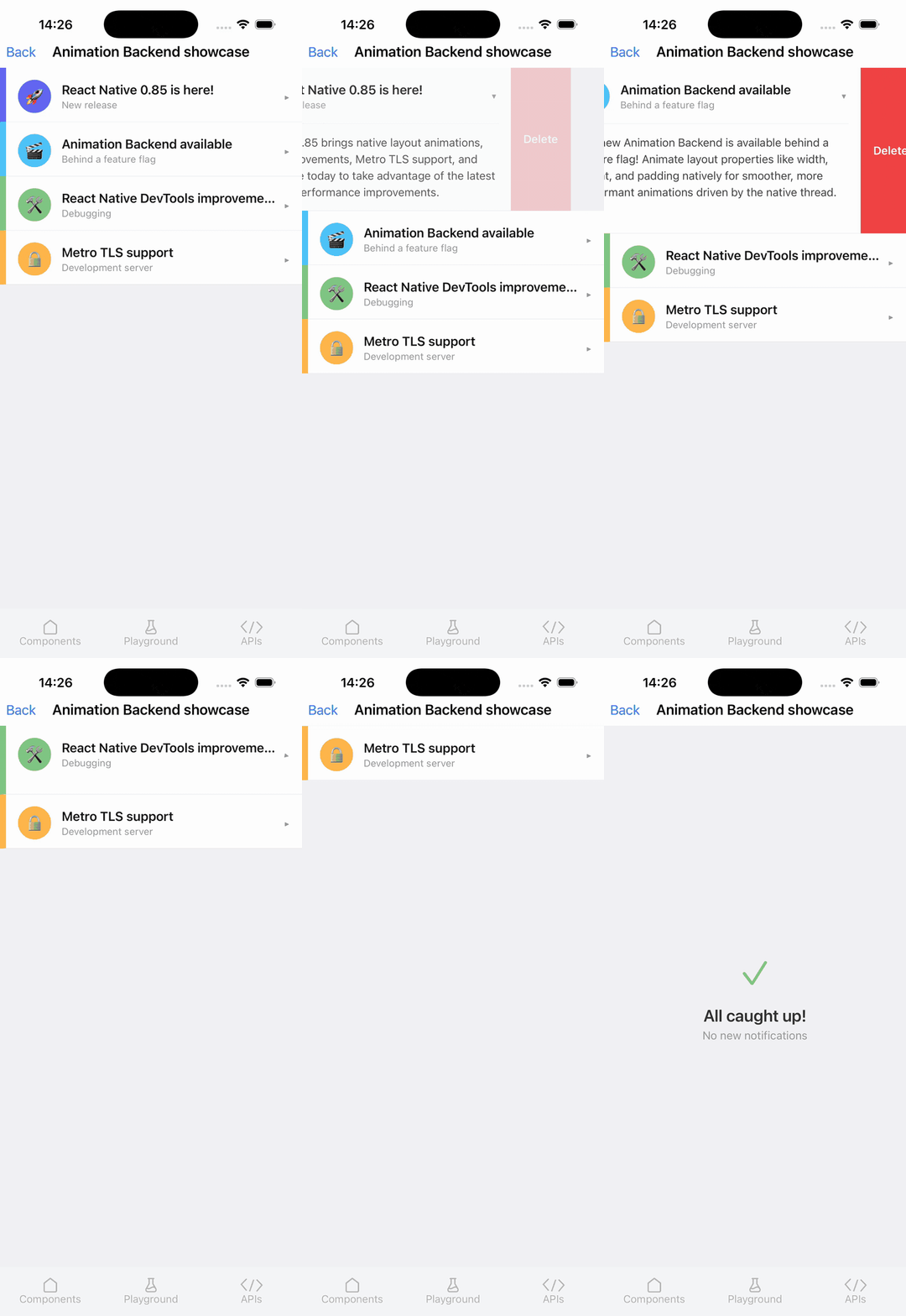
The standout feature of this release is the Shared Animation Backend. For developers utilizing the core Animated library, this update removes historical barriers, allowing layout properties such as Flexbox dimensions and positioning attributes to be smoothly animated using the native driver. Developers no longer need to rely exclusively on transform matrices for basic resizing or repositioning tasks that previously triggered costly layout recalculations on the JavaScript thread.
To take advantage of this new engine, developers can explore implementation examples located within the react-native/packages/rn-tester/js/examples/AnimationBackend/ directory of the official repository. Because this feature is initially rolling out through an experimental channel, the full feature set will be fully realized starting with the imminent release of React Native 0.85.1. Implementing a basic width expansion using the native driver now follows a streamlined pattern:
import
  Animated,
  Button,
  View,
  useAnimatedValue,
 from 'react-native';

function MyComponent()
  const width = useAnimatedValue(100);
  const toggle = () =>
    Animated.timing(width,
      toValue: 300,
      duration: 500,
      useNativeDriver: true,
    ).start();
  ;
  return (
    <View style=flex: 1>
      <Animated.View
        style=width, height: 100, backgroundColor: 'blue'
      />
      <Button title="Expand" onPress=toggle />
    </View>
  );
Metro TLS Support for Secure Local Development
In modern mobile engineering, testing applications against secure backend services often poses local development hurdles, particularly when APIs enforce strict HTTPS standards or Secure WebSockets (WSS) for Fast Refresh. React Native 0.85 directly resolves this friction by enabling the Metro development server to accept a dedicated Transport Layer Security (TLS) configuration object.
By defining certificate authorities, certificates, and private keys directly within the metro.config.js file, developers can seamlessly replicate production-grade secure environments locally. Utilizing tools such as mkcert allows engineers to generate locally trusted certificates without triggering browser or device security warnings. A standard configuration takes the following form:
const fs = require('fs');
config.server.tls =
  ca: fs.readFileSync('path/to/ca'),
  cert: fs.readFileSync('path/to/cert'),
  key: fs.readFileSync('path/to/key'),
;
DevTools Enhancements
React Native DevTools has received multiple usability enhancements in this cycle. Most notably, the interface now integrates native tab support on macOS, offering a more cohesive and ergonomic debugging experience for developers working within the Apple ecosystem. These refinements aim to reduce context-switching overhead and streamline inspection workflows for performance profiling and network monitoring.
Breaking Changes and Ecosystem Adjustments
Every major framework update requires deprecating legacy code and trimming technical debt to ensure long-term health. React Native 0.85 is no exception, introducing several critical breaking changes that engineering teams must address during the upgrade process.

Extraction of the Jest Testing Preset
To reduce the overall footprint of the core react-native package and grant projects greater flexibility in their testing configurations, the official Jest preset has been decoupled from the primary repository. It now lives in a dedicated, independently versioned package: @react-native/jest-preset.
Upgrading projects will need to adjust their testing suites accordingly. Developers must update their jest.config.js file to replace the legacy reference:
- preset: 'react-native',
+ preset: '@react-native/jest-preset',
Deprecation of EOL Node.js Versions
Aligning with broader JavaScript ecosystem standards, React Native 0.85 officially drops support for end-of-life Node.js environments and versions preceding v20.19.4. Teams are strongly advised to audit their continuous integration (CI) pipelines and local developer machines to ensure they are running supported runtime versions prior to initiating the upgrade procedure.
Removal of StyleSheet.absoluteFillObject
The legacy and long-deprecated StyleSheet.absoluteFillObject API has been completely pruned from the codebase. Developers utilizing this utility must transition to StyleSheet.absoluteFill or declare custom absolute positioning styles manually:
- const styles = StyleSheet.absoluteFillObject;
+ const styles = StyleSheet.absoluteFill;
Broader Implications and Industry Analysis
The release of React Native 0.85 underscores a deliberate strategy by the core maintainers: shifting focus toward architectural resilience, developer experience, and tighter integration with specialized ecosystem partners like Software Mansion. By moving complex animation logic into the core architecture, the framework bridges the performance gap between cross-platform abstractions and native rendering engines.
Furthermore, the modularization of testing utilities like the Jest preset reflects a broader trend toward a decoupled, plugin-driven architecture. This philosophy minimizes bloat in core installations, allowing enterprise teams to tailor their toolchains without carrying unnecessary dependencies. As organizations increasingly rely on React Native for mission-critical consumer applications spanning finance, e-commerce, and media, these incremental improvements in security (via Metro TLS) and tooling reliability translate directly into reduced maintenance overhead and faster time-to-market.
Upgrading and Community Adoption
With the launch of version 0.85, the previous 0.82.x release line officially transitions to unsupported status under React Native’s standard support policy. Teams managing existing codebases are encouraged to leverage the official React Native Upgrade Helper to systematically identify and apply necessary code diffs.
For developers initiating brand-new applications, projects can be bootstrapped using the updated command-line interface:
npx @react-native-community/cli@latest init MyProject --version latestMeanwhile, users of the Expo ecosystem can anticipate native integration of React Native 0.85 in the upcoming SDK 56 release, ensuring that managed workflow projects will soon benefit from the performance gains delivered by the new animation backend and enhanced developer tooling.