Paul Boag Launches UX Insiders to Address the Growing Isolation of In-House Design Professionals

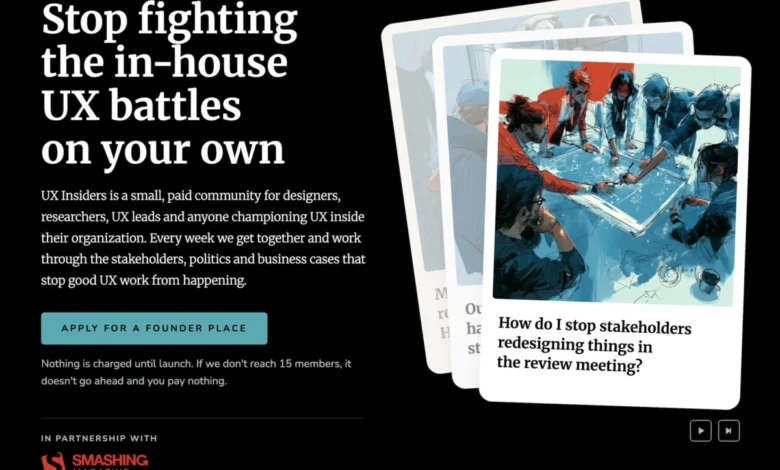
The landscape of professional digital design is undergoing a significant structural shift as organizational demands evolve, leaving many practitioners working in-house feeling increasingly isolated. Paul Boag, a veteran of the industry with a long-standing association with Smashing Magazine, has announced the launch of UX Insiders, a specialized community platform designed to provide a support network for UX researchers, designers, and managers embedded within corporate structures. This initiative, scheduled for an official launch on January 5, 2027, aims to mitigate the professional challenges inherent in internal UX roles by providing a dedicated space for peer-to-peer knowledge exchange and resource sharing.
The Challenges of the In-House UX Environment
Contemporary UX roles have moved beyond pure design execution. Industry data suggests that the "design debt" and stakeholder management responsibilities now constitute a significant portion of a UX professional’s workload. According to recent surveys within the UX community, over 60% of in-house practitioners report that "navigating organizational politics" and "communicating design value to non-design leadership" are their primary sources of workplace stress.
These challenges are exacerbated by the unique nature of in-house work. Unlike agency environments, where practitioners have a breadth of external clients to draw experience from, in-house teams often operate within a single organizational culture. This often creates "blind spots," where team members lack the external perspective required to navigate recurring issues—such as project stalling, shifting stakeholder priorities, or the rapid integration of artificial intelligence tools into research workflows.
The rise of generative AI has added a new layer of complexity. With senior management frequently under the impression that AI can automate complex user research in a matter of hours, in-house UX professionals are finding themselves in a position where they must defend the necessity of rigorous human-centered methodology while simultaneously learning how to incorporate these new technologies into their existing processes.

Chronology and Launch Logistics
The development of UX Insiders follows a period of observation by Boag, who has authored three books and 77 articles for Smashing Magazine over his tenure. The project is being developed in partnership with the Smashing editorial team, leveraging their reach within the professional design community.
The timeline for the platform is structured as follows:
- Late November 2024: Commencement of the application period for the first cohort of "founder" members.
- December 11, 2024: A critical milestone date. The platform requires a minimum of 15 confirmed sign-ups to proceed with the launch. If this threshold is not met, the project will be dissolved, and no financial transactions will occur.
- January 5, 2027: Official launch date for the platform, at which point the first billing cycles for the inaugural members will commence.
The platform utilizes a "founder pricing" model to incentivize early adoption. The first 25 members will secure a locked-in rate of £49 per month for annual billing or £59 per month for a rolling monthly subscription. This pricing structure is designed to be accessible to professional training budgets, allowing members to expense the membership through their respective employers.
Comparative Analysis: Agency vs. In-House Support
The launch of UX Insiders arrives on the heels of the successful implementation of the Agency Academy, a similar community platform managed by Boag since July 2024. The Agency Academy, tailored for freelancers and boutique agency owners, has seen sustained growth by focusing on the specific business needs of small firms, such as lead generation and work-life balance.
While the structural support provided by both platforms is similar—incorporating weekly interactive calls and collaborative Slack channels—the intended audience for UX Insiders is strictly delineated. By limiting membership to in-house practitioners, the platform creates a "safe harbor" where members can discuss specific organizational issues, internal project failures, and sensitive stakeholder dynamics without the concern of external observers, such as consultants or service providers, who might use the information for sales purposes.
This exclusionary policy is a calculated strategic choice. In an era where professional networking is often dominated by public-facing content or marketing-heavy interactions, the demand for "closed-door" professional development has risen. Data from private professional networks indicates that retention rates are significantly higher in communities that implement rigorous vetting processes, as the value proposition shifts from broad networking to high-trust peer advice.
The Role of Knowledge Sharing in Modern UX
The core value proposition of UX Insiders is the creation of a shared library of documentation. This will include anonymized business cases, project templates, and research plans that have demonstrated success in real-world environments.
The rationale for this is grounded in the observation that many UX professionals are currently "reinventing the wheel." When an in-house designer encounters a difficult stakeholder or a stalled project, they often have no access to the "lessons learned" of their peers in similar sectors. By centralizing these resources, UX Insiders aims to reduce the time spent on administrative and advocacy tasks, theoretically allowing for more time to be dedicated to core UX functions.
Implications for the Industry
The launch of this community suggests a maturing of the UX profession. As the industry moves away from the "growth at all costs" era and toward a phase of professional consolidation, practitioners are increasingly seeking specialized, high-fidelity support systems rather than generalist design resources.
Furthermore, the involvement of established industry platforms like Smashing Magazine indicates that there is a recognized gap in the market for sustained, long-term professional development that goes beyond traditional workshops or one-off courses. By focusing on the "soft skills" of the job—negotiation, internal advocacy, and navigating corporate bureaucracy—UX Insiders addresses the aspects of the profession that are rarely covered in academic or bootcamp curriculums.
For organizations employing these professionals, the emergence of such communities could prove beneficial. A better-supported, more confident, and well-resourced UX team is likely to be more effective at championing user-centric strategies, potentially reducing the friction between design teams and executive leadership.
Conclusion and Future Outlook
The success of the UX Insiders initiative will ultimately depend on the quality of its member base and the efficacy of its peer-mentoring model. As the project approaches its December 11 milestone, the industry will be watching to see if the demand for a dedicated in-house support network is as high as the initial interest suggests.
Paul Boag has stated that he intends to remain personally active in the community, managing the weekly calls and participating in daily Slack discussions. This hands-on approach is intended to maintain the quality of discourse within the group. For those interested in joining, the application process is designed to be efficient, focusing primarily on verifying the applicant’s status as an in-house employee to ensure the integrity of the community’s mission.
Whether this model of "community-as-a-service" becomes a standard fixture for professional development remains to be seen. However, as organizations continue to integrate digital design into their core business structures, the need for specialized, private, and peer-led support systems appears to be a growing trend in the professional services sector.