Managing Enterprise-Scale Java Upgrades with Autonomous AI Agents and Strategic Governance

Engineering teams overseeing vast Java estates are increasingly confronted with the relentless cadence of software obsolescence. As legacy Java Development Kit (JDK) versions reach their end-of-support milestones, organizations are faced with a daunting arithmetic: hundreds of services requiring manual dependency audits, complex migrations from javax to jakarta namespaces, and significant overhauls to test frameworks. Traditionally, these tasks have demanded weeks of developer attention per repository, a timeline that rarely adjusts to accommodate the rigid nature of end-of-support deadlines. However, the emergence of autonomous AI transformation agents has fundamentally shifted the operational paradigm, enabling organizations to execute these upgrades in minutes rather than weeks.
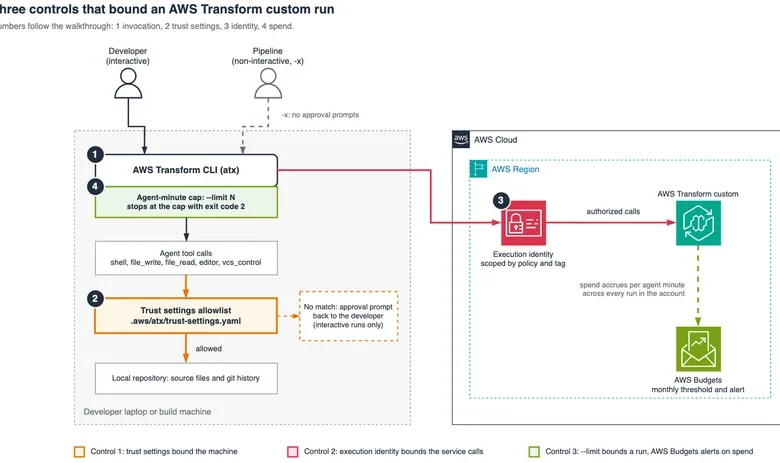
While the speed of agentic transformation is transformative, it introduces a complex footprint that necessitates robust governance. When an AI agent is tasked with modifying a repository, it executes shell commands, leverages cloud credentials, and consumes compute resources on a per-minute billing model. For an engineering organization managing hundreds of services, the risk of unmanaged agent behavior—ranging from unauthorized tool execution to unchecked financial liability—is significant. Consequently, enterprises are now adopting a framework of three distinct configuration controls to harness the efficiency of AWS Transform custom while maintaining enterprise-grade security and budget oversight.
The Evolution of Automated Modernization
The shift toward autonomous code modification represents a major milestone in DevOps maturity. In the past, modernization was largely restricted to static analysis tools that could identify issues but rarely resolve them. Modern agentic systems, by contrast, function as a collaborative partner. They perform dependency audits, refactor code, run build processes, and commit changes directly to version control.
This capability is best illustrated by the AWS Transform custom service, which allows teams to execute managed transformations—such as the AWS/java-version-upgrade—across a diverse fleet of applications. By utilizing the AWS Transform CLI, engineers can initiate transformations either interactively for testing or non-interactively within a CI/CD pipeline for massive scale. Yet, this power requires a "trust but verify" approach to ensure that the autonomous agent acts within the strict boundaries defined by the organization.
The Three Pillars of Agentic Governance
To mitigate the risks inherent in autonomous code manipulation, engineering leaders must implement a tripartite governance strategy: a trust allowlist, scoped execution identities, and rigorous spend management.
The first control, the trust allowlist, is designed to govern tool execution. By default, an AI agent may request permission for every action—reading files, writing code, or executing build commands. While necessary for security, constant prompting is untenable for large-scale operations. By defining a trust settings file at the user or system level, organizations can explicitly permit trusted tools and command patterns. For example, by pre-approving specific shell commands like Maven builds or Git operations, developers can eliminate unnecessary manual intervention. Crucially, this control must be granular, distinguishing between safe operations and potentially dangerous commands, such as those involving file deletion or elevated privileges.
The second pillar involves the separation of execution identity from authoring identity. This is a fundamental tenet of the principle of least privilege. Organizations should utilize distinct IAM policies to ensure that the role executing a transformation lacks the permissions to modify the transformation definition itself. By utilizing AWS-managed policies such as AWSTransformCustomExecuteTransformations, firms can restrict the scope of the agent to operational tasks. Furthermore, for organizations authoring custom transformations, resource tagging offers an additional layer of protection; by scoping execution roles to only interact with tagged, pre-approved transformation packages, engineering teams can prevent the accidental execution of unauthorized or untested logic.
The final pillar is fiscal accountability. Agentic transformations are billed by the minute, and in a fleet-wide rollout involving hundreds of services, costs can scale rapidly if left unchecked. By implementing per-run agent-minute caps, teams can establish "circuit breakers" that halt a process if it exceeds expected compute thresholds. This not only protects the budget but also serves as a diagnostic tool; an agent hitting a limit prematurely often signals a configuration issue or an unusually complex repository that requires manual review before proceeding.
Chronology and Operational Reality
Recent field testing performed in the third quarter of 2026 highlights the practical impact of these controls. In initial runs using version 3.9.0 of the AWS Transform CLI, a single Java modernization task prompted for approval 23 times. By version 3.10.0 and the introduction of a refined trust allowlist, that number was reduced to zero. This transition illustrates the maturity of the workflow: initial runs serve as a discovery phase where developers map out the necessary permissions, which are then codified into the infrastructure as configuration.
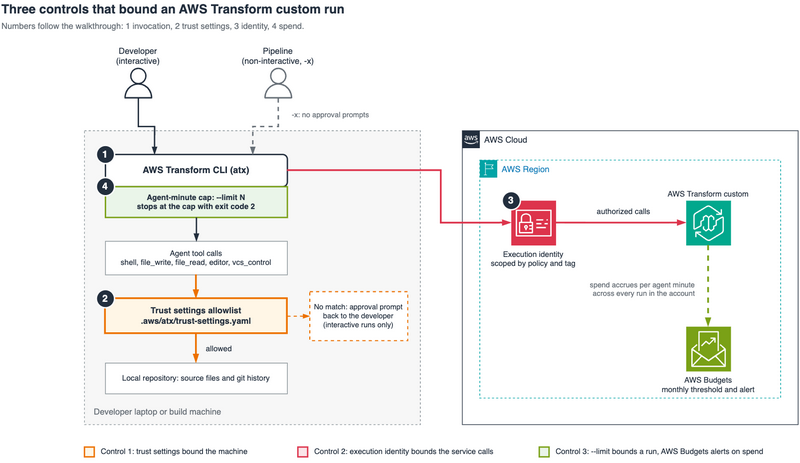
The operational flow for these agents is designed to be integrated into existing CI/CD pipelines. A pipeline execution role, equipped with the necessary IAM policies and configured with a budget cap, can trigger these transformations across an entire estate. If a run hits a defined agent-minute limit, the process exits with a specific code, allowing the pipeline to pause and notify a human engineer for review. This creates a feedback loop where the agent handles the heavy lifting of code transformation while the human engineer remains the final arbiter of intent and outcome.
Fact-Based Analysis of Implications
The shift toward agentic transformation has profound implications for enterprise software lifecycles. By lowering the cost and risk associated with major upgrades, organizations are no longer forced to defer maintenance due to capacity constraints. This accelerates the adoption of modern runtime environments, which often feature improved security, performance, and compatibility with modern cloud-native features.
However, this transition requires a fundamental change in the role of the software engineer. The focus shifts from writing every line of code to acting as a systems architect who defines the parameters and guardrails within which the AI operates. As these tools continue to evolve, the ability to manage "AI drift"—where agents learn from previous executions and adjust their behavior—will become a critical skill for DevOps teams. For example, if an agent performs a transformation that inadvertently impacts a repository-specific README, engineers must be prepared to adjust their validation logic to ensure that human-authored content is not misattributed or lost during the automated process.
Strategic Recommendations for Enterprises
For organizations looking to deploy agentic transformation at scale, the following steps are recommended:
- Inventory the Estate: Conduct a thorough audit of current JDK versions and build systems. Identify which services are candidates for standardized upgrades and which possess unique requirements that may require custom transformation definitions.
- Establish a Governance Baseline: Implement the three controls—trust allowlists, execution identities, and spend caps—in a sandbox environment. Use these to establish an empirical understanding of the "agent-minute cost" for your specific service portfolio.
- Integrate with Existing CI/CD: Rather than running agents as an isolated exercise, incorporate them into your established pipeline release processes. This ensures that every automated upgrade is subjected to the same unit testing, integration testing, and quality gates as manually authored code.
- Maintain Human Oversight: Despite the autonomy of these agents, code review remains essential. Ensure that all changes committed by agents are subject to pull request reviews, just as they would be for a human contributor.
As the industry moves toward a future where autonomous agents manage the technical debt of legacy systems, the ability to define, enforce, and iterate upon security guardrails will be the defining characteristic of successful engineering organizations. By treating governance as code—just like the applications themselves—teams can unlock the full potential of AI-driven modernization while maintaining the stability and security required for enterprise operations.