Streamlining Digital Publishing: How Docsify-This Brings Flexible Markdown Rendering to Web and Learning Management Systems

The modern digital publishing landscape has long demanded a balance between simplicity and versatility. For educators, developers, and content creators alike, Markdown has emerged as the preferred syntax for writing due to its lightweight nature and platform-agnostic readability. However, translating raw Markdown files into polished, responsive web pages traditionally required complex static site generators, dedicated hosting environments, or intricate build pipelines. Enter Docsify-This, an open-source tool built on top of the popular Docsify.js framework, which eliminates these technical barriers by allowing users to instantly publish, style, and embed Markdown content anywhere on the web without a traditional website setup.
The Evolution of Lightweight Publishing and Docsify-This
To understand the significance of Docsify-This, one must examine the trajectory of web publishing over the past two decades. Content Management Systems (CMS) such as WordPress and Drupal revolutionized digital publishing by separating content from design, but they often introduced heavy database dependencies and maintenance overhead. Concurrently, static site generators like Jekyll and Hugo gained immense popularity among developers by compiling Markdown into static HTML files. Despite their efficiency, these tools still require command-line knowledge, configuration files, and hosting deployments—hurdles that frequently alienate non-technical subject matter experts, such as university professors or corporate trainers.
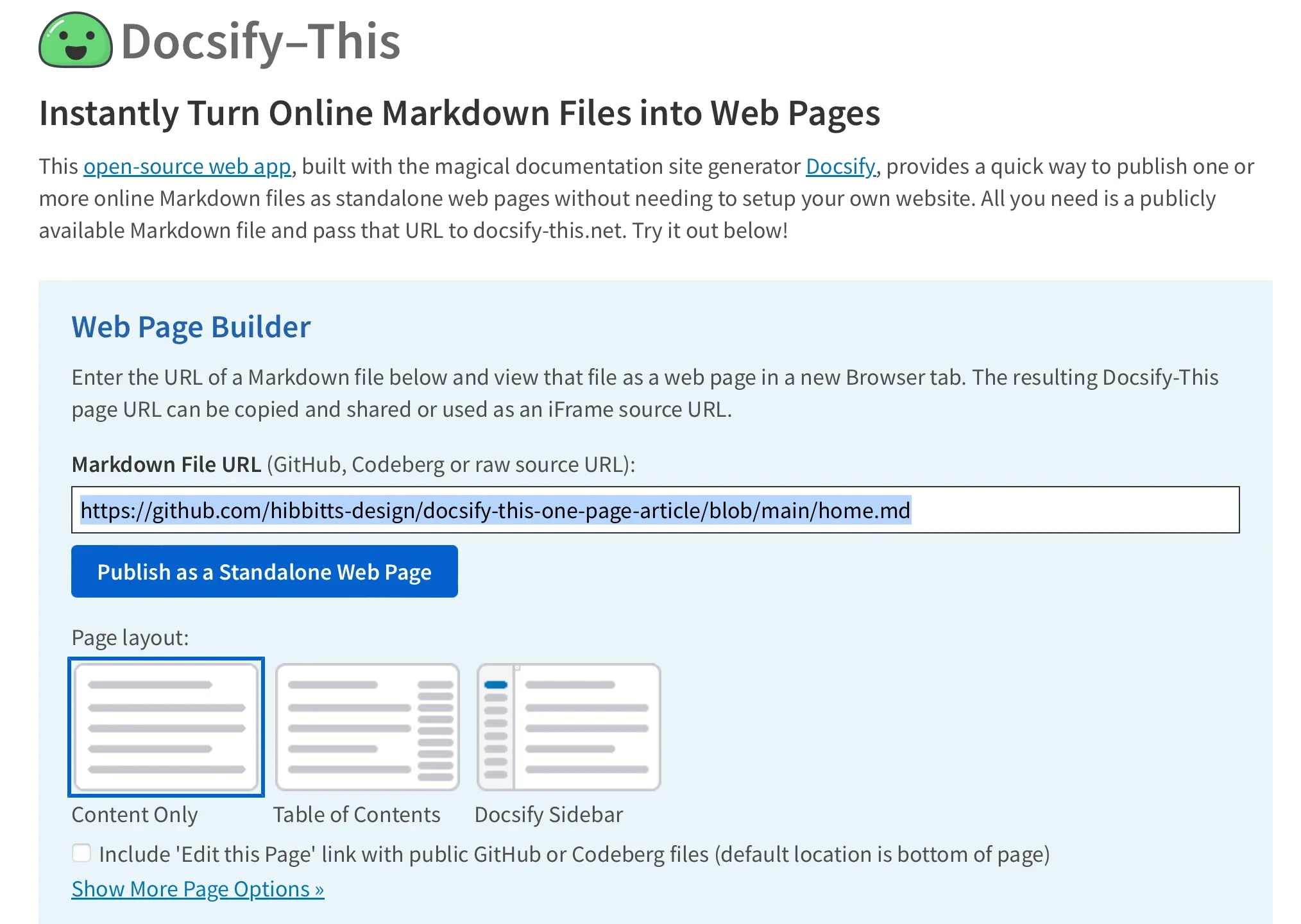
Docsify-This bridges this usability gap. By utilizing a URL-based parameter system paired with a web page builder interface, the project allows any publicly accessible Markdown file hosted on platforms like GitHub or Codeberg to be transformed into a responsive, standalone web page instantaneously. The architecture relies on client-side rendering via Docsify.js, meaning that the source file remains untouched while the presentation layer is dynamically generated on the fly.

Core Architecture and Web Page Builder Mechanics
At its core, Docsify-This operates by parsing a base repository path and a target homepage file via URL parameters. For instance, a standard deployment directs the application to a raw GitHub URL containing the Markdown text. The service then renders this file inside a clean, modern template complete with responsive typography and layout handling.
The utility provides a straightforward Web Page Builder interface hosted directly on its platform. Users simply input the URL of a public repository file, click a generation button, and receive a fully functional, shareable web link. Beyond single-page views, creators can link multiple Markdown files within a repository to construct cohesive, multi-page web documentation without managing server-side routing.
Furthermore, version control integration remains a central pillar of the project. By anchoring content in Git repositories such as Codeberg or GitHub, authors can automatically append an "Edit this Page" link to the rendered output. This feature transforms static reading material into a collaborative workspace, enabling peers, students, or colleagues to propose edits directly through pull requests or repository forks. Because the project is open source, organizations can deploy their own independent instances of Docsify-This, mitigating the risks of vendor lock-in and ensuring long-term data sovereignty.
Customization Through URL Parameters and CSS Classes
One of the most powerful aspects of Docsify-This is its granular control over visual presentation. Traditional Markdown renderers often lock users into a predefined stylesheet, forcing developers to hack global CSS files to achieve desired branding. Docsify-This circumvents this limitation by accepting standard CSS attributes directly through URL query strings.
Content managers can dynamically modify typography and layout metrics by appending parameters such as font-family, font-size, link-color, and line-height directly to the web address. For example, injecting a specific font family parameter ensures that external documentation inherits the exact aesthetic of a parent organization’s portal.
In addition to global URL parameters, Docsify-This supports specialized Markdown CSS classes that extend standard syntax formatting. Authors can transform ordinary hyperlinks into styled interactive elements, such as buttons, by appending class tags directly within the Markdown link syntax. For advanced use cases, creators can embed custom <style> blocks directly inside their Markdown files, defining bespoke CSS rules that alter the visual hierarchy, margins, and color palettes of specific sections without leaving the text editor.
Standard HTML snippets, including multi-column layout wrappers and structural division tags (<div>), are also fully supported. This compatibility ensures that content creators are not strictly bound by the limitations of basic Markdown, allowing for the integration of complex grid systems and layout elements when necessary.
Seamless Integration with Learning Management Systems and iFrames
While standalone web publication is a primary use case, Docsify-This was engineered with platform interoperability in mind. Modern digital ecosystems—particularly in higher education and enterprise training—rely heavily on Learning Management Systems (LMS) such as Moodle, Canvas, and Blackboard. These platforms are notorious for restrictive text editors and cumbersome content updating workflows.
Docsify-This solves this integration challenge through two primary mechanisms: iFrame embedding and external URL redirection.
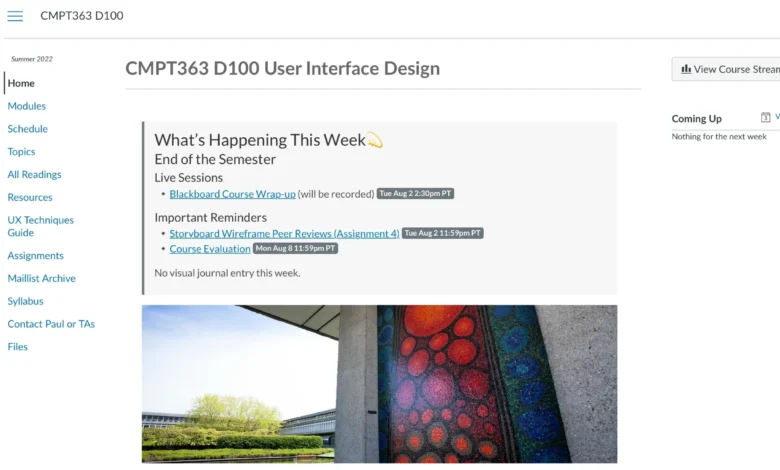
Using HTML iFrame tags, administrators can embed a fully rendered Docsify-This web page directly into an LMS course module or CMS page. Because the content is pulled dynamically from a Git repository, updating a syllabus, assignment guideline, or resource list requires only a quick edit to the underlying Markdown file in GitHub. The changes reflect immediately within the LMS or corporate portal, eliminating the tedious cycle of exporting, uploading, and linking static documents or PDF files.
Moreover, advanced LMS integrations are possible using external navigation tools. In platforms like Canvas, administrators can leverage the Redirect Tool to link external web pages directly to course navigation menus. By passing a specialized Docsify-This URL string equipped with custom font scaling and hidden credits parameters, educators can present external Git-backed documentation as native course modules, vastly improving the user experience for students.
Workflow Integration and Version Control Ecosystems
The operational efficiency of Docsify-This is maximized when paired with modern text editing and version control ecosystems. Because the platform relies on standard Markdown files stored in Git repositories, authors can choose from a wide array of open-source and proprietary tools to draft and manage their content.

Developers and technical writers frequently utilize advanced code editors like Visual Studio Code or Pulsar Edit, both of which feature robust, built-in Git integrations. For non-technical contributors who may find command-line Git intimidating, graphical user interface (GUI) clients provide an approachable alternative. Tools such as GitHub Desktop, Git-Cola, and SparkleShare allow users to commit, push, and pull changes to their Markdown repositories with simple point-and-click actions.
This democratization of version control brings the benefits of collaborative writing—such as change tracking, rollback capabilities, and distributed authorship—to demographics that historically relied on desktop word processors and shared cloud drives.
Industry Implications and Future Outlook
The introduction and refinement of tools like Docsify-This signal a broader architectural shift in how lightweight content is distributed across heterogeneous digital environments. As organizations increasingly move toward decoupled architectures and modular software stacks, the ability to manage content as plain text while retaining high-fidelity visual presentation becomes an invaluable asset.
For educational institutions, the adoption of Git-backed Markdown publishing reduces administrative overhead and aligns with open-educational-resource (OER) initiatives. Instructors can collaboratively author textbooks or course modules, version them semester by semester, and distribute them seamlessly across multiple learning platforms without proprietary software restrictions.

For enterprise environments, Docsify-This offers a lightweight alternative to cumbersome internal wikis and knowledge bases. Teams can maintain technical documentation, standard operating procedures, and onboarding guides in a shared repository, rendering them dynamically inside internal corporate intranets or project management tools like Notion, Jira, or custom dashboards.
As open-source projects continue to prioritize interoperability and user-centric design, tools that remove friction from digital workflows will undoubtedly shape the future of online publishing. By transforming basic text files into dynamic, responsive, and easily embeddable web assets, Docsify-This demonstrates that powerful web publishing does not require complex infrastructure—only the right abstraction layer.
Related posts: