Poly Duo Brings ChatGPT and Claude Together on Mobile Devices to Combat Artificial Intelligence Hallucinations

The landscape of generative artificial intelligence has fundamentally transformed how millions of individuals work, study, and solve complex problems. However, a persistent challenge continues to plague even the most advanced large language models: the phenomenon of confident hallucinations. Artificial intelligence applications routinely present incorrect, misleading, or entirely fabricated information with an absolute tone of certainty, leaving users vulnerable to errors unless they independently cross-reference outputs across multiple platforms. To address this friction in daily digital workflows, independent artificial intelligence researcher and doctoral holder Vadym Chernets has introduced Poly Duo, a lightweight iOS shortcut and mobile utility designed to synchronize ChatGPT and Claude seamlessly on a single device with a single tap.
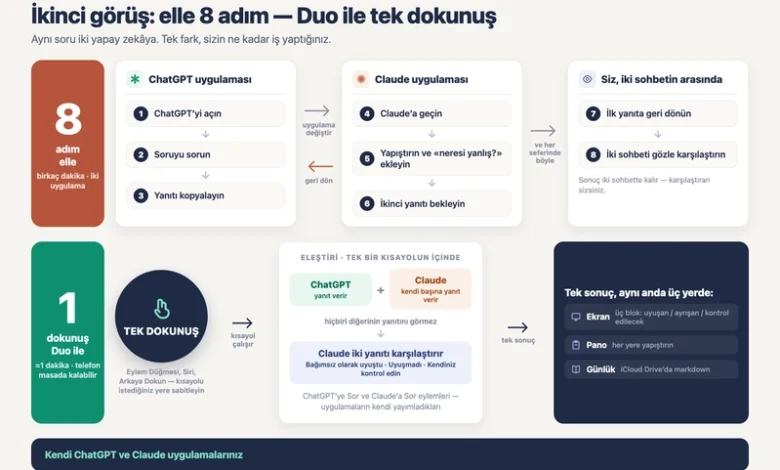
The genesis of Poly Duo stems from empirical research regarding the reliability of artificial intelligence evaluations, which Chernets presented at NeurIPS 2026 workshops. The core finding of this academic investigation is straightforward yet profound: a single artificial intelligence model’s internal self-confidence metrics provide virtually no reliable indication of whether its generated response is objectively accurate. When users rely solely on one model, they risk accepting flawed reasoning masked by polished prose. While experienced users previously had to manually copy prompts, open a secondary application from a competing developer, and paste the text to verify facts—a cumbersome process that is frequently abandoned during moments of urgency—Poly Duo automates this cross-examination protocol directly on consumer hardware.
Operating the utility requires minimal technical setup. Designed for iPhones running iOS 18 or newer, the application operates by taking a single user query and dispatching it concurrently to both OpenAI’s ChatGPT and Anthropic’s Claude. Crucially, neither model views the other’s response prior to generating its own independent output. Once both systems formulate their answers, the utility compiles and contrasts the results, delivering a concise three-line synthesized summary in approximately one minute. If both industry-leading models align in their conclusions, the statistical probability of factual correctness increases dramatically; conversely, if the models diverge, the discrepancy becomes immediately apparent before the user acts upon potentially erroneous guidance.

The practical implications of this dual-model verification span numerous professional and personal scenarios. Consider high-stakes decision-making, such as evaluating a complex employment offer featuring a twenty percent salary increase offset by a ninety-minute daily commute in each direction. Querying a single artificial intelligence model might yield a biased or overly optimistic assessment focused strictly on financial metrics. By deploying Poly Duo, users receive a multi-faceted critique that simultaneously weighs lifestyle degradation, long-term career trajectories, and hidden logistical costs. Similarly, software engineers debugging intricate code blocks, researchers synthesizing historical timelines, and financial analysts reviewing market data benefit heavily from receiving parallel independent analyses without enduring the tedious overhead of manual copy-pasting between separate applications.
Technical prerequisites for utilizing Poly Duo remain remarkably accessible. The utility requires an iOS device running iOS 18 or later—such as an iPhone 14 or newer—alongside standard, free-tier accounts for both the ChatGPT and Claude mobile applications. Users who already subscribe to premium tiers, such as ChatGPT Plus or Claude Pro, experience uninterrupted integration, as Poly Duo automatically leverages the advanced underlying reasoning models tied to their existing subscriptions. Furthermore, queries are processed in the user’s native language, ensuring that both artificial intelligence engines respond appropriately without requiring secondary translation steps. For transparency-focused communities, the underlying codebase remains fully open-source and accessible via GitHub, allowing independent developers to inspect, audit, and verify the tool’s security architecture.
The empirical foundation supporting Poly Duo is anchored in rigorous data analysis conducted on flagship models. According to Chernets’s research dataset—which re-analyzed responses across 1,459 factual queries utilizing benchmark architectures—when flagship models from OpenAI and Anthropic generated independent answers and reached a consensus, their collective output demonstrated a ninety-eight percent accuracy rate, reducing confident hallucinations by more than half compared to single-model deployments. Conversely, mid-tier models demonstrated significantly lower reliability, agreeing on incorrect answers with alarming frequency. This stark performance gap underscores the necessity of pairing robust, top-tier architectures rather than relying on generalized redundancy. Subsequent post-hoc evaluations conducted in late October 2026 on unreleased test suites reaffirmed these findings, demonstrating a ninety-seven percent accuracy rate across matching responses from advanced iterations including GPT-6.1 Sol and Claude Opus 5.5.
As artificial intelligence integration deepens across mobile operating systems, tools like Poly Duo represent a critical evolution in how humans interact with machine intelligence. By moving away from blind reliance on isolated proprietary chatbots and embracing decentralized, multi-model verification frameworks, users gain a reliable digital safeguard. The utility is currently available as a free shortcut for iOS users via dedicated deployment links, with complementary builds accessible on Android and TestFlight beta channels. Through academic rigor translated into practical consumer software, Poly Duo bridges the gap between raw computational capability and everyday operational trust.
Related posts: