Rust AI Development Moves Toward Mainstream Practicality with the Rig Framework

The landscape of artificial intelligence development is undergoing a significant shift as specialized ecosystems mature beyond the experimental phase and into production-grade infrastructure. A primary catalyst in this transition is the emergence of robust tooling within the Rust programming language, which is increasingly favored for its memory safety, performance, and concurrency capabilities. Central to this evolution is the recent collaboration between the Rust Foundation and JetBrains, which aims to provide developers with a structured roadmap for building AI-integrated applications. This partnership recently highlighted the Rig library, an open-source framework designed to abstract the complexities of interacting with disparate Large Language Model (LLM) providers, effectively standardizing the developer experience for AI-native software.
The Chronology of Rust’s AI Integration
For years, Python has maintained a near-monopoly on AI research and development due to its extensive library ecosystem. However, as the industry pivots toward deploying AI in high-performance production environments, the limitations of Python’s global interpreter lock and runtime overhead have pushed engineers toward Rust.
The timeline of this transition accelerated in late 2024 and early 2025, as major organizations began moving away from "proof-of-concept" LLM wrappers toward sophisticated agentic workflows. JetBrains, recognizing the growing demand for reliable Rust-based AI tools, initiated a livestream series in late 2025 to bridge the gap between theoretical Rust performance and practical AI application development. This series serves as a public knowledge base, showcasing how libraries like Rig—maintained by 0xPlaygrounds—provide the necessary scaffolding for complex, stateful AI interactions.
The Technical Challenge: Provider Fragmentation
Modern AI applications rarely rely on a single model. Developers often find themselves toggling between OpenAI’s GPT-4, Anthropic’s Claude, and Google’s Gemini, each of which presents a unique API contract. While many providers attempt to maintain "OpenAI-compatibility," subtle differences in response structures, rate-limiting, and error handling often break applications that are not built with abstraction in mind.
Rig addresses this fragmentation by introducing a unified interface. By implementing a common abstraction layer, Rig allows developers to switch between various LLM backends with minimal code refactoring. This is a critical development for enterprise-level applications, where the ability to rotate models based on cost, performance, or privacy requirements—without re-engineering the core application logic—is a primary architectural goal.
Anatomy of an AI Agent in Rust
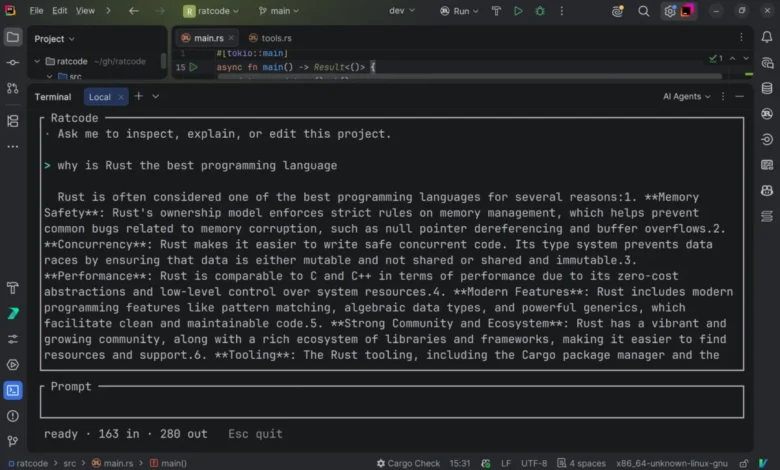
At the recent industry showcase, JetBrains Developer Advocate Orhun Parmaksız demonstrated the practical application of these principles through a project dubbed "Rat Code." This terminal-based agent, built with the Ratatui terminal UI library and the Rig framework, illustrated the modular nature of contemporary AI software.
The architecture of such an agent typically consists of four pillars:

- The Provider Client: A persistent connection handler that manages authentication and networking with the LLM API.
- The Completion Model: The core engine that processes inputs and generates tokens, configured within the agent’s specific constraints.
- The Agentic Wrapper: A logic layer that provides a "preamble" or system prompt, which dictates the agent’s behavior and operational boundaries.
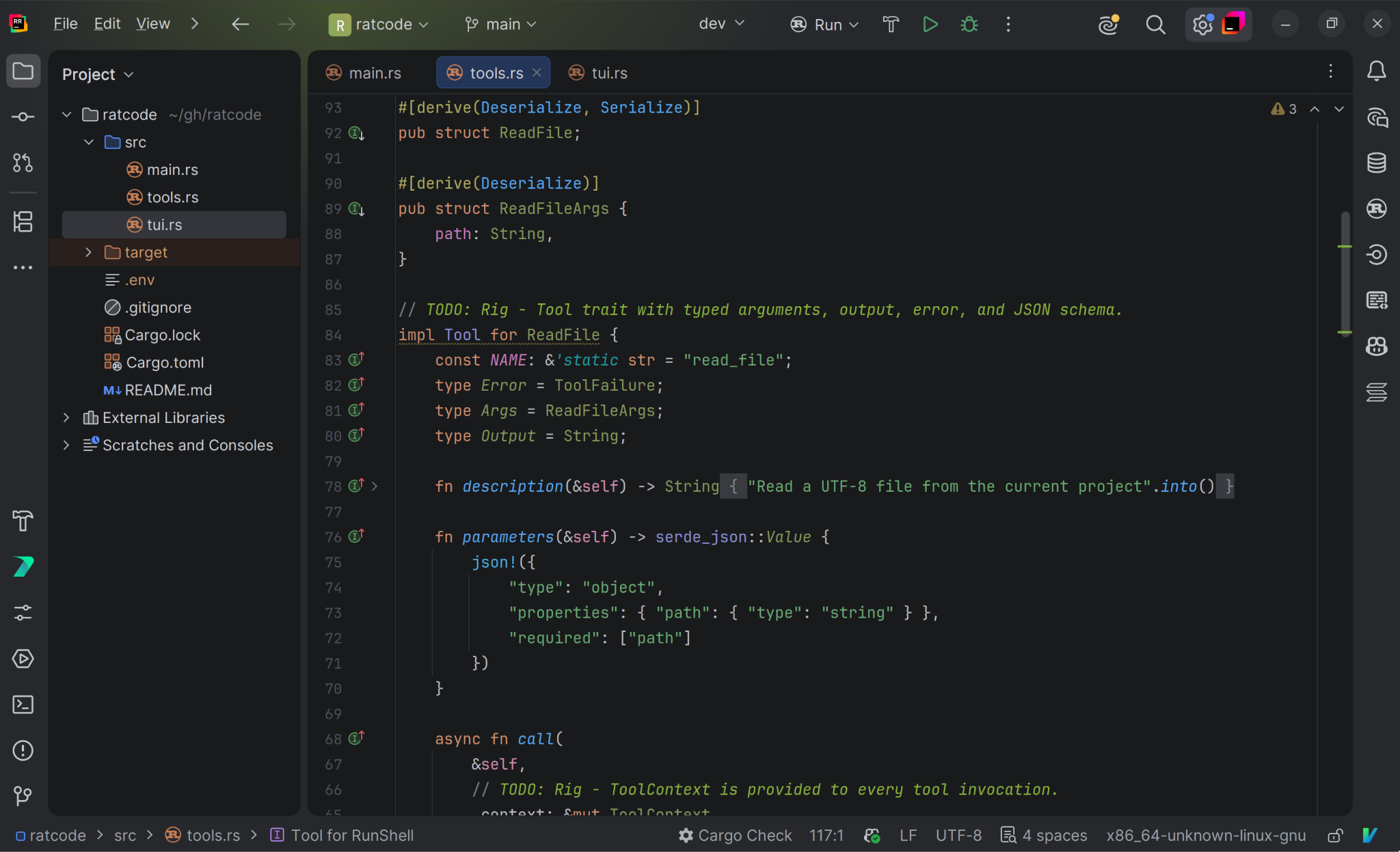
- Tool Interfaces: The mechanisms through which the LLM interacts with the host operating system, such as reading files, executing shell commands, or querying local databases.
Stephen Korzeniewski, Lead Maintainer of Rig, emphasizes that the "agent" is effectively an abstraction layer that sits atop the LLM, managing state, token limits, and tool-calling capabilities. By utilizing Rust’s strictly typed Tool trait, developers can define functions that the model can invoke to perform real-world tasks, transforming the model from a simple text generator into an autonomous worker.
Data Handling and Retrieval-Augmented Generation (RAG)
One of the most significant challenges in building production AI is grounding the model in proprietary data. Rig addresses this through comprehensive abstractions for Retrieval-Augmented Generation (RAG). By integrating with vector databases, Rig enables applications to retrieve contextually relevant information before sending a request to the LLM.
This functionality is increasingly important as companies move away from fine-tuning models—which is resource-intensive and often leads to catastrophic forgetting—toward RAG, which provides real-time access to accurate, up-to-date data. Rig’s support for vector store abstractions allows developers to plug in various databases, ensuring that the AI has access to the correct knowledge base without the need for custom, proprietary data pipelines.
Localized Inference and Edge Deployment
The drive for privacy and reduced latency has spurred interest in running models locally. The integration of rig-candle is particularly notable in this regard. Candle, a minimalist ML framework for Rust, allows developers to embed model weights directly into their binaries. This capability permits the execution of inference without the need for an external API or a heavy inference server, making it possible to ship AI-powered applications that function in offline or highly restricted environments.

By leveraging WebAssembly (Wasm) and local inference, developers can effectively distribute AI capabilities at the edge. This represents a departure from the "cloud-only" paradigm of the last two years, aligning with the broader industry trend of decentralizing intelligence.
Testing and Validation in a Non-Deterministic Environment
Perhaps the most daunting task in AI development is maintaining quality assurance when the underlying model is non-deterministic. Traditional unit testing is ill-suited for LLMs, as the same input can yield vastly different outputs depending on the model’s temperature or updates to the provider’s backend.
Rig employs a "cassette" system for testing, a technique borrowed from HTTP request recording. By capturing the interaction between the application and the provider as YAML files, Rig allows developers to replay these interactions in a CI/CD environment. This ensures that the application’s logic—its ability to parse responses, manage tools, and handle errors—remains robust even if the model provider updates its internal parameters. While these tests do not measure the "quality" of the generated text, they are essential for verifying the reliability of the integration, allowing teams to ship with higher confidence.
Broader Implications for the Software Industry
The rise of Rust-based AI tools like Rig signals a maturation of the AI software development lifecycle. By moving away from the "scripting" mindset that defined early LLM integration, the industry is entering an era of software engineering where AI is treated as a first-class citizen in the application stack.
The primary implication of this shift is an increase in software reliability and scalability. Rust’s compiler-enforced safety guarantees ensure that as AI agents grow in complexity, they remain predictable and manageable. Furthermore, the performance benefits of Rust enable developers to build agents that are significantly faster and more resource-efficient than their Python counterparts.
As the Rust Foundation continues its collaboration with industry leaders like JetBrains, we can expect to see an expansion of these frameworks. The focus is shifting from simply "connecting to an API" to "architecting intelligent systems." For developers, this necessitates a deeper understanding of concurrency, memory management, and asynchronous programming—the very strengths that have made Rust a powerhouse in systems engineering for over a decade.
Conclusion and Outlook
The integration of Rig into the Rust ecosystem provides a necessary bridge for developers who wish to build production-grade AI applications without sacrificing the performance and safety for which Rust is known. By standardizing the interface between models, tools, and databases, Rig lowers the barrier to entry for building complex, agentic systems.
The ongoing series by the Rust Foundation and JetBrains remains an essential resource for those looking to keep pace with these developments. As the tooling continues to evolve, the distinction between "AI software" and "traditional software" is likely to fade, replaced by a new standard where intelligent capabilities are simply an expected feature of any robust application architecture. For organizations looking to leverage the power of LLMs while maintaining the stringent standards of enterprise software, the transition to a Rust-based AI stack appears not just as a trend, but as a strategic necessity.