In the modern digital economy, the difference between a high-performing application and a stagnant one often hinges on the ability to make rapid, evidence-based improvements. Organizations frequently find themselves paralyzed by the tension between "gut-feeling" intuition and the lack of concrete production data. To bridge this gap, Amazon Web Services (AWS) has introduced AWS AppConfig experimentation, a new capability within AWS Systems Manager that empowers developers and product managers to conduct sophisticated A/B testing on live production traffic without the need for complex, separate testing platforms.
The introduction of this tool marks a significant shift in how engineering teams manage feature releases and performance tuning. Historically, testing was confined to development or staging environments, which often failed to capture the nuances of real-world user behavior or the complexities of large-scale production workloads. By enabling controlled, slice-based experimentation directly within the AWS ecosystem, teams can now validate hypotheses regarding user interface changes, backend optimizations, and even AI model behavior with empirical precision.
The Problem with Intuition-Based Development
For years, the standard deployment model involved releasing code to all users simultaneously or utilizing rigid, binary feature toggles. While these methods allow for rapid delivery, they inherently carry the risk of widespread disruption if a change, such as a redesigned checkout button or a modified cache time-to-live (TTL), negatively impacts user experience or system performance. When teams lack a mechanism to measure these changes against a control group, decisions often devolve into internal debates based on subjective preference rather than measurable outcomes.
AWS AppConfig experimentation solves this by allowing teams to define a hypothesis, segment their audience, and serve different versions of a feature to specific groups. By using the AWS AppConfig Agent, which operates at the edge of the compute environment, the platform ensures that the right treatment is delivered consistently to each user. This process is inherently safer, as it provides a middle ground between the isolation of a test environment and the full-scale exposure of a production rollout.
Architecture and Operational Workflow
At its core, the AWS AppConfig experimentation framework leverages the existing AWS AppConfig infrastructure, which functions as the control plane. This design choice is critical for enterprise adoption; it ensures that there is no separate, third-party platform to stand up or secure. The architecture relies on three distinct runtime responsibilities: delivery, measurement, and safety.
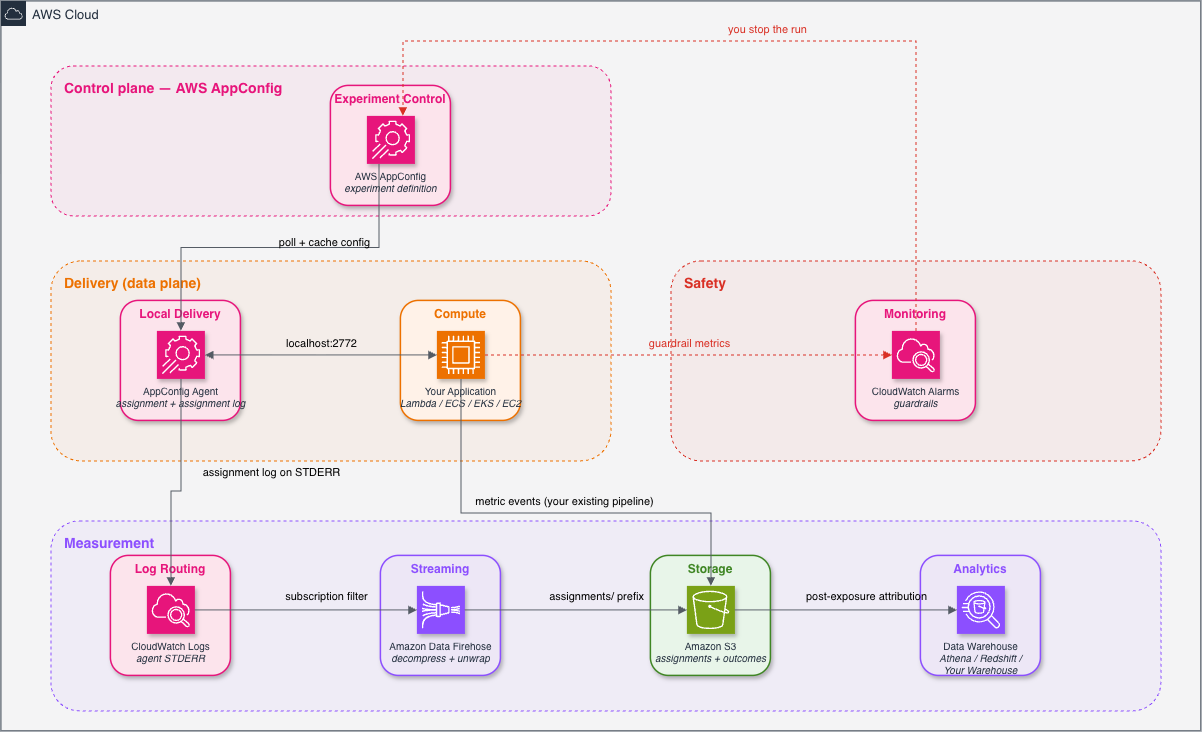
- Delivery: The AWS AppConfig Agent, running locally in the compute environment (ECS, EKS, EC2, or Lambda), receives the flag value and ensures that the user receives the assigned variant.
- Measurement: Instead of forcing users into a proprietary analytics silo, the system allows for the logging of treatment assignments to an existing data warehouse. Whether a team uses Amazon Athena, S3, Redshift, or Snowflake, the data remains under their direct control.
- Safety: Through the integration of Amazon CloudWatch alarms, teams can set automated guardrails. If an experiment triggers a spike in 5xx error codes or a degradation in latency, the experiment can be paused or rolled back, protecting the broader user base.
Implementing Frontend and Backend Experiments
The flexibility of the system is best illustrated through two distinct use cases: frontend user interface design and backend infrastructure optimization.
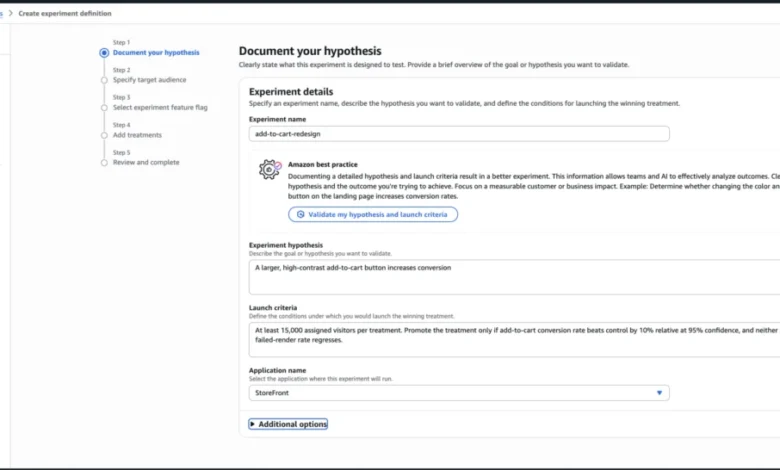
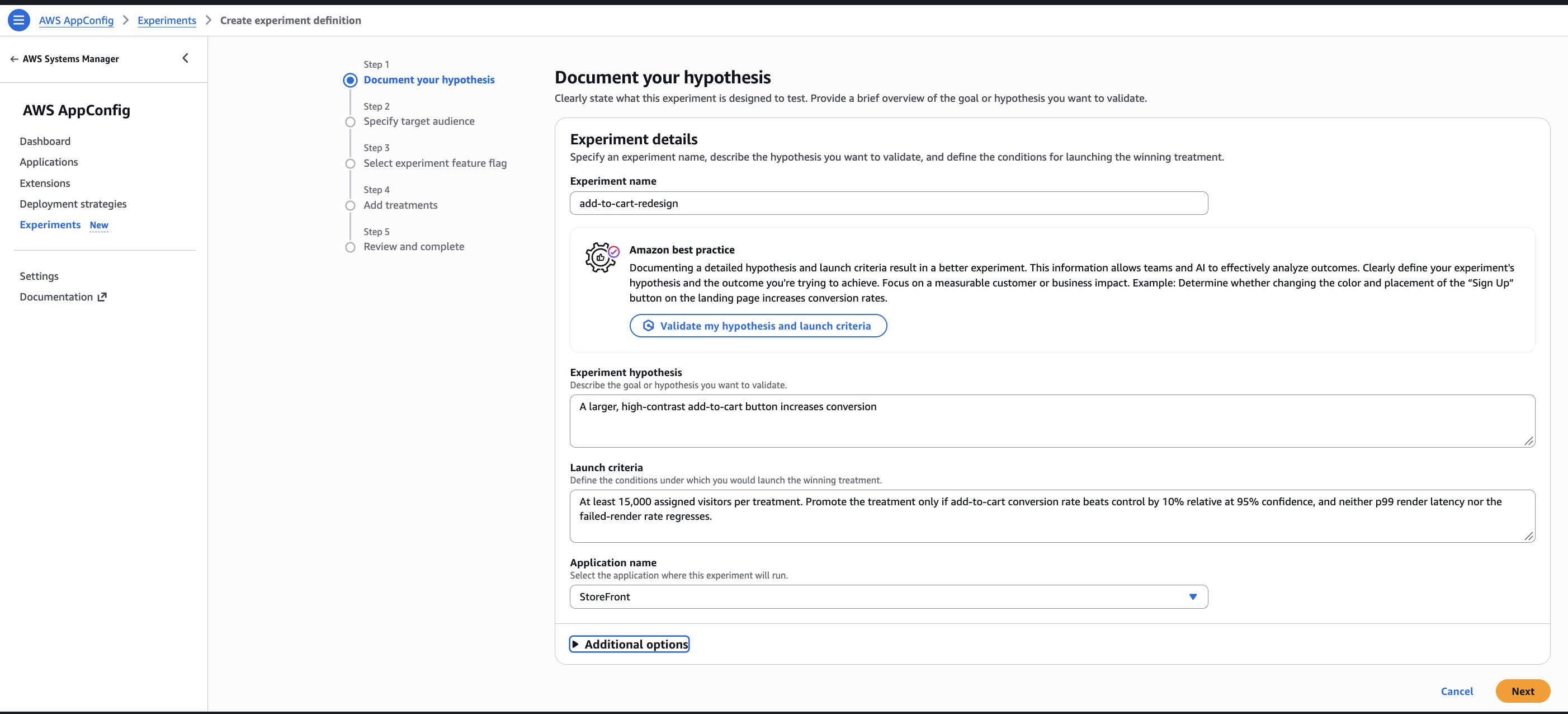
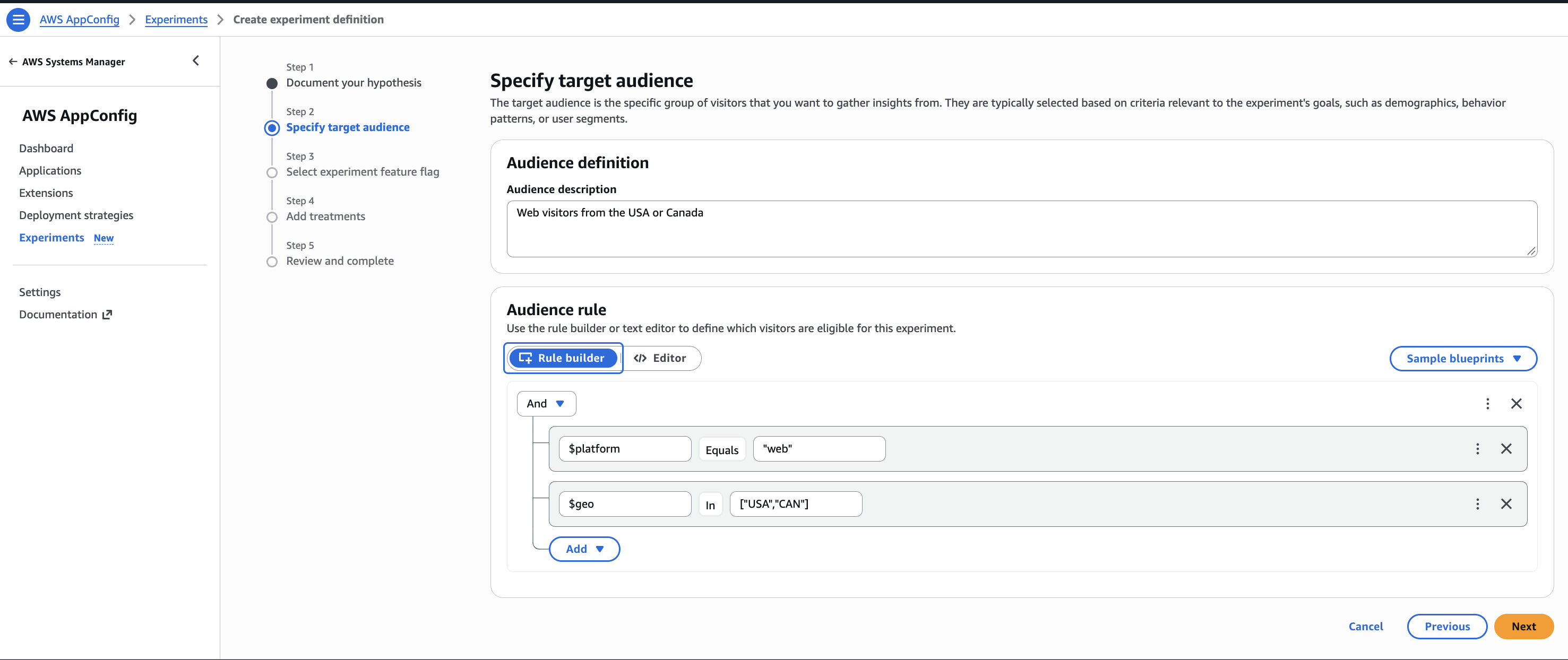
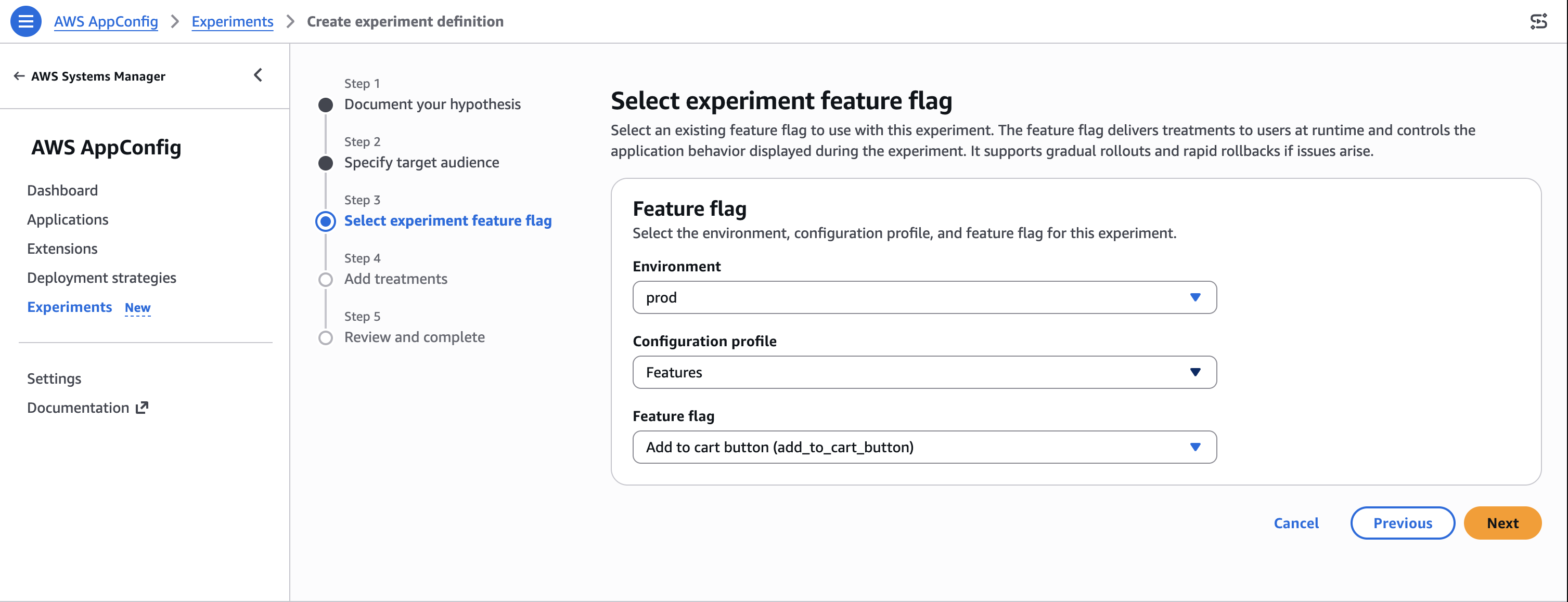
In the frontend scenario, a team might want to test a new "Add to Cart" button design. By defining an experiment in the AWS AppConfig console, the team can create a control group (the current button) and a treatment group (the new design). The console offers AI-assisted design validation, ensuring that the experiment is set up according to best practices—such as ensuring a statistically significant traffic split—before the run begins.
Conversely, for backend experiments, such as tuning cache TTL settings for a product catalog service, the unit of assignment shifts from the user to the service instance. By using the task ID as the entity identifier, developers can ensure that individual service instances maintain a consistent configuration, allowing for a pure comparison of how different TTL values affect database load and cache hit rates. This level of granularity is essential for performance-critical systems where even minor misconfigurations can have downstream impacts on database stability.
The Importance of Post-Exposure Attribution
A common pitfall in A/B testing is "pre-exposure bias," where data from users who have not yet been assigned to a treatment is included in the analysis. AWS AppConfig experimentation addresses this by emphasizing post-exposure attribution. By joining assignment records—emitted by the Agent via STDERR—with business outcome data using a shared entity identifier, developers can ensure that only events occurring after the assignment are counted.
This analytical rigor is further supported by the ability to export assignment logs to Amazon S3 using Amazon Data Firehose. By utilizing processors like Decompression and DataMessageExtraction, teams can normalize their logs into a clean, queryable format. This enables the use of standard SQL queries in Amazon Athena to calculate conversion rates, latency metrics, or revenue per user, providing a clear "winner" without the bias often found in less rigorous testing frameworks.
Safety Guardrails and Financial Considerations
Experimentation is an inherently risky activity, which is why AWS has built safety into the lifecycle of the experiment. The "0% exposure" window is a vital phase of the process. Before any production traffic is routed to the treatment, engineers can use overrides to pin specific QA entities to a treatment. This allows for final validation of the user experience and logging pipeline.
Once the run starts, the incremental ramp-up strategy—moving from 1% to higher percentages—ensures that if an error occurs, the blast radius is contained. Furthermore, the use of CloudWatch alarms serves as a "circuit breaker." It is imperative that teams define what "unhealthy" looks like before they initiate a run. Whether it is monitoring CPU utilization, request latency, or error rates, the integration of these alarms provides the confidence necessary to conduct experiments on critical systems.
From a cost perspective, AWS AppConfig experimentation is billed per experiment-run hour. This encourages teams to be strategic with their testing duration. By estimating the required sample size beforehand and utilizing the 0% validation window, organizations can minimize costs while maximizing the quality of their findings. The removal of an experiment is equally streamlined, with clear CLI commands to archive definitions and purge logs, ensuring that technical debt is not accumulated alongside the findings.
Broader Implications and Industry Impact
The introduction of this tool reflects a broader trend in software engineering: the transition toward "Progressive Delivery." As organizations move away from monolithic, infrequent releases, the ability to test in production has become a competitive necessity. By democratizing access to A/B testing, AWS is enabling developers to act more like data scientists, moving beyond the question of "Does this code work?" to "Does this code improve our business outcomes?"
Industry analysts suggest that companies utilizing such experimentation frameworks see higher rates of successful feature adoption and lower rates of production incidents. By treating every feature as a hypothesis to be validated, rather than a certainty to be shipped, engineering teams can foster a culture of continuous improvement. The ability to integrate this into existing workflows—without the friction of adopting new, external SaaS tools—lowers the barrier to entry significantly.
Conclusion
The evolution of AWS AppConfig from a simple feature-flagging tool to a robust experimentation platform represents a major leap forward for DevOps teams. By providing a secure, scalable, and data-agnostic framework, AWS has provided the infrastructure needed to turn "we think" into "we know." Whether a team is looking to improve conversion rates on a web store or optimize the cache efficiency of a distributed backend, the tools for rigorous, empirical testing are now integrated into the standard AWS development lifecycle.
For organizations looking to scale, the recommendation is clear: start with small, well-defined experiments using the console, ensure that the logging pipeline is robustly configured to an analytics destination of choice, and prioritize safety through automated guardrails. As the organization matures, the ability to script these experiments via the AWS CLI and integrate them into continuous integration and continuous deployment (CI/CD) pipelines will become a hallmark of a high-velocity, data-driven engineering culture. The future of software development is not just about writing code; it is about proving the value of that code through the lens of real-world, production-verified performance.