Fine-Tuning vs. Frozen Embeddings: When to Adapt the LLM vs. the Sklearn Head

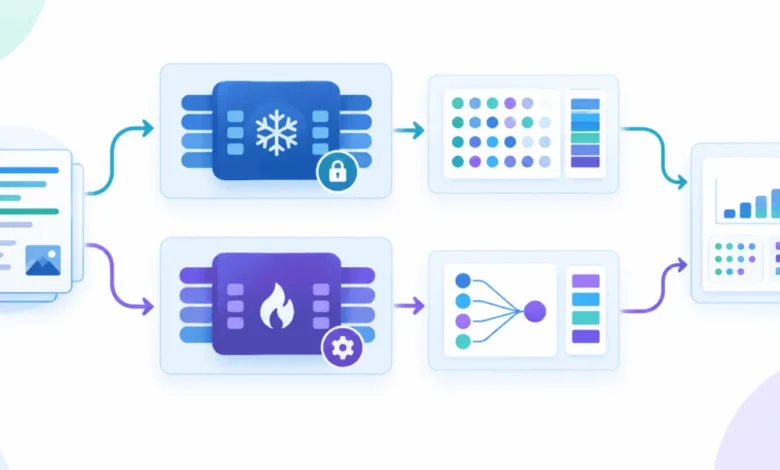
The rapid proliferation of large language models (LLMs) has fundamentally altered the landscape of natural language processing (NLP). As businesses and developers look to integrate these powerful architectures into domain-specific applications, they are frequently confronted with a strategic dilemma: should they invest in the computational intensity of full-parameter or parameter-efficient fine-tuning, or should they leverage the model as a static feature extractor? This decision-making process is no longer just a matter of technical preference; it is a critical calculation of cost, latency, performance, and scalability.
The Evolution of Model Adaptation
Historically, the machine learning community relied on fine-tuning as the gold standard for adapting pre-trained neural networks to new tasks. By updating the weights of a model on a domain-specific dataset, engineers could force the architecture to internalize the nuances of specialized jargon, proprietary document formats, or niche sentiment analysis. However, as the parameter counts of modern LLMs have ballooned from millions to hundreds of billions, the "fine-tuning by default" approach has become increasingly prohibitive.
The emergence of parameter-efficient fine-tuning (PEFT) methods, specifically Low-Rank Adaptation (LoRA), provided a middle ground. By freezing the majority of the model’s weights and injecting trainable rank-decomposition matrices into transformer layers, LoRA allows for adaptation with a fraction of the original parameter count. Concurrently, the rise of "frozen embedding" strategies—where the LLM acts as a static vectorizer feeding into a classical machine learning classifier, such as a Random Forest or Support Vector Machine—has gained traction in enterprise environments prioritizing low-latency deployment and minimal compute footprints.
Comparative Analysis: The Two Methodologies
The choice between these two paradigms hinges on the specific objectives of the deployment. Strategy A, utilizing frozen embeddings, treats the LLM as a sophisticated feature extraction engine. The model is kept in an evaluation-only state, meaning its weights remain constant regardless of the incoming data. The embeddings generated by the final hidden state of the model are then used to train a secondary, lightweight classifier. This method is often favored for its simplicity and the ability to iterate rapidly on the classification head without the need for backpropagation through the massive transformer backbone.
Strategy B, centered on QLoRA (Quantized Low-Rank Adaptation), takes a more invasive approach. By quantizing the base model to 4-bit precision to reduce memory overhead and applying LoRA adapters, developers can fine-tune the model to adjust its internal representations to the target domain. This method inherently requires more GPU cycles, higher power consumption, and a more complex training pipeline, but it offers the potential for higher classification accuracy and a deeper understanding of domain-specific syntax.
Empirical Performance and Computational Costs
In recent controlled trials using the AG News dataset—a standard benchmark for topic classification—the trade-offs between these two approaches became clear. When employing a frozen model (such as the Qwen2.5-1.5B architecture), the time required for feature extraction is substantial, often dominated by the inference latency of the LLM. However, the subsequent training of a Scikit-learn Random Forest classifier is almost instantaneous. In testing, this pipeline achieved approximately 82% accuracy.
Conversely, applying QLoRA fine-tuning resulted in a marked improvement, yielding an 87% accuracy rate. While the 5% performance gain is statistically significant in high-stakes environments, the computational cost was roughly three times higher in terms of training duration. These figures highlight a critical threshold: if an application demands 90%+ accuracy, the investment in fine-tuning is mandatory. However, if the business case allows for a minor performance deficit in exchange for rapid, cost-effective updates, the frozen embedding approach provides a superior ROI.
Chronology of Implementation
The implementation timeline for these two strategies differs significantly. For a frozen embedding workflow, the process is linear:
- Model Loading: Deploying the pre-trained LLM in an evaluation configuration.
- Feature Extraction: Passing the corpus through the model to capture hidden states, often requiring batch processing to manage memory.
- Downstream Training: Fitting a classical algorithm on the resulting vector space.
- Deployment: Serving the static model alongside the classifier.
In contrast, the fine-tuning lifecycle involves a more iterative, high-touch process:
- Adapter Attachment: Configuring the PEFT/LoRA wrapper around the base architecture.
- Hyperparameter Tuning: Determining optimal learning rates, ranks, and dropout values to prevent catastrophic forgetting.
- Epoch-Based Training: Running the trainer, which requires careful monitoring of loss curves to ensure the model is converging correctly.
- Integration: Merging the adapter weights with the base model for inference.
Broader Implications for Enterprise AI
The implications for industry practitioners are twofold. First, the "one-size-fits-all" approach to LLM deployment is rapidly becoming obsolete. Organizations must perform a cost-benefit analysis before committing to a fine-tuning strategy. For tasks involving simple classification or sentiment analysis where the base model’s pre-training already covers the vocabulary, the frozen embedding method is not just "good enough"—it is the architecturally superior choice due to its stability and reduced susceptibility to overfitting.
Second, the rise of modular AI architectures suggests a future where the LLM is treated as a foundational "backbone" utility, while specific domain knowledge is handled by a variety of interchangeable "heads" or adapters. This modularity allows companies to pivot quickly. If a new product line is launched, a firm could theoretically swap the classification head or the adapter in a matter of hours, rather than re-training a massive model from scratch.
The Verdict on Future Deployments
As the field progresses, the distinction between these methods will likely blur. We are already seeing the emergence of "hybrid" architectures where frozen embeddings are used for real-time inference, while periodic "fine-tuning bursts" are applied to update the model’s core knowledge base.
Ultimately, the decision to fine-tune versus using frozen embeddings should be governed by the specific requirements of the application’s environment. When the goal is to build cost-friendly, compute-constrained applications that prioritize operational stability, the frozen embedding approach remains an underutilized and highly effective tool. When the goal is to extract every possible percentage point of accuracy from a dataset, particularly when the data contains highly specialized language that the model has not encountered during pre-training, QLoRA is the standard-bearer for success.
As of late 2026, the consensus among data scientists is shifting toward a tiered strategy: start with frozen embeddings to establish a baseline, assess the performance gap, and only invest in the significant computational overhead of fine-tuning if the delta in performance justifies the increase in technical debt and operational expense. This disciplined approach ensures that resources are allocated where they deliver the most value, keeping enterprise AI deployments both performant and sustainable in a competitive, resource-constrained market.