Mastering Python Descriptors for Advanced Attribute Control and Data Integrity

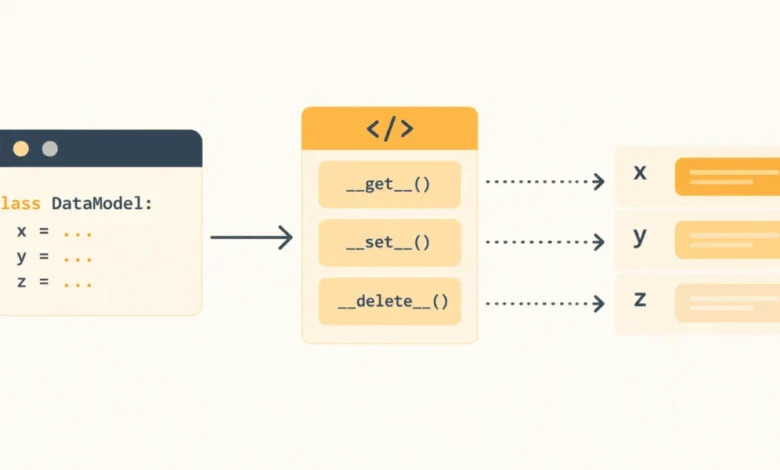
The evolution of the Python programming language has consistently favored readability and maintainability, yet beneath its elegant surface lies a sophisticated architecture designed for complex object-oriented programming. Central to this architecture are descriptors—a powerful yet often underutilized protocol that governs how object attributes are accessed, modified, and managed. By implementing special methods such as __get__, __set__, and __delete__, developers can move beyond simple variable assignments to create "controlled attributes." This mechanism is the silent engine behind many of the Python standard library’s most common features, including the @property decorator, static methods, and class methods. In the context of enterprise-level software, mastering these tools allows for the creation of robust, self-validating data structures that reduce boilerplate code while significantly enhancing system reliability.
The Mechanics of the Descriptor Protocol
At its core, a descriptor is any object that defines the descriptor protocol. When an attribute access occurs in Python, the interpreter checks if the object being accessed is a descriptor. If so, it invokes the descriptor’s methods rather than performing a standard dictionary lookup. This provides a hook for developers to inject custom logic into the attribute lifecycle.
The introduction of the __set_name__ method in Python 3.6 was a milestone for this protocol, as it allowed descriptors to automatically identify the attribute name to which they were assigned. This advancement eliminated the need for repetitive manual naming, allowing for cleaner, more modular code. By encapsulating logic within a descriptor class, developers can apply consistent behaviors—such as validation or caching—across multiple attributes or even multiple classes, adhering strictly to the "Don’t Repeat Yourself" (DRY) principle.
Ensuring Data Integrity with Validated Attributes
Data integrity is a primary concern in software development, particularly when managing user inputs or external API responses. Traditionally, developers might rely on manual setter methods or complex if-else blocks scattered throughout their codebases to validate data. This approach is prone to human error and difficult to maintain as project requirements scale.
Using a descriptor to enforce validation rules—such as type checking or range constraints—centralizes this logic. Consider a scenario involving a travel application that tracks user ratings for various tourist destinations. By defining a ValidatedRating descriptor, developers can ensure that any value assigned to a rating attribute is not only a numeric type but also falls within a predefined range (e.g., 1.0 to 5.0).
class ValidatedRating:
    def __init__(self, min_val=1.0, max_val=5.0):
        self.min_val = min_val
        self.max_val = max_val

    def __set_name__(self, owner, name):
        self.public_name = name
        self.private_name = f"_name"

    def __get__(self, obj, objtype=None):
        if obj is None:
            return self
        return getattr(obj, self.private_name)

    def __set__(self, obj, value):
        if not isinstance(value, (int, float)):
            raise TypeError(f"self.public_name must be a number.")
        if not (self.min_val <= value <= self.max_val):
            raise ValueError(f"self.public_name must be between self.min_val and self.max_val.")
        setattr(obj, self.private_name, float(value))
This implementation provides an immediate "fail-fast" mechanism. If an invalid value is assigned, the system raises an exception during the assignment phase rather than allowing corrupted data to propagate through the application, thus simplifying debugging and increasing system stability.
Enhancing Efficiency with Computed and Lazy Attributes
In complex systems, performance is often hindered by redundant calculations or the premature loading of heavy resources. Descriptors provide two primary strategies to mitigate these issues: computed attributes and lazy loading.
Computed attributes are ideal for data that depends on the state of other variables. For instance, a tourism application may store prices in local currency (Japanese Yen) but must display them in US Dollars for international users. A computed attribute descriptor can perform this conversion dynamically whenever the attribute is accessed, ensuring the data is always up-to-date without requiring manual re-calculation or redundant storage.
Conversely, lazy loading is essential when dealing with expensive data retrieval operations, such as querying a large database or reading extensive configuration files. By deferring the computation until the moment of access, developers can significantly reduce startup times and memory usage. Once the value is computed for the first time, the descriptor can cache the result directly in the instance’s __dict__. Subsequent access attempts bypass the logic entirely, returning the cached value with near-zero overhead.
Case Study: A Robust Tourism Management System
To illustrate the practical impact of these patterns, consider the development of a JapanTour class. By integrating the three descriptor types—validated, computed, and lazy—the class becomes a model of efficiency.
- Validation: The
ratingattribute ensures that only valid scores are accepted, preventing downstream errors in analytics or reporting modules. - Computed: The
price_usdattribute provides a real-time conversion, eliminating the need to manually sync currency changes. - Lazy Loading: The
itineraryattribute remains empty until the user specifically requests it. This is critical for mobile applications where network requests and local processing power must be optimized to preserve battery and provide a seamless user experience.
When a JapanTour object is instantiated, the system initializes the structure without triggering expensive database queries for itineraries. It is only when a user interacts with the itinerary property that the descriptor executes the logic, prints the status to the console, and caches the final output. This granular control over the object’s lifecycle allows for highly responsive applications that are easier to scale and test.
Broad Industry Implications
The use of descriptors is not merely an academic exercise; it represents a fundamental shift toward more declarative programming in Python. As software systems grow in complexity, the ability to define the behavior of data alongside the data itself—rather than relying on external validation functions—becomes an essential architectural pattern.
Many of the industry’s most successful frameworks rely heavily on this protocol. For example, Django’s Object-Relational Mapper (ORM) uses descriptors to manage database fields. When a developer accesses a field on a Django model, they are interacting with a descriptor that abstracts away the underlying SQL queries. Understanding these concepts allows engineers to better debug complex library behaviors and, more importantly, to design their own custom frameworks that are as intuitive and powerful as those they use daily.
Future Perspectives
While descriptors are a powerful feature, they should be used judiciously. Over-engineering a system with complex, hidden logic can sometimes lead to decreased code clarity for junior developers or team members unfamiliar with the codebase. Documentation and consistent naming conventions remain paramount. However, when applied to scenarios involving data validation, resource management, and state synchronization, descriptors offer a level of control and elegance that is difficult to replicate with traditional methods.
As Python continues to dominate fields like data science, machine learning, and backend web development, the importance of writing efficient, maintainable code cannot be overstated. By mastering the descriptor protocol, developers can elevate their work from simple scripts to professional-grade systems that handle complexity with grace, ensuring data integrity and performance throughout the software development lifecycle. The transition from procedural code to declarative, descriptor-backed objects marks a significant step in the maturity of a Python developer, enabling the creation of systems that are not only functional but also inherently robust.