Engineering teams managing extensive Java estates are increasingly caught in a high-stakes race against technical debt, specifically the recurring, mandatory deadlines imposed by aging Java Development Kit (JDK) versions. For organizations maintaining hundreds of legacy services, the prospect of manual upgrades—which involve intricate dependency audits, migrations from legacy javax to modern jakarta namespaces, and sweeping test framework overhauls—has historically been a major drain on resources. As these deadlines loom, the engineering group’s velocity often stalls, forced into a repetitive cycle of manual labor that does not account for the rapid pace of modern software development.
The emergence of AI-driven agentic transformation platforms, such as AWS Transform custom, has fundamentally altered this arithmetic. By enabling autonomous agents to execute repository upgrades in place—running builds, editing source code, and committing changes directly to version control—tasks that once spanned weeks can now be completed in mere minutes. However, this shift toward autonomous execution introduces a significant security and financial footprint. When an agent is granted shell access to source code and authorized to use cloud credentials, engineering leaders must shift from manual task management to rigorous architectural governance.
The Anatomy of Autonomous Transformation Risks
Transitioning from human-led updates to agentic workflows is not a simple swap of tools; it is a change in the trust model. When an AI agent performs an upgrade, it operates as a process on infrastructure owned by the user, not as a passive patch generator. This operational model introduces three distinct risk vectors: tool execution, identity management, and uncontrolled expenditure.
First, the agent relies on a suite of tools—file editors, git utilities, and shell commands—to perform its work. Without guardrails, an agent might be granted carte blanche to execute any command requested by the transformation logic. If the environment contains sensitive credentials, an unrestricted agent could potentially perform unauthorized actions. Second, the identity assigned to the agent often possesses broader permissions than necessary. If the same role is used for both executing upgrades and authoring transformation definitions, the security boundary is effectively erased. Finally, the billing model, which is typically tied to agent-minutes, presents an uncapped financial risk. A single, small-scale experiment may be inexpensive, but a fleet-wide automated migration involving hundreds of repositories can lead to significant, unforeseen costs if not constrained by strict budgetary limits.
Establishing a Tri-Layered Governance Framework
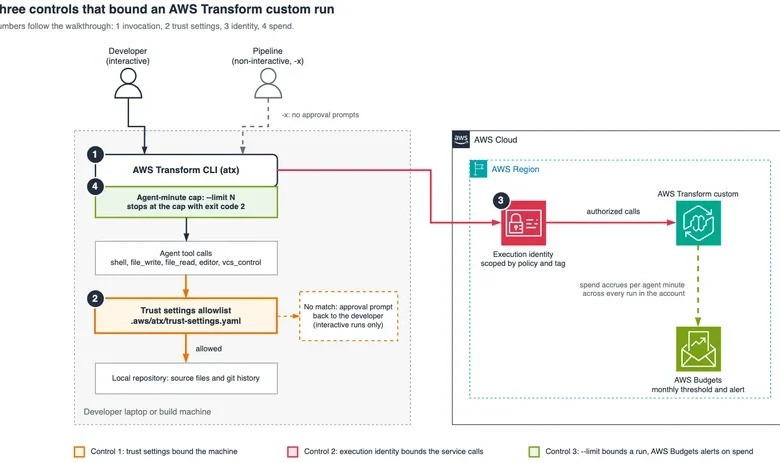
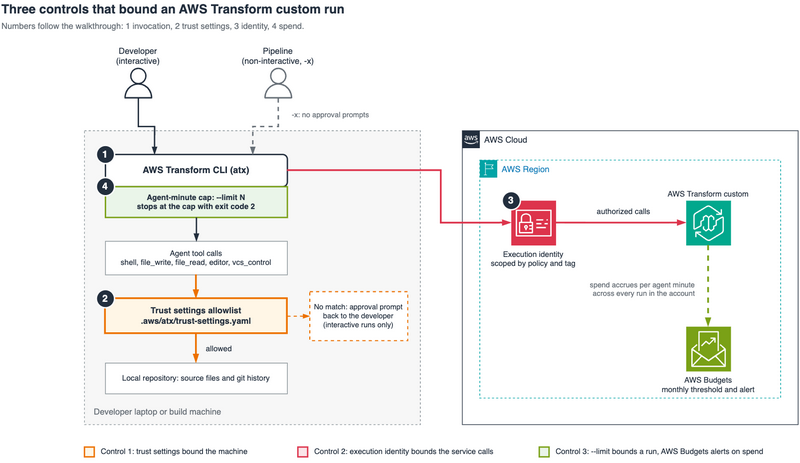
To mitigate these risks, organizations must adopt a configuration-driven control strategy. This approach relies on three primary pillars: a trust allowlist, scoped execution identities, and rigorous financial caps.
The trust allowlist serves as the primary barrier against arbitrary command execution. By defining which shell commands and tools are permitted to run automatically, teams can prevent the agent from executing potentially dangerous operations—such as rm -rf or unsanctioned system-level changes—without human intervention. In practice, the allowlist is developed iteratively on a developer’s machine. By monitoring the tool calls made during initial test runs, engineers can build a whitelist of approved command patterns. Once established, this configuration ensures that subsequent runs in a CI/CD pipeline proceed smoothly without requiring constant manual approval, while still prohibiting unauthorized behavior.
The second pillar involves the principle of least privilege regarding identity. By leveraging AWS managed policies, organizations can separate the execution identity from the authoring identity. The AWSTransformCustomExecuteTransformations policy is designed specifically for pipeline roles, granting only the permissions necessary to run existing transformations. More granular control can be achieved by tagging transformation packages as "approved" and scoping IAM policies to require these tags. This ensures that even if an execution role is compromised, it cannot run arbitrary or unvetted transformation code.
Finally, the financial control layer is essential for fleet-wide stability. By setting an agent-minute cap on every individual run, organizations can ensure that even a runaway process or an unusually complex migration does not deplete the monthly budget. When the limit is reached, the agent terminates with a specific exit code, allowing the pipeline to pause and notify human operators. This creates a feedback loop where costs are treated as part of the operational logic, rather than a passive byproduct of the development process.
Chronology and Operational Implementation
The practical application of these controls follows a disciplined progression. In August and September 2026, empirical testing demonstrated the efficacy of these guardrails using the AWS Transform CLI version 3.10.0. A baseline discovery run of a typical Spring Boot 1.5/Java 8 application—destined for Java 17 and Spring Boot 3.2—revealed that without configuration, an agent might prompt the user for dozens of manual approvals. By crafting a specific trust-settings.yaml file, developers were able to reduce these interruptions to zero.
The workflow for scaling this to a fleet involves:
- Discovery: Running the transformation on a representative sample to log required tool calls and command patterns.
- Configuration: Defining the
trust-settings.yamland attaching the execute-only IAM policy to the CI/CD execution role. - Validation: Testing the configuration in an interactive environment to confirm that zero manual prompts are required for the transformation.
- Deployment: Integrating the hardened CLI execution into the pipeline with predefined
--limitflags to enforce financial guardrails.
Broader Implications for Enterprise DevOps
The move toward agentic modernization represents a fundamental maturation of the DevOps lifecycle. It marks a transition from "Infrastructure as Code" to "Logic as Code," where the transformation process itself is version-controlled, policy-governed, and budget-aware.
This model offers significant relief to engineering teams struggling with the "modernization treadmill." By automating the repetitive aspects of JDK and framework upgrades, companies can reallocate human talent toward high-value architectural improvements and feature development. However, the requirement for these controls highlights a new reality: as agents become more capable, the primary responsibility of the software architect shifts from direct implementation to policy design and risk mitigation.
Official documentation from AWS emphasizes that these controls—trust settings, scoped identities, and spend caps—are intended to work in tandem. While individual tools like the AWSTransformCustomExecuteTransformations policy provide a baseline, they are not a silver bullet. The integration of AWS Budgets to provide account-level alerts serves as a necessary safety net, acknowledging that while individual runs can be capped, the cumulative impact of hundreds of services migrating simultaneously requires macro-level monitoring.
Conclusion and Future Outlook
The integration of autonomous transformation agents into enterprise workflows is no longer a theoretical exercise but an operational necessity for managing large-scale Java estates. By implementing the three-layered governance framework—trust allowlists, role-based execution, and financial caps—engineering organizations can confidently harness the speed of AI while maintaining the rigor required for enterprise security.
As these technologies continue to evolve, the focus will likely shift toward more sophisticated, policy-based automated governance. For now, the combination of CLI-level configuration and IAM-based permission scoping provides a robust, repeatable path forward. Teams that embrace these controls early will be better positioned to navigate future JDK transitions and library migrations, ultimately reducing the accumulated technical debt that hampers so many modern development cycles. As the industry looks toward 2027 and beyond, the ability to safely automate these foundational shifts will likely be a key differentiator in software delivery speed and systemic stability.