Speculative Decoding Explained: Achieving 3x Faster LLM Inference Through Parallel Verification

The deployment of large language models (LLMs) has revolutionized artificial intelligence, yet a persistent technological bottleneck remains: the autoregressive nature of token generation. Every time a user interacts with a chatbot, the underlying model produces text one token at a time. This sequential process forces the system to perform a complete pass through its massive parameter set for every individual character or word generated. As models have scaled into the hundreds of billions of parameters, this "memory-bandwidth bound" constraint has created significant latency issues, particularly for real-time applications like coding assistants and autonomous agents. Speculative decoding has emerged as the industry-standard solution, allowing developers to achieve two to three times faster inference speeds without sacrificing the mathematical integrity of the model’s output.
The Architectural Bottleneck: Why Autoregression Stalls Hardware
To understand the significance of speculative decoding, one must first recognize the fundamental disconnect between modern GPU architecture and LLM execution. High-performance hardware, such as the NVIDIA H100, is engineered for massive parallelization—performing billions of matrix operations simultaneously. However, in standard autoregressive decoding, the model is limited by the speed at which it can move weights from High Bandwidth Memory (HBM) to the compute cores.
Because the model must read its entire weight matrix for every single token, the GPU’s compute units spend the majority of their time idling while waiting for data transfers. This creates a scenario where adding more compute power yields diminishing returns. The system is essentially constrained by the "memory wall," where the latency of moving data dictates the speed of the output, rather than the raw processing speed of the silicon.
The Evolution of Speculative Decoding: A Chronology
The concept of speculative decoding gained prominence around early 2023, as researchers sought ways to bridge the performance gap without resorting to model compression techniques like quantization, which can degrade output quality. The core breakthrough was the realization that while generating a high-quality token is computationally expensive, verifying whether a token is "correct" is significantly cheaper.
In early 2023, seminal research papers from Google DeepMind and independent teams introduced the two-model architecture. The logic was simple: utilize a small, "draft" model—often a few orders of magnitude smaller than the target—to predict the next several tokens. The "target" model then evaluates these predictions in a single parallel operation. By the end of 2023, this methodology had moved from academic experimentation to production-grade deployment, with major inference engines like vLLM and llama.cpp integrating speculative decoding as a primary optimization feature.
Mechanics of the Speculative Loop
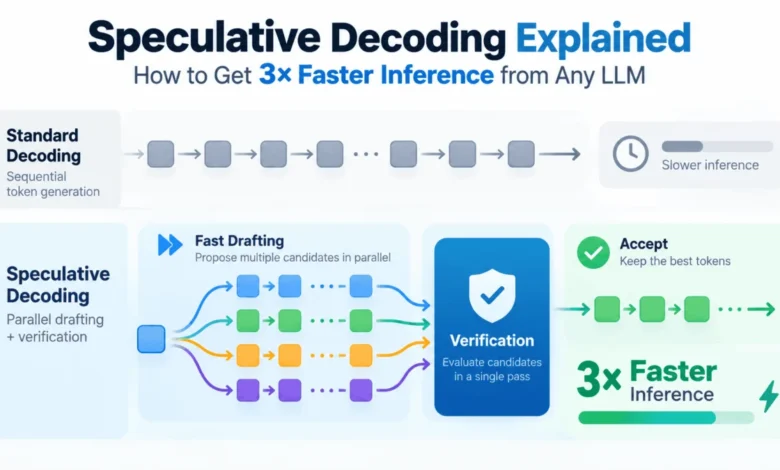
The speculative decoding process operates through a continuous, high-speed loop. The draft model generates a sequence of "candidate tokens"—typically ranging from four to eight tokens—in a fraction of the time required by the target model. This sequence acts as a high-probability guess of the target model’s output.
Once the draft is generated, the target model performs a single forward pass over the entire sequence. Through a process known as rejection sampling, the target model compares its own internal probability distribution against the draft’s tokens. If the target model’s confidence in a candidate token exceeds a specific threshold, it is accepted immediately. If the target model disagrees, it replaces the incorrect token with its own prediction and continues the process.
A critical aspect of this technique is that it maintains a mathematical guarantee: the final output is statistically indistinguishable from the target model’s standalone output. It is not an approximation; it is an exact replication of the target model’s decision-making process, accelerated by the draft model’s speed.
Data-Driven Performance Gains
Industry benchmarks indicate that when implemented effectively, speculative decoding consistently reduces time-to-first-token and overall latency. In scenarios involving predictable text—such as technical documentation or boilerplate code—acceptance rates often reach 80% or higher.
Supporting data from recent deployment trials shows:
- Throughput Increases: Systems using speculative decoding typically observe a 2.2x to 3.1x improvement in tokens per second (TPS).
- Latency Reduction: For interactive chat interfaces, the perceived latency drops significantly, often moving from "noticeable lag" to "instantaneous" for the user.
- Optimal Use Cases: The greatest gains are observed in low-batch, high-latency environments. Conversely, in high-throughput, multi-tenant server environments, the overhead of the draft model can sometimes consume memory that would be better allocated to additional concurrent requests.
Advanced Implementations: Medusa, Eagle, and Prompt Lookup
As the field has matured, researchers have moved beyond the "two-model" requirement, which previously necessitated the storage of two separate sets of weights in memory.
- Medusa: This approach eliminates the need for an external draft model by attaching "heads" directly to the target model’s architecture. These heads predict multiple future tokens simultaneously, allowing the target model to draft its own candidates.
- Eagle: An extrapolation algorithm that utilizes the model’s internal hidden states. By leveraging richer contextual data rather than just the previous token, Eagle achieves higher acceptance rates for complex, non-repetitive text.
- Prompt Lookup Decoding: A zero-model-overhead technique that scans the input prompt for repeating phrases. It is highly effective for document editing or summarization tasks where the model is likely to reproduce parts of the existing context.
The Broader Impact on Enterprise AI
The integration of speculative decoding into production environments carries profound implications for the enterprise AI landscape. First, it enables the deployment of larger, more intelligent models on hardware that was previously considered underpowered for real-time interaction. Second, it shifts the focus of inference optimization from pure compute scaling to algorithmic efficiency.
Industry analysts suggest that as speculative decoding becomes a native component of inference stacks, companies will see a reduction in the "total cost of ownership" for AI features. By extracting more utility out of existing GPU clusters, organizations can serve more users with less hardware, directly impacting the bottom line.
Future Outlook and Limitations
Despite the clear advantages, the implementation of speculative decoding is not a "silver bullet." The technique remains highly dependent on the quality of the draft model. If the draft model is poorly aligned with the target model, the rejection rate climbs, and the overhead of generating the draft can actually lead to slower performance than standard decoding. Furthermore, for highly creative or unpredictable text generation, the draft model may struggle to anticipate the target model, limiting the speedup potential.
As the industry moves toward 2025 and beyond, the focus is shifting toward "speculative decoding at scale." We are seeing the development of adaptive draft models that learn the specific patterns of a given user or task in real-time, further increasing acceptance rates.
Ultimately, speculative decoding represents a shift in the philosophy of AI engineering: the transition from brute-force computation to intelligent, strategic generation. By breaking the cycle of single-token processing, developers have unlocked a new standard for performance, ensuring that as models continue to grow in intelligence, they do not become hindered by the very constraints that once defined them. The technology is no longer an optional optimization; it is becoming a foundational pillar of high-performance, real-world AI applications.