From Code to Cap Tables: Founder Glo Maldonado Breaks Down the Engineering Mindset in Tech Startups

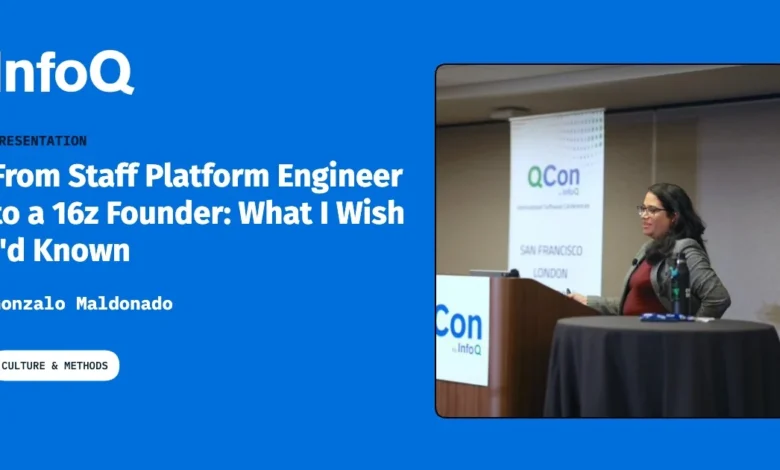
The transition from software engineer to startup founder is fraught with operational hazards, cultural adjustments, and critical financial pivots that extend far beyond traditional computer science training. Addressing an audience of developers and technical leaders, veteran engineer and startup founder Glo Maldonado delivered a comprehensive blueprint for translating engineering acumen into entrepreneurial success. Drawing on 15 years of industry experience, including five corporate exits and leadership roles, Maldonado outlined a tactical framework designed to help technologists navigate the unforgiving landscape of venture-backed companies, market validation, and organizational scaling.
The modern technology ecosystem presents unique challenges that differentiate it starkly from the previous decade of startup growth. According to industry analyses, the macroeconomic climate has fundamentally shifted away from the zero-interest-rate policy (ZIRP) era of the 2010s. During the period of near-zero interest rates, venture capital functioned with loose parameters, frequently underwriting exploratory bets with minimal immediate traction required. Today, with benchmark interest rates offering a secure five percent return on risk-free government bonds, venture capital firms operate under much stricter risk-reward matrices. VCs must now clear higher hurdles to justify investments, demanding proof of hockey-stick growth and clear paths to profitability. This economic tightening has translated into a rigorous environment where early-stage startups face failure rates hovering around 90 percent.
Within this macro environment, Maldonado introduced the concept of the VC Abstraction Layer Knowledge (VALK), a conceptual framework designed to help engineers repurpose their technical evaluation skills for business decision-making. Just as software developers conduct rigorous return-on-investment analyses when evaluating new continuous integration tools, cloud frameworks, or AI coding assistants, venture capitalists evaluate market opportunities through a similar due diligence lens. Understanding this methodology requires technologists to abandon the idealistic mantra of "build it and they will come." Instead, founders must rigorously analyze market sizing, customer acquisition costs, and unit economics. A startup that spends five dollars to generate one dollar in revenue faces a fatal structural flaw, regardless of how elegant its underlying codebase may be.
Establishing product-market fit requires a disciplined, time-sensitive validation phase before any significant engineering resources are deployed. Maldonado outlined an aggressive 12-week framework for prospective founders. The process begins not with drafting architecture diagrams, but with conducting dozens of direct interviews with prospective users to isolate genuine operational pain points rather than polite affirmations. Founders must seek tangible proof of market demand, such as letters of intent, pilot agreements, or pre-orders, which demonstrate that customers possess genuine skin in the game. Only after validating the problem should teams develop a minimum viable product (MVP), aiming to secure initial revenue generation within a two-to-three-month window. If traction fails to materialize, founders must be willing to pivot or return to the drawing board rather than pouring capital into an unvalidated product.
The strategic imperative of market selection forms another cornerstone of early-stage survival. Maldonado emphasized the necessity of understanding the hierarchy of Total Addressable Market (TAM), Serviceable Addressable Market (SAM), and Serviceable Obtainable Market (SOM). While founders naturally aspire to capture billion-dollar global markets, operational success requires dominating a specific, reachable niche before expanding horizontally. Successful enterprises like Datadog and Honeycomb achieved their market dominance by initially targeting acute, deeply felt operational pain points—such as distributed logging and rapid system debugging—before scaling into broader infrastructure monopolies. For technical founders, building a "painkiller" that resolves an immediate, agonizing problem yields vastly superior market adoption compared to developing an optional "vitamin" or nice-to-have utility.
Operationalizing a startup also demands a radical shift in human resource management and legal infrastructure. A recurring pitfall for technical founders is the temptation to act as a central bottleneck, attempting to maintain direct control over every architectural and business decision. Maldonado stressed that effective leaders must systematically delegate responsibilities, operating under the principle that if a founder is not successfully offloading aspects of their role every three to six months, they are stunting organizational scale. Furthermore, early-stage ventures must prioritize legal hygiene from inception. Establishing proper corporate structures, such as a Delaware C-Corporation, utilizing standardized investment vehicles like SAFEs, and drafting airtight intellectual property agreements with co-founders and early contractors are vital preventive measures against crippling legal debt.
Co-founder dynamics represent another critical determinant of startup longevity. Operational friction, mismatched visions, and equity disputes remain leading causes of early-stage mortality. Maldonado recommended rigorous stress-testing of co-founder relationships prior to incorporation, suggesting extended collaborative trials or shared high-pressure experiences to evaluate behavioral compatibility under stress. Clear alignment on mission, vision, and values provides an internal compass that streamlines executive decision-making, sparing teams from endless architectural debates and strategic drift.
Ultimately, the transition from engineering to entrepreneurship requires a fundamental recalibration of timelines and success metrics. While software engineering provides near-instantaneous feedback loops via syntax checkers and automated testing suites, startup validation unfolds over agonizingly slow horizons, frequently requiring 18 months to two years just to establish market sustainability. By embracing rigorous customer validation, maintaining disciplined unit economics, and leveraging their inherent scientific problem-solving abilities, technologists can successfully bridge the gap between writing code and building enduring, scalable enterprises.
Related posts: