SvelteKit 3 Enters Release Candidate Phase Marking a Major Architectural Evolution for the Framework

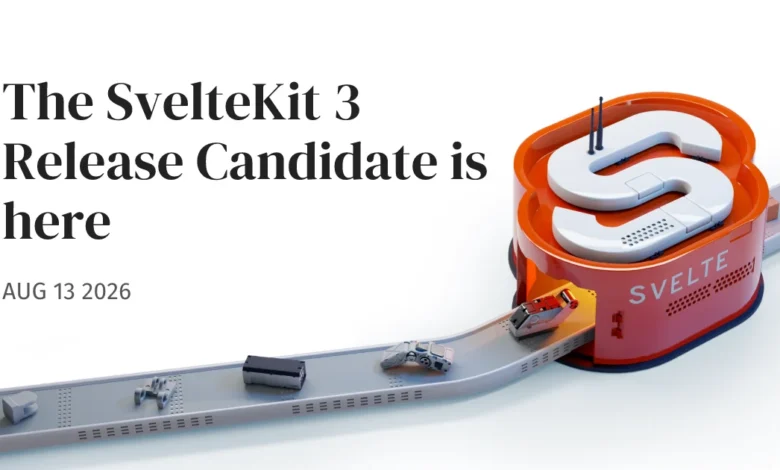
The Svelte ecosystem has reached a pivotal milestone as the development team officially announced that SvelteKit 3 has transitioned into the Release Candidate (RC) phase. This shift signals that the framework is nearing a stable, production-ready state, contingent upon final community testing and the resolution of any remaining edge cases identified during this period. For developers currently maintaining applications on SvelteKit 2, this transition represents not merely an incremental update, but a significant re-engineering of the framework’s internals, designed to simplify configuration, enhance type safety, and better integrate with modern web standards.
The Path to SvelteKit 3: A Chronology of Development
The trajectory toward SvelteKit 3 has been marked by a concerted effort to align the framework with the rapidly evolving JavaScript landscape. Since the release of SvelteKit 2 in late 2023, the core maintainers have focused on pruning legacy code and refining the build process. The introduction of Svelte 5, which brought fundamental changes such as Runes and error boundaries, provided the necessary infrastructure for SvelteKit 3 to address long-standing limitations in error handling and state management.
The transition process is facilitated by a dedicated migration tool, sv migrate, which allows developers to automate the bulk of the conversion. This tool is designed to identify breaking changes and generate a comprehensive "to-do" list for developers, ensuring that complex code paths that cannot be auto-migrated are clearly flagged for manual intervention. This methodical approach reflects the project’s emphasis on developer experience, aiming to minimize the friction typically associated with major framework upgrades.
Architectural Refinements and Developer Experience
A central pillar of the SvelteKit 3 release is the consolidation of configuration. Previously, developers were required to manage project settings across multiple files, including svelte.config.js and various Vite-specific files. By centralizing configuration within vite.config.ts, the framework eliminates the asynchronous resolution delays that previously plagued large-scale projects, particularly those integrating tools like Vitest. This shift is expected to improve startup times and reduce the complexity of the project root directory.
Further streamlining is evident in the handling of internal aliases. The long-standing $lib alias is being superseded by the native Node.js feature known as "subpath imports." While this change requires developers to be more explicit—using imports like #lib/foo.ts rather than the more ambiguous #lib/foo—it aligns SvelteKit with standard Node and TypeScript practices, ultimately reducing the need for custom framework-level coordination code.
TypeScript and Service Worker Enhancements
TypeScript integration, a frequent point of contention in web framework development, has seen a marked simplification. The new release moves away from the "scruffy" configuration of extending local files within the .svelte-kit directory, opting instead to extend $app/tsconfig. This change not only results in cleaner project structures but also injects more robust, framework-specific compiler options by default.
Service workers, often treated as a peripheral concern, have been brought into the fold of the standard SvelteKit development experience. By allowing developers to import core utilities—such as env and paths—directly from standard modules rather than the legacy $service-worker interface, the framework creates a more cohesive development environment. This change is particularly significant for developers building Progressive Web Apps (PWAs), as it simplifies the implementation of complex caching strategies and improves the overall accuracy of type definitions for service worker events.
Advanced Environment Variable Handling
SvelteKit has long been lauded for its sophisticated approach to environment variables. SvelteKit 3 pushes this further by graduating "explicit environment variables" from an experimental feature to a core component of the framework. By defining application dependencies in a centralized src/env.ts file, developers can now enforce strict validation using Standard Schema libraries. This ensures that environment variables are not only type-safe but also explicitly managed, preventing the common pitfalls of undefined variables or incorrect types surfacing in production environments. The ability to distinguish between variables resolved at build time versus those resolved at boot time provides developers with granular control over optimization, including the potential for enhanced dead-code elimination.
Error Handling and Modern Navigation
The shift to Svelte 5 as a mandatory dependency has unlocked superior error management capabilities. In SvelteKit 2, error boundaries were limited to the "load" phase, leaving developers with few options for errors occurring during the render phase. SvelteKit 3 addresses this with comprehensive error boundary support, ensuring that +error.svelte components can handle exceptions consistently throughout the application lifecycle. Furthermore, the integration of source maps into stack traces promises to significantly reduce debugging time, a major quality-of-life improvement for production-level applications.
Navigation logic has also been refined, with shallow routing now handled through the goto function with a shallow: true configuration. This change, coupled with the introduction of persistState: true, allows for more predictable navigation flows and better state management during page reloads, addressing a common pain point for developers building complex, state-heavy interfaces.
Integration with Vite 8 and Rolldown
The mandatory upgrade to Vite 8 is a critical component of the SvelteKit 3 release. Vite 8’s inclusion of Rolldown, a high-performance bundler written in Rust, is expected to yield substantial improvements in build performance. This adoption of the Vite Environment API reflects a broader industry trend toward frameworks that leverage platform-agnostic build tools to reduce the complexity of server-side and client-side code synchronization.
While the team has opted against supporting FetchableDevEnvironment due to the complexity it imposes on framework authors, they remain committed to solving the underlying challenges, such as providing access to Cloudflare Workers bindings during local development. This decision highlights a "less is more" philosophy regarding framework-level abstractions, focusing on long-term maintainability over immediate feature parity.
The Future: Remote Functions and Async Svelte
Looking ahead, the SvelteKit team is positioning "remote functions" as the cornerstone of future client-server communication. By moving away from traditional load functions and actions, the team aims to create a more fluid, intuitive model for data fetching and mutation. Although these features remain behind an experimental flag in the RC release, they signal the next stage of the framework’s evolution. When combined with "async Svelte," these tools are intended to unify the developer experience, potentially rendering many existing patterns obsolete.
Broader Industry Implications
The release of SvelteKit 3 occurs in a highly competitive climate where web frameworks are increasingly judged by their performance, type safety, and ease of migration. By prioritizing a clean, standards-compliant architecture and deep integration with the latest versions of Vite and Svelte, the SvelteKit team is attempting to solidify its position as a framework that balances advanced power-user features with a streamlined developer experience.
Industry analysts note that the framework’s focus on pruning legacy code and enforcing strict typing reflects a broader shift toward "enterprise-ready" standards in the JavaScript ecosystem. As applications grow in size and complexity, the ability to rely on robust, validated environment variables and consistent error boundaries becomes an asset that extends beyond mere syntax, impacting the long-term maintainability and reliability of web applications.
The success of SvelteKit 3 will ultimately be determined by the adoption rate among existing users and the framework’s ability to maintain its performance edge as it scales. With the Release Candidate phase now underway, the focus shifts to the community. The developers have issued a clear call to action: by stress-testing the framework, reporting bugs, and providing feedback on the migration path, the community will play a definitive role in shaping the final stable release. As the ecosystem prepares for this transition, the consensus remains that SvelteKit 3 is not just an upgrade, but a foundational step toward a more efficient and predictable future for web development.
Related posts: