The modern software development ecosystem is defined by unprecedented acceleration. Tools like Next.js power millions of web applications globally, serving as the foundational framework for startups, enterprises, and individual developers alike. Yet, this massive adoption creates a profound operational bottleneck: open-source maintenance. With millions of active users and the widespread deployment of automated coding agents capable of generating detailed bug reports en masse, maintainers are increasingly overwhelmed by incoming technical debt. For the Next.js core team at Vercel, this modern dilemma culminated in a staggering peak of 3,109 open issues on their GitHub repository in January 2025.
To confront this growing mountain of unattended reports, the Next.js team engineered a sophisticated, AI-driven automation pipeline utilizing autonomous research agents. By deploying a specialized agent named closability built on Vercel’s open-source eve framework, the team systematically analyzed, triaged, and reduced their backlog to fewer than 1,000 issues by early September 2026. This initiative showcases a turning point in open-source software management, illustrating how artificial intelligence can safely assist maintainers in administrative curation without compromising community trust or code integrity.
The Anatomy of an Open-Source Backlog Crisis
The issue tracker of a major open-source framework functions as the primary diagnostic tool for understanding developer friction. For Next.js, this mechanism continuously ingests an average of 36 new reports every single week. While the rise of coding agents has democratized and improved the technical precision of bug reporting, it has simultaneously inflated the volume of data that human maintainers must sift through.
Historically, investigating a single GitHub issue requires significant manual overhead. Maintainers must parse conversational threads, examine historical pull requests, cross-reference commits spanning several years, and construct isolated environments to reproduce reported bugs across various versions of the framework. When hundreds or thousands of tickets accumulate, active regressions become obscured by a thicket of duplicate reports, obsolete issues concerning unsupported framework versions, and bugs that were silently resolved in subsequent patches.
Prior to deploying AI-driven solutions, the Vercel team attempted traditional automated hygiene methods. In January 2025, alongside the peak of their backlog, they introduced a standard GitHub workflow designed to flag issues as stale after two years of inactivity—a threshold later shortened to 18 months—followed by automated closure after a designated grace period. While this blunt approach helped reduce the open count to 2,244 by August 10, 2026, it laid bare the fundamental flaw of relying solely on timestamps as a proxy for relevance.
Inactivity cannot distinguish between a genuine, unresolved bug that slipped through the cracks and an issue that is demonstrably outdated, duplicated, or already fixed. Consequently, time-based automation inevitably resulted in the accidental closure of valid community reports, underscoring the urgent need for context-aware investigation at scale.
Chronology of the AI-Driven Triage Initiative
Recognizing that manual reviews could not scale with incoming volume, the Next.js maintainers embarked on an aggressive, systematic cleanup campaign utilizing custom AI infrastructure. The chronology of this operational shift highlights a rapid and disciplined execution model:
- January 2025: The Next.js issue backlog reaches its all-time high of 3,109 open reports. Vercel introduces time-based stale-issue automation to mitigate the influx.
- June 15, 2026: Active development begins on dedicated automated research pipelines to evaluate the backlog with granular contextual awareness.
- August 10, 2026: Despite previous stale-issue closures, the backlog stubbornly sits at 2,244 open reports, buried under years of legacy tickets.
- Late August 2026: The team deploys
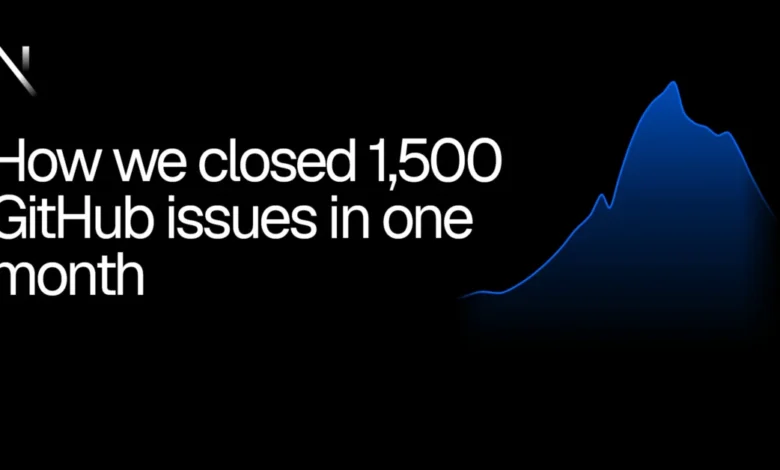
closability, an autonomous research agent running on theeveframework powered by advanced reasoning models like GPT-5.6 Luna. Operating concurrently across up to 200 isolated sandbox sessions, the agent evaluates the entire backlog. - September 4, 2026: The results are tallied. Over a span of roughly three weeks, the repository successfully closes 1,462 issues—incorporating both agent-recommended closures and standard maintainer reviews—bringing the total open count down to 995, even as 218 new reports arrive during the same window.
Architecting the Closability Agent and Sandbox Security
The success of the Next.js backlog reduction strategy hinges on the technical architecture of the closability agent. Built upon eve—Vercel’s open-source framework for persistent, scheduled, and structured agentic runs—the system executes code within isolated environments using Vercel Sandbox infrastructure.
Each investigation spins up a fresh sandbox containing the Next.js repository, Node.js, Playwright, and Chromium. Within this secure perimeter, the agent performs rigorous diagnostic tasks: it reads issue descriptions, checks linked pull requests and commits, attempts to reproduce the reported bug against current and legacy releases, and gathers empirical evidence regarding the issue’s current validity.
To maintain strict safety guardrails, the agent operates under a read-only mandate outside its sandbox environment. It cannot comment on issues, alter repository labels, close tickets, push code, or trigger deployments. Furthermore, to mitigate security vulnerabilities such as indirect prompt injection—where malicious instructions hidden inside user-submitted bug reports could hijack the AI’s behavior—the agent is explicitly configured to ignore extraneous directives embedded within issue text.
Rather than making binary pass/fail determinations, closability operates with conservative confidence thresholds. A failed reproduction attempt alone is insufficient to recommend closure; a high confidence score requires robust, current empirical evidence supported by zero credible contradictions. Once an investigation concludes, the agent outputs structured metadata which is compiled into a centralized Close Queue for human verification.
Empirical Results and Community Validation
When the closability agent completed its run on GPT-5.6 Luna at maximum reasoning effort, each investigation required an average of 30 minutes. By scaling concurrency up to 200 simultaneous eve sessions, the system rapidly parsed the legacy backlog. Human maintainers subsequently reviewed the evidence compiled behind every single recommendation before acting.
The breakdown of the 1,462 closed issues reveals the composition of the technical debt that had accumulated over the years:
- Already fixed: 543 issues (37%)
- Duplicate: 278 issues (19%)
- Expected behavior: 237 issues (16%)
- No longer reproducible: 89 issues (6%)
- Unsupported or obsolete versions: 66 issues (5%)
- Other categories: 249 issues (17%)
To ensure that automated or bulk triage did not alienate the developer community, Vercel implemented an automated safeguard prior to the review process. Using a specialized GitHub Action, whenever a maintainer closes an eligible issue, the system posts a transparent notification informing the original author and commentators. If an error is made, contributors can request a reopening within a 14-day window simply by replying with Reopen: <reason> explaining why the issue remains relevant. If the user originally opened or commented on the ticket, it reopens automatically.
This accountability mechanism provided a clear metric for accuracy. As of September 4, 2026, out of 1,462 closed issues, only 3 were subsequently reopened by the community, resulting in an astonishing 99.8% retention rate for the closed queue. This data suggests that the contextual evaluations performed by the AI agent closely aligned with the actual technical state of the codebase.
The Broader Implications for Open-Source Maintenance
The successful deployment of the closability agent is merely one component of a broader operational vision at Vercel known as the "Maintainer Agent." This umbrella initiative integrates multiple independent eve agents specialized in distinct lifecycle tasks, including issue reproduction, canary verification, code bisecting to isolate committing changes, end-to-end test creation, and patch preparation.
These agents are tied directly into an internal Next.js dashboard that tracks backlog trends, displays research metrics, and allows maintainers to manually trigger investigations or review the Close Queue. When complex tasks require multi-agent orchestration, the dashboard automatically routes data between agents, logs execution history, and pushes high-priority findings alongside daily recaps to team communication channels like Slack.
Looking forward, Vercel is institutionalizing this automation to prevent future backlog accumulation. Every Monday, the closability system automatically investigates up to 100 open issues that have remained untouched for at least 30 days, discarding saved research if human activity subsequently resumes. Furthermore, the team has begun granting agents the autonomy to directly close the most unambiguous cases—capped at 25 issues per week—without waiting for manual review, while preserving the community’s 14-day reopening window.
As frameworks like Next.js continue to scale and AI accelerates the pace of software development industry-wide, open-source maintainers face an escalating tide of contributions and bug reports. Vercel’s experiment demonstrates that intelligent, sandboxed automation can effectively shoulder the burden of repository curation. By combining rigorous AI research with mandatory human oversight and community feedback loops, open-source projects can maintain pristine issue trackers, ensuring that valuable community insights are never lost beneath mountains of technical debt.