Android Studio Introduces Bring Your Own Agent Support for Enhanced Developer Productivity

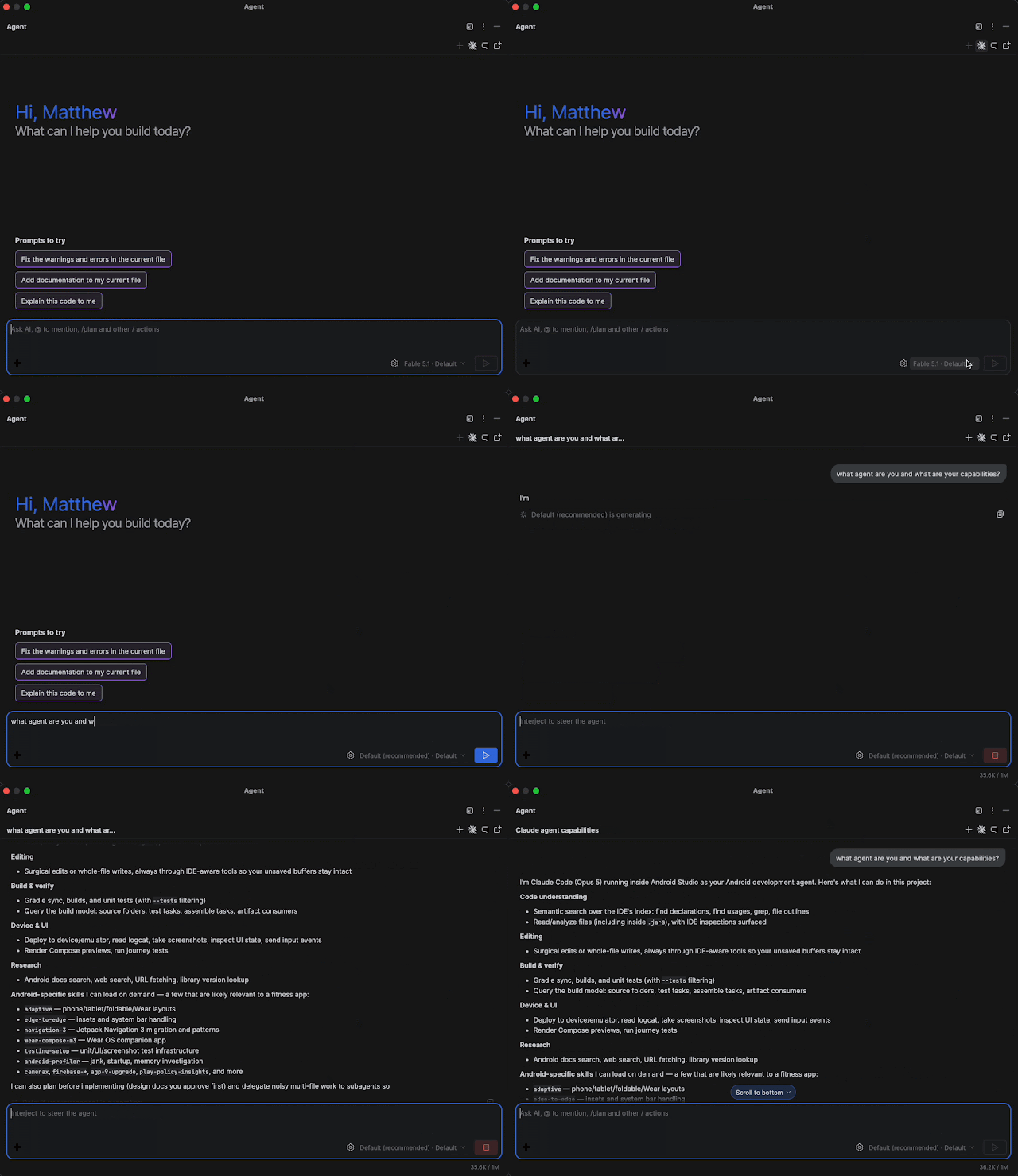
The landscape of professional software engineering is undergoing a tectonic shift as artificial intelligence transitions from a novelty tool to a fundamental infrastructure layer. Today, Google has announced a significant evolution in its Android development environment: the introduction of Bring Your Own Agent (BYOA) support within Android Studio. This strategic move marks a departure from closed, proprietary AI ecosystems, allowing developers to integrate third-party coding agents—such as Anthropic’s Claude, OpenAI’s Codex, and Google’s own Antigravity—directly into their IDE workflows. By providing an open interface for these agents, Android Studio is positioning itself as a central hub for agentic development, aiming to cater to the diverse and specialized needs of global engineering teams.
The Evolution of AI-Assisted Development
The integration of AI into Integrated Development Environments (IDEs) began in earnest with basic autocomplete features, such as GitHub Copilot and Tabnine. However, the industry has rapidly pivoted toward "agentic" systems—AI entities capable of not just suggesting code snippets, but planning, executing, and refining complex technical workflows across an entire codebase.
Last year, the Android Studio team signaled this shift by enabling remote model support, allowing developers to move beyond local compute limitations. The launch of BYOA represents the logical maturation of this strategy. Rather than forcing teams to choose between the convenience of an integrated tool and the performance of an external model, Android Studio now acts as a bridge. This flexibility is critical for enterprise environments where engineering teams may have already standardized on a specific model family for security, cost, or performance reasons.

A Chronology of Integration
The push toward more sophisticated AI in Android Studio has been methodical:
- Mid-2023: Android Studio begins integrating basic AI code assistance, focusing on boilerplate reduction and unit test generation.
- Late 2023: Google introduces remote model support, decoupling the IDE from the necessity of local heavy-lifting for AI processing.
- Early 2024: The industry sees a surge in "agentic" capabilities, where models like Claude 3.5 Sonnet and various iterations of GPT-4 prove capable of handling multi-file refactoring and bug remediation.
- Late 2024: Android Bench 2 is introduced, providing a standardized metric for evaluating how well models perform in long-horizon coding tasks.
- Current Date: The official rollout of the BYOA feature in Android Studio Canary, allowing for the native plug-and-play of third-party agents.
The Technical Mechanics of BYOA
The BYOA feature functions by utilizing Android Studio’s AI-optimized infrastructure to provide these third-party agents with "IDE-native intelligence." An agent is only as effective as the context it is provided; by plugging these agents into the Android Studio environment, the agents gain access to the Android Knowledge Base and specific project metadata.
When a developer integrates a model such as Anthropic’s Claude Agent, the IDE does not simply pass a text prompt; it provides a structured awareness of the project’s dependency tree, file structure, and architectural patterns. This context-awareness is designed to mitigate the "hallucination" problems common in generic coding assistants. By ensuring that the AI understands the nuance of Android-specific libraries and best practices, the integration significantly increases the accuracy of code generation.
Supporting Data and Industry Context
Recent industry surveys suggest that the adoption of AI coding tools has reduced developer "time-to-first-commit" by as much as 40% for routine tasks. However, larger, more complex tasks—such as migrating an entire module from Java to Kotlin or refactoring architecture to follow Clean Architecture principles—remain bottlenecks.

Google’s internal testing, reflected in the latest updates to the Android Bench 2 benchmark, indicates that agentic workflows are currently outperforming traditional LLM chat interfaces by a factor of three in long-horizon tasks. The ability for an agent to "self-correct" by running a build or a test suite after a suggested change is the primary driver of this efficiency. By opening the platform to external agents, Google is effectively allowing the market to decide which model provides the best "self-correction" performance for specific project types.
The Role of Google Antigravity and Gemini
While the platform is now open to external agents, Google continues to promote its proprietary stack through the Google Antigravity agent. For teams heavily invested in the Google Cloud ecosystem, Antigravity offers a seamless transition to the latest Gemini models, including the high-throughput Gemini Flash 3.8.
The distinction for enterprise users is notable: the Antigravity agent is built with hooks into Gemini Enterprise, which maintains the data privacy and security guarantees required by large-scale organizations. For these users, the value proposition is not just the model performance, but the compliance framework surrounding it. Enterprises can utilize their existing Google Cloud API keys or AI Pro/Ultra licenses to authenticate, ensuring that their code remains within the secure boundary of their enterprise environment.
Implications for the Developer Ecosystem
The implications of this move are two-fold. First, for the individual developer, the move represents a "democratization of tooling." A developer is no longer locked into the default AI provider chosen by their IDE manufacturer. If an independent agent provider releases a model that is uniquely optimized for, say, Compose Multiplatform development, that developer can immediately integrate it into their daily driver.

Second, for the broader software industry, this signals a shift in the "moat" strategy of IDE vendors. Previously, the goal was to keep users within a proprietary ecosystem. Now, the goal is to become the "orchestration layer" for all coding activity. By providing the best environment for any agent to run, Android Studio is reinforcing its position as the standard tool for Android development, regardless of which underlying AI is doing the heavy lifting.
Official Stance and Future Outlook
Google’s developer relations team has emphasized that the rollout is currently in the "Canary" phase, specifically within the Android Studio Rabbit 2 release. The focus at this stage is on gathering feedback from early adopters regarding latency, context-window management, and the stability of the API hooks used to connect third-party agents.
Industry analysts observe that this move is a proactive response to the rise of specialized AI IDEs, such as Cursor or Windsurf, which have gained significant traction by prioritizing the agentic experience over traditional IDE features. By integrating these capabilities natively, Google is effectively preventing a migration of its user base to these new platforms.
For developers looking to integrate these tools, the process involves selecting the preferred agent from the registry within the IDE settings, authenticating via an API key or Oauth, and configuring the scope of access. The platform supports a variety of billing models, including per-token usage via API keys or flat-rate enterprise subscriptions, reflecting the diverse financial structures of modern software development shops.

Analysis of Long-Term Impact
The long-term success of the BYOA initiative will depend on the stability of the underlying interfaces. If the "hooks" provided to third-party agents are too restrictive, developers will continue to seek out dedicated AI-first IDEs. If, however, Android Studio manages to provide a "best-of-all-worlds" experience—where the deep, specialized Android tooling of the traditional IDE is combined with the cutting-edge reasoning capabilities of external models—it will likely set a new standard for how professional software is built.
As of this writing, the documentation for the BYOA API is available to developers in the Android Studio preview channel. The community is already reporting early success with multi-model testing, where developers compare the output of Anthropic’s models against Google’s own in real-time. This iterative, open-market approach to AI integration is likely to accelerate the pace of innovation within the Android ecosystem, potentially shortening development cycles for complex applications by months.
In conclusion, the launch of BYOA in Android Studio is not merely a feature update; it is a fundamental reconfiguration of the developer’s workbench. By acknowledging that no single AI model can solve every problem for every developer, Google has embraced a modular future. Whether this will lead to a more fragmented or a more efficient development lifecycle remains to be seen, but for the present, the power to choose has been firmly placed in the hands of the engineering community. As developers begin to experiment with the Canary release, the focus will now shift to performance metrics and the reliability of these agents in production-grade, high-stakes environments. The integration of advanced agents into the IDE is no longer a vision of the future; it is the current reality of Android development.