How GitHub Ported the Copilot Agent Runtime to 800,000 Lines of Production Rust Using AI Agents


The landscape of software engineering has reached a historic milestone with the successful, end-to-end migration of the GitHub Copilot agent runtime—encompassing over 800,000 lines of production Rust code—executed primarily by autonomous artificial intelligence agents under the supervision of a single engineer. Historically, a rewrite of this magnitude within a live production environment would require a dedicated team of software developers working across multiple years, representing a massive capital expenditure and a high risk of operational disruption. Instead, the multi-month project was completed incrementally through 128 pull requests merged directly into the main branch, fundamentally transforming the performance, efficiency, and architectural reach of GitHub’s ubiquitous AI tooling.
The Copilot agent runtime serves as the underlying orchestration engine for a vast ecosystem of developer tools and enterprise applications. Originally built to power the GitHub Copilot cloud agent, the runtime was written entirely in TypeScript running on Node.js and the V8 JavaScript engine. As the platform expanded, its architecture was adopted across the GitHub Copilot CLI, the GitHub Copilot mobile and desktop applications, integrated development environments such as VS Code and Visual Studio, specialized offerings like Copilot Code Review and Copilot Cowork, and productivity suites across Microsoft Excel, Outlook, PowerPoint, and Word.
The Architectural Imperative: Moving Beyond Node.js and V8
While TypeScript and Node.js offered rapid initial development and broad accessibility for command-line interfaces and terminal user interfaces, they introduced severe performance limitations when embedded broadly across disparate application environments. The original architecture coupled the user interface directly with the agent loop. When downstream applications required programmatic access via the GitHub Copilot SDK, engineers implemented an out-of-process communication model: consuming programs would spawn the CLI as a subprocess and communicate asynchronously via a JSON-RPC protocol over pipes or sockets.
This design forced every SDK consumer—whether operating in C#, Python, Go, Java, or Rust—to bundle or locate a complete Node.js runtime and V8 environment. Each client instantiation incurred a working set memory overhead of approximately 100 megabytes purely for the language runtime, while every event, message, and session file system operation traversed a heavy process boundary. A failure in the Node process would immediately terminate the active session, creating complex supervision, monitoring, and debugging requirements for enterprise deployments.

To resolve these bottlenecks, engineering leadership sought a runtime framework capable of in-process embedding through a C ABI (Application Binary Interface), minimal startup overhead, high server density driven by exceptionally low memory consumption, and deterministic resource utilization. Rust was selected to meet these rigorous constraints, offering precise memory management without a garbage collection pause, though requiring explicit handling of lifetimes and shared state structures.
Chronology and In-Place Porting Strategy
Rather than adopting a "big-bang" cutover approach—which would have required maintaining a long-lived, isolated branch and risking catastrophic integration failures at the conclusion of the project—the development team pursued an in-place, incremental migration strategy. Between May 12 and August 21, the codebase underwent continuous transformation directly on the main production branch.
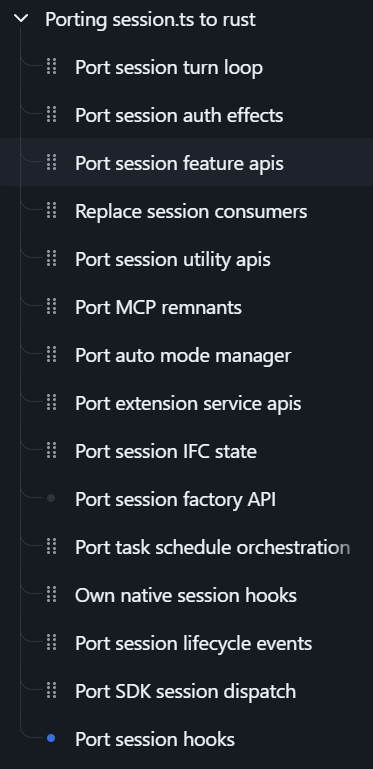
The migration began with foundational infrastructure, establishing the Rust workspace, lint rules, continuous integration pipelines, and foreign function interface (FFI) patterns using pure-logic primitives devoid of input/output operations or shared state. Once the machinery was proven, the work progressed systematically from the leaves inward: content exclusion utilities, shell helpers, and session filesystem operations were translated first. Stateful subsystems, tool integrations, hooks, model clients, and Model Context Protocol (MCP) handlers followed in subsequent waves. Session orchestration—the most highly coupled and complex subsystem—was addressed near the final stages of the port.
Throughout the nearly fourteen-and-a-half-week window, the repository maintained continuous delivery. Main shipped 135 public releases, consisting of 100 pre-release versions and 35 stable releases, averaging approximately 1.3 releases per day. By August 21, the transformation was complete: the runtime comprised 832,378 lines of production Rust and 468,689 lines of Rust unit tests, alongside 174,675 lines of end-to-end TypeScript tests, while the separate Copilot SDK repository incorporated an additional 130,000 lines of test code across six programming languages.
Quantitative Analysis of Agent-Driven Development
An exhaustive analysis of the session logs and repository history provides unprecedented empirical insight into the operational mechanics of large-scale agentic software engineering. Across the constituent porting pull requests, the agentic harness processed more than 12.7 million events, including 31,247 user-role messages, 1.3 million assistant messages, 6.4 million hook events, and 1.8 million tool invocations.
Analysis of tool usage revealed that autonomous agents spent the vast majority of their operational time—roughly a 10-to-1 ratio—gathering evidence and investigating code rather than mutating files. Read-only Git inspections, file viewing via view, and codebase searches using ripgrep (rg) vastly outnumbered code generation actions via edit or apply_patch. This pattern mirrors rigorous human engineering: iterative investigation, hypothesis formation, targeted modification, and continuous validation.
Prompt caching played an indispensable economic role in sustaining long autonomous workflows. The prompt-cache hit rate reached an extraordinary 96.22%, with cache writes accounting for 3.07% and fresh input representing just 0.71%. Because GitHub Copilot structured the agent loop to maintain a stable system prompt, tool definitions, and historical conversation prefix, intermediate computations were reused efficiently, discounting cache reads by up to 90% and making multi-hundred-hour autonomous coding sessions economically viable.
Static analysis served as a vital guardrail. Direct compilation diagnostics captured thousands of occurrences of rustc error codes, with the vast majority stemming from standard mechanical wiring issues—such as mismatched signatures, renamed fields, or incorrect types—rather than complex borrow-checker or lifetime violations. Ownership and lifetime errors accounted for a mere 1.7% of coded diagnostics, disproving the common assumption that lifetime management represents the primary hurdle for AI-generated Rust code.
Interoperability and Dual-Front Architecture
To maintain seamless backward compatibility while transitioning the ecosystem, the project utilized a dual-interoperability strategy. During the transition phase, the napi Rust crate enabled Rust code to compile into native Node addons, allowing asynchronous Rust functions to be exposed directly to JavaScript as promises via temporary N-API exports and thread-safe callbacks. At the peak of the migration on August 3, the temporary seam supported 2,019 internal N-API exports and 3,356 TypeScript call sites. Upon completion, all internal interop was eradicated, leaving zero temporary exports and zero TypeScript call sites.
For permanent external consumption, the completed Rust runtime exposes two distinct front doors:
- The N-API door: Loaded as a native addon by Node processes, maintaining the existing CLI path.
- The C ABI door: A platform shared library exposing exactly 19 exported functions. This minimalist interface utilizes a dispatch-based JSON-RPC protocol over function calls, allowing SDK consumers in C#, Go, Java, Python, Rust, and TypeScript to run the runtime entirely in-process.
By retaining JSON-RPC as the underlying byte transport for in-process hosting, the engineering team avoided the creation of bespoke, per-method bindings across six languages while completely eliminating the inter-process communication penalty, subprocess supervision overhead, and separate memory footprints associated with external Node instances.
Performance Gains and Resource Optimization
The transition from Node.js and V8 to native Rust yielded dramatic performance improvements across all measured benchmarks, validating the core objectives of the rewrite. Benchmarks conducted via the C# SDK comparing pre-port builds to the finalized Rust runtime demonstrated orders-of-magnitude gains:
- Client, Session, and Single Turn: Execution time dropped from 5.25 seconds down to 1.33 seconds out-of-process, and to 292 milliseconds in-process—an 18-fold acceleration.
- Session Resumption: Resuming a 32-turn session improved from 5.64 seconds to 264 milliseconds in-process, representing a 21.4-fold speedup.
- Throughput Capacity: Running a stress test of 1,000 one-turn session lifecycles across concurrent pipelines increased output from 7.55 sessions per second in TypeScript to 120.0 sessions per second using the in-process Rust runtime.
- CPU Consumption: Aggregate CPU time required for a 100-by-10 workload dropped from 312 seconds in the Node-backed process tree to approximately 110 seconds in Rust configurations.
- Memory Footprint: Resident private memory added during a ten-client batch plummeted from an overhead of 1,383 megabytes above baseline down to 126 megabytes in-process—a 91% reduction in memory consumption.
Regression Taxonomy and Quality Assurance
Despite the overwhelming success of the migration, a project of this scale inevitably encountered correctness and performance regressions. By mid-September 2026, engineering teams had cataloged and resolved dozens of distinct port regressions grouped into several recurring categories:
- Ambiguous Semantics: Mismatches arising from type conversions, such as implicitly floating-point numbers (
f64) substituting for strict integers, or string evaluations differing between JavaScript’s truthy falsification (||) and Rust’s explicit option handling (unwrap_or). - Ambient Behaviors: Unspoken dependencies on host environment states, local time zones, process environment variables, or working directories that required explicit capture and refreshing in Rust.
- Lifecycle and Disposal Failures: Discrepancies in ownership, resource cleanup, and asynchronous task cancellation leading to orphaned handles or wedged conversation loops.
- Main Thread Blocking: Synchronous operations across the N-API boundary freezing the single-threaded Node event loop, which was subsequently resolved by enforcing asynchronous execution via
spawn_blocking.
Despite these challenges, public issue tracking across the github/copilot-cli and github/copilot-sdk repositories revealed no statistically significant spike in quality-related or bug-labeled issues during or after the rewrite, indicating that incremental delivery and rigorous automated review effectively shielded end users from systemic disruption.
Broader Industry Implications and Future Outlook
The successful port of the GitHub Copilot agent runtime establishes a powerful precedent for enterprise software engineering in the era of advanced artificial intelligence. By demonstrating that an autonomous agent fleet, directed by an experienced engineer, can execute an 800,000-line language migration in place within a few months, the project redefines the economic calculus of technical debt remediation and architectural modernization.
The total direct token expenditure for the porting effort amounted to approximately $120,000, processing over 136 billion tokens under highly optimized prompt caching protocols. Combined with supervisory developer time, the initiative achieved a transformation that previously would have required multi-year team allocations at a fraction of the traditional cost.
With the production runtime now operating entirely in native Rust, GitHub has unlocked new deployment frontiers. The SDK can now be embedded directly into host processes across desktop, cloud, mobile, and embedded devices without the baggage of a separate JavaScript virtual machine. As engineering teams begin to optimize native data structures beyond literal translations of legacy TypeScript algorithms, the foundation is set for the next generation of scalable, high-performance developer intelligence tools.