Unlocking Android Security with Open-Source AI Agents Uncovers Critical Vulnerabilities in Popular Applications


Artificial intelligence has rapidly transitioned from an experimental novelty into an essential operational tool across the software development lifecycle, and its influence on cybersecurity is scaling at an unprecedented rate. Security researchers, vulnerability analysts, and defensive engineering teams are increasingly turning to automated systems to process massive codebases, identify subtle logic flaws, and mitigate attack vectors before malicious actors can exploit them. To streamline this process, security professionals have developed specialized frameworks designed to automate and package effective prompts and workflows for large language models (LLMs). Among these initiatives, the open-source GitHub Security Lab Taskflow Agent has emerged as a prominent framework, enabling researchers to systematically direct AI models through incremental, multi-step auditing processes. By breaking down code analysis into structured, targeted tasks, security analysts can leverage LLMs to uncover complex vulnerabilities that might otherwise evade traditional static analysis tools or manual reviews.
The evolution of automated security research using AI models represents a paradigm shift in how vulnerabilities are discovered and cataloged. Traditionally, vulnerability discovery relied heavily on pattern-matching static analysis tools, fuzzers, and painstaking manual code reviews. While these methods remain vital, they often struggle with high-level logic flaws, complex inter-component communication channels, and context-dependent security boundaries. Advanced LLMs possess a deep, granular understanding of application programming interfaces, syntax patterns, and historical exploit behaviors across numerous programming languages. However, raw models often fail when applied broadly to massive repositories without proper guidance. To counteract this, researchers engineered custom taskflow prompts that divide code auditing into manageable milestones. This methodology has yielded tangible results, leading to the identification and responsible disclosure of more than 20 high-impact vulnerabilities in major Android applications to date.
The Mechanics of Targeted AI Audit Taskflows for Mobile Environments
Auditing mobile applications presents unique challenges compared to traditional web or desktop software. Mobile operating systems rely on complex inter-process communication frameworks, intent routing, permission models, and exported components that define a distinctive attack surface. Recognizing that generalized auditing prompts often miss mobile-specific security regressions, security researchers recently expanded the GitHub Security Lab Taskflow Agent framework to incorporate specialized taskflows tailored specifically for Android architecture.
The first major enhancement involves the implementation of a dedicated entry point mapping workflow, designated as gather_mobile_entry_point_info.yaml. In software security, an entry point represents any segment of code where external, potentially malicious data can cross application trust boundaries. By systematically categorizing entry points into mobile-specific vectors—such as content providers, broadcast receivers, exported activities, and intent filters—and non-mobile vectors, the AI can accurately parse hybrid repositories that contain multiple application architectures. This ensures that the LLM maintains a precise mental model of the relevant attack surface without confusing web server request handlers with mobile intent handlers.

Following entry point identification, the auditing framework utilizes a refined classification workflow known as classify_application_local.yaml. Because mobile application vulnerabilities often involve subtle misconfigurations and logic errors that are less widely documented than memory corruption issues, relying entirely on the autonomous reasoning of an LLM can lead to inconsistent coverage. To mitigate this non-deterministic behavior, the updated taskflow injects a structured taxonomy of prominent mobile vulnerability classes into the prompt. When the AI analyzes an intent-based entry point, for example, it is explicitly directed to evaluate the code against known threat patterns, such as confused deputy vulnerabilities, insecure broadcast transmissions, and unauthorized component exposure. By combining rigid, deterministic prompt guidelines with the broad creative capabilities of the underlying model, researchers can ensure comprehensive coverage while minimizing the risk of overlooked edge cases.
Real-World Case Studies: Exploiting OsmAnd and Wikipedia
To validate the efficacy of these targeted mobile taskflows, security analysts deployed the open-source framework against several prominent applications available on commercial app stores. The resulting disclosures highlight how AI-driven taskflows successfully unearth severe logic vulnerabilities capable of compromising user privacy and account integrity.
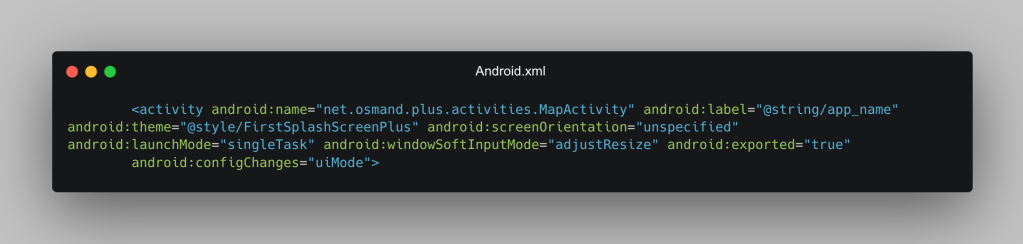
The first major case study involved OsmAnd, a widely utilized open-source navigation application boasting more than 10 million downloads on the Google Play Store. The security audit uncovered a critical flaw centered around the application’s MapActivity component, which is explicitly exported in the Android manifest to facilitate deeplink handling and settings file management. Although the application intended for sensitive configuration parameters—such as settings versions, silent import flags, and export type lists—to originate exclusively from trusted in-process channels or AIDL services, the implementation improperly accepted these parameters via intent extras.
Because Android imposes no structural restrictions preventing external applications from attaching arbitrary key-value pairs to intents directed at exported components, any malicious application installed on the device could invoke MapActivity and trigger the handleOsmAndSettingsImport function. By supplying manipulated intent extras, an unauthorized third-party app could silently modify application settings without user awareness. Specifically, attackers could overwrite default map tile URLs to point to an external, attacker-controlled server. As the user navigated within the OsmAnd application, background tile requests leaked precise latitude and longitude coordinates, effectively enabling real-time device tracking. Furthermore, the vulnerability allowed attackers to remotely harvest the origin and destination coordinates of every planned route generated by the user, representing a severe violation of user privacy executed entirely through an unprivileged background application.
A second high-impact discovery targeted the official Wikipedia Android application. The application registers custom URL schemes via deep-linking hooks to render web content seamlessly within its native interface. However, a logical flaw within the application’s hostname validation parser allowed malicious actors to bypass domain restrictions and direct users to arbitrary, external websites disguised as legitimate Wikipedia pages.
By chaining this deeplink redirection primitive with a secondary cookie management vulnerability identified in the application’s SharedPreferenceCookieManager module, researchers demonstrated a complete account takeover vector. The cookie manager failed to adequately validate domain specifications when building persistent cookie lists, enabling injected web contexts running inside the application’s WebView to illicitly harvest long-term authentication cookies associated with the victim’s Wikipedia account. Through this automated discovery chain, the AI framework successfully mapped out a multi-step exploit path that required deep contextual reasoning across disparate codebase files.
Evaluation, Limitations, and the Future of AI-Assisted Security
While the deployment of automated taskflow agents has dramatically accelerated vulnerability discovery rates, empirical observations from recent audits highlight significant operational hurdles that must be addressed by security teams. Chief among these challenges is the discrepancy between vulnerability identification and accurate severity estimation. Large language models frequently flag theoretical issues that depend on highly improbable runtime states or present negligible security impact in real-world deployments. Despite explicit instruction prompts discouraging low-severity noise, models routinely generate false positives that require rigorous manual validation by experienced security researchers.
Furthermore, evaluating mitigating factors—such as internal storage data prioritization overriding external storage modifications—remains a persistent struggle for current LLM architectures. Without explicit, multi-stage prompts that compel the model to generate functional proof-of-concept exploits and debug execution flows, models may misinterpret theoretical path traversal vectors as critical application compromises. Addressing these inaccuracies currently demands either significant human oversight or advanced debugging integrations that allow models to programmatically test their assumptions against actual code execution environments.
Despite these limitations, the deep structural knowledge exhibited by LLMs regarding API behaviors, syntax conventions, and historical exploit patterns continues to redefine the efficiency of modern security research. As context windows expand and multi-agent reasoning frameworks mature, the integration of artificial intelligence into software security practices will transition from an innovative auxiliary method to a fundamental pillar of defensive engineering across open-source and enterprise ecosystems alike.