How AI Agents Can Slash Token Consumption by Switching from JSON to Markdown

The rapid proliferation of autonomous AI agents has ushered in a new era of software development, but it has also surfaced a significant economic and technical challenge: the "token tax." As these agents perform recursive loops, conduct deep web research, and ingest massive datasets for file retrieval, the cost of operation often spirals out of control. Because Large Language Models (LLMs) charge per token—the fundamental units of text they process—every unnecessary character in a search result or API response represents a direct drain on budget and compute resources. Recent industry analysis confirms that search engine results, when delivered in traditional JSON formats, contain vast amounts of redundant metadata, tracking parameters, and structural overhead that offer zero utility to the reasoning capabilities of an AI model.
The Anatomy of Token Bloat in AI Workflows
In modern AI agentic workflows, the process of "search and reason" typically involves querying a search engine API and feeding the resulting payload into a model’s context window. Traditionally, developers have relied on JSON (JavaScript Object Notation) for this data exchange. While JSON is the gold standard for web applications—providing type-safe, machine-readable structures for front-end frameworks—it is notoriously inefficient for LLM consumption.
A standard search query for a common topic, such as "local coffee shops," involves fetching dozens of results. Each result in a JSON response includes technical identifiers, image URLs, tracking pixels, and internal system metadata. When an agent attempts to parse this, it must "read" every character. If a query returns 24,000 tokens in JSON, the developer is billed for every token, even though the LLM likely only requires the entity name, location, and brief summary to perform its task. The mismatch between human-readable data requirements and machine-parseable data formats has created a hidden inefficiency in the AI stack.
Chronology of Data Format Evolution in LLM Contexts
The evolution of how data is fed into LLMs has moved through three distinct phases. In the early days of GPT-3, developers simply fed raw text or poorly formatted scrapings into models, which often led to hallucinations due to noisy input. In the second phase, developers pivoted to structured JSON to ensure that the AI received data in a reliable, predictable format. While this improved reasoning, it drastically increased the token count per request.
We are now entering the third phase: token-efficient structured formats. As developers have become more cost-conscious, they have begun to realize that the structural overhead of JSON—brackets, quotation marks, key-value labels, and repetitive schema definitions—is effectively "dead weight." By transitioning to Markdown, developers are finding a middle ground: a format that is light enough to save thousands of tokens while remaining semantic enough for the LLM to understand relationships between headers, tables, and lists.
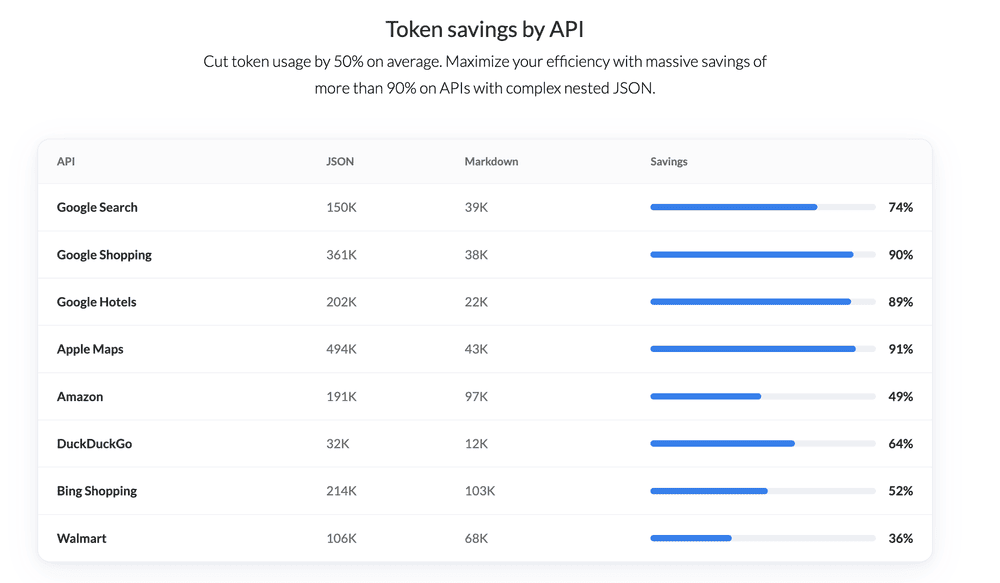
Empirical Evidence: The 74 Percent Reduction Metric
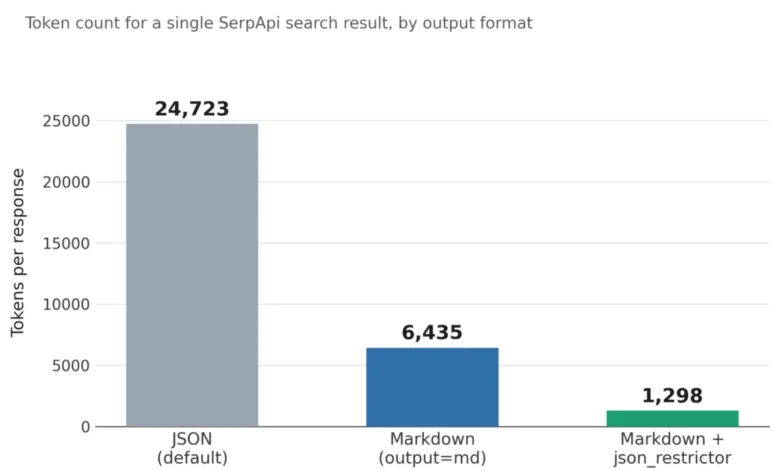
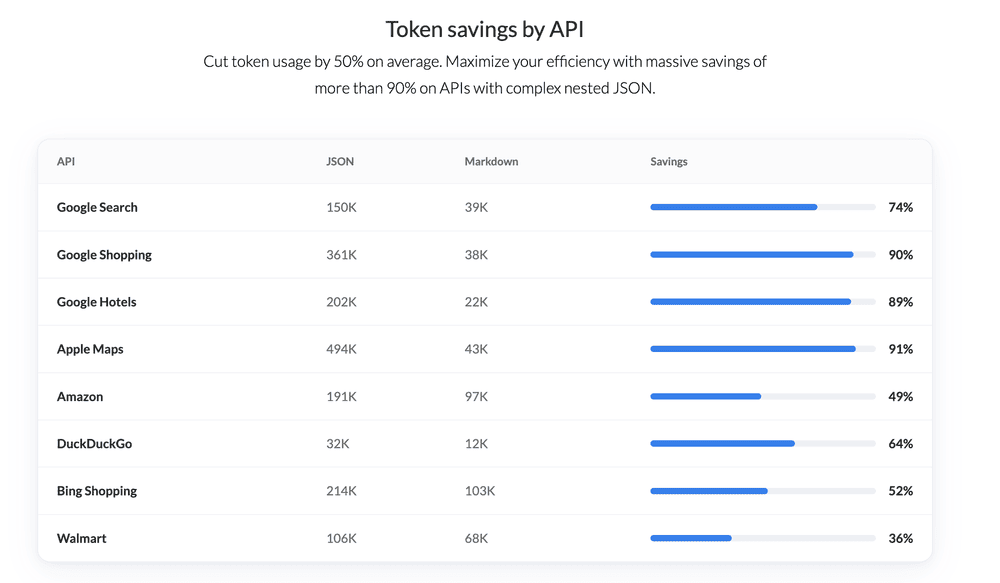
The industry benchmark for this shift is demonstrated by the recent implementation of Markdown output capabilities in SerpApi, a leading provider of search engine scraping services. In controlled testing, a search query that consumed 24,723 tokens in its JSON format was reduced to 6,435 tokens when converted to Markdown. This represents a 74% reduction in data volume.
The implications of this reduction are twofold. First, it directly lowers the cost per API call. If a company runs one million search queries a month, a 74% reduction in token consumption could equate to thousands of dollars in monthly savings. Second, it optimizes the context window. LLMs have finite context limits; by stripping away redundant data, developers can fit more search results into a single prompt, allowing agents to perform more complex comparative analysis without hitting "max token" errors. Even further filtering, by restricting fields to only the most essential information, has shown the ability to compress similar queries down to just 1,298 tokens—a massive efficiency gain that allows for more frequent and deeper research cycles.
Comparative Analysis: When to Use Markdown vs. JSON
While Markdown is a breakthrough for AI agents tasked with summarization, classification, and research, it is not a universal replacement for JSON. The choice between the two formats depends on the "downstream consumer" of the data.
JSON remains the superior choice for programmatic pipelines where data integrity is paramount. If an AI agent needs to perform a mathematical operation on a list of prices, calculate the average rating of a product, or extract longitude and latitude coordinates for a mapping service, it requires the strict typing of JSON. Without defined types, an LLM might misinterpret a string as a number or lose precision when handling financial data.
Markdown, conversely, is an "inference-optimized" format. It is designed to be read by the LLM’s attention mechanism to extract context and synthesize information. By using Markdown, the agent receives a clean document structure—tables for comparisons, headers for categorization, and lists for features—which aligns with the way modern models are trained to prioritize information.
Implementation and Industry Adoption
To facilitate this transition, infrastructure providers are beginning to integrate "Markdown-first" modes into their APIs. For instance, SerpApi allows developers to toggle between JSON and Markdown via simple query parameters or headers. This "on-the-fly" transformation occurs server-side, meaning the developer does not need to build complex post-processing scripts to clean the data.
The strategy of using json_restrictor or similar field-selection tools is gaining traction as a best practice. By defining the required schema on the server side before the data even traverses the network, developers eliminate the transmission of unnecessary fields entirely. This minimizes latency and reduces the bandwidth required for large-scale data ingestion.
The Broader Economic Implications for AI Agents
The move toward token-efficient data structures is part of a larger trend toward "Agentic Efficiency." As AI agents move from experimental side-projects to enterprise-grade tools, the hidden costs of their architecture are coming under intense scrutiny. A system that is technically accurate but economically unsustainable will fail in a production environment.
By optimizing the data shape, organizations are not only reducing costs but also improving the performance of their agents. Research suggests that when an LLM is presented with cleaner, more concise context, its "reasoning" accuracy often improves. This is because the model spends less of its limited attention span filtering through noise and more time focused on the salient facts provided in the Markdown tables or lists.
Future Outlook and Conclusion
The transition from JSON to Markdown for LLM ingestion is likely just the beginning of a broader movement toward "model-native" data formats. We may soon see specialized formats designed specifically for AI consumption that combine the structure of JSON with the lightness of Markdown.
For developers and enterprises, the mandate is clear: the shape of your data is a variable in your profit-and-loss statement. Every byte of data that enters a model’s context window should provide value. If the data is simply overhead used by a UI that the model never sees, it must be removed. By auditing current API usage and shifting to more efficient representations, teams can scale their AI operations, lower their operational overhead, and create more capable agents that are unencumbered by the weight of legacy data formats.
The era of unchecked token consumption is reaching its limit. In its place, a new discipline of "token engineering" is emerging, where the primary objective is to maximize intelligence per token. As demonstrated by the significant reduction in costs and increase in context capacity, Markdown is currently the most accessible and effective tool in the developer’s arsenal to achieve this efficiency. Whether through automated tools or manual field restriction, the focus on data shape will define the next generation of cost-effective AI development.