Neo4j Unveils Major Enterprise Updates to Bridge the Gap Between Early AI Proof-of-Concepts and Industrial-Scale Production

As global enterprises move past the initial phase of experimentation with artificial intelligence, the overarching technological landscape is undergoing a fundamental paradigm shift. For years, the primary benchmark of success for an AI initiative was proving that a machine learning model or a Large Language Model (LLM) could successfully execute a single, isolated use case. Today, however, engineering leaders, chief technology officers, and enterprise architects are confronting a far more complex reality. The pressing challenge is no longer merely getting a model to function in a controlled sandbox environment, but rather sustaining, securing, and scaling AI applications across expansive production ecosystems while solving deeply entrenched, multidimensional business problems, such as sophisticated financial crime.
Addressing this critical inflection point in the enterprise technology lifecycle, graph database and analytics pioneer Neo4j has announced a comprehensive suite of product updates and architectural enhancements. Designed to bridge the notoriously difficult chasm between proof-of-concept and high-throughput production, the new releases target two distinct yet interdependent imperatives: delivering domain-specific intelligence for highly complex industry workflows, and providing the robust architectural scalability required to run heavy AI workloads reliably in enterprise environments.
The Evolution of Enterprise AI: Moving Beyond the Initial Proof-of-Concept
To understand the weight of Neo4j’s latest announcements, one must examine the broader trajectory of enterprise software adoption over the past half-decade. Following the generative AI boom that accelerated significantly in 2023, organizations rushed to deploy foundational models. According to various enterprise technology market analyses, upwards of 70 percent of Fortune 500 companies successfully launched at least one AI pilot project by the end of 2024.
However, industry data also reveals a persistent bottleneck: fewer than a third of those initial pilots successfully transitioned into fully integrated, enterprise-wide production systems. The reasons for this disparity are multifaceted. As AI applications scale, they demand access to vast, disparate reservoirs of corporate data. They require architectures capable of handling hundreds of concurrent tenants, minimizing latency, preventing catastrophic infrastructure failures, and isolating heavy analytical processing from day-to-day operational transactions. Furthermore, as regulatory scrutiny mounts regarding automated decision-making, organizations need transparency, provenance, and contextual explainability embedded directly into their data pipelines.
Neo4j’s latest product rollout is a direct response to these compounding infrastructural and domain-specific demands. By marrying advanced graph intelligence with enterprise-grade scaling mechanisms, the company aims to position knowledge graphs as the foundational data layer for next-generation, production-ready AI applications.
Tackling Financial Crime Through Connected Graph Intelligence
One of the most profound challenges organizations face in the modern digital economy is the inadequacy of siloed data when combating sophisticated, multi-channel adversaries. Financial crime serves as a prime textbook example of this systemic vulnerability.
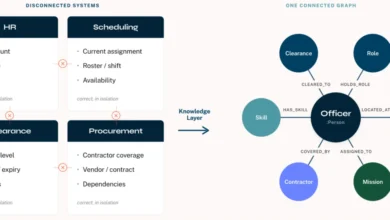
Modern financial criminals rarely operate in isolation. Instead, they function as highly agile, decentralized networks of connected entities—rapidly shifting funds across multiple bank accounts, synthetic identities, compromised digital devices, and disparate geographic jurisdictions specifically to evade legacy surveillance systems. Fraudsters actively exploit the operational gaps between organizational silos. Conversely, the compliance and investigative teams tasked with stopping them are frequently hobbled by those exact same silos, utilizing fragmented data repositories, legacy rule engines, and disconnected investigative tools.
To dismantle this asymmetrical advantage, Neo4j has introduced the Neo4j GraphAware Financial Crime Intelligence (FCI) solution. Built upon the premise that fighting connected networks requires connected data, FCI is engineered to bridge the operational gap between fragmented compliance workflows.
The system leverages pre-defined, graph-powered detection rules designed to unearth intricate behavioral patterns that conventional, tabular rule-based systems routinely miss. Crucially, every automated alert generated by the system is deeply enriched with comprehensive contextual data—mapping out the exact web of people, corporate entities, accounts, and transactional relationships underlying the suspicious activity. All of this information is unified within a single, entity-resolved knowledge layer.
For financial investigators and compliance officers, the practical implications are substantial. By surfacing high-fidelity risk signals and dramatically reducing the volume of false-positive alerts, FCI allows human investigators to spend less time wading through administrative noise and more time exercising expert judgment on high-risk cases. Moreover, because the underlying evidence, contextual relationships, and chain of provenance are permanently preserved within the graph, financial institutions retain a fully auditable trail. This ensures that every automated or human-led compliance decision can be thoroughly explained, reviewed, and defended before regulatory bodies.
Importantly, Neo4j designed the GraphAware FCI solution with enterprise pragmatism in mind. Rather than demanding a disruptive, expensive, and high-risk wholesale replacement of an institution’s existing core banking or compliance technology stack, the solution is built to integrate with and build upon pre-existing architectural investments, providing a clear and viable path toward modernized financial crime detection.
Solving the Infrastructure Puzzle: Scaling AI into Production
While domain-specific solutions like FCI address complex business problems, the underlying infrastructure must be equally capable of scaling to meet the demands of enterprise-grade AI workloads. As organizations expand their AI footprints, they encounter compounding challenges related to data gravity, administrative overhead, resource contention, and high availability.
Neo4j’s recent updates introduce several key architectural capabilities explicitly engineered to alleviate these production bottlenecks.

Zero-Copy Agility with Virtual Graphs
Data distribution is one of the primary hurdles in modern data engineering. Enterprises rarely store all their information in a single repository; instead, data is perpetually scattered across relational databases, data lakes, cloud object storage, and third-party APIs. Forcing organizations to extract, transform, and load (ETL) this data into a centralized graph database before it can be utilized for AI or knowledge graph applications introduces significant latency, cost, and governance risks.
To mitigate this friction, Neo4j has advanced its Virtual Graph capability. Currently available in Preview and slated for General Availability within the coming months, Virtual Graph introduces zero-copy graph capabilities directly to data where it already resides. Organizations can now construct and query dynamic knowledge graphs across distributed data sources without the cumbersome requirement of physically migrating that data into Neo4j first. This significantly accelerates deployment times for Retrieval-Augmented Generation (RAG) pipelines and LLM applications that rely on real-time enterprise context.
Advanced Multi-Tenant Consolidation and Resource Optimization
As enterprises scale their deployment of internal and external AI applications, managing administrative overhead becomes a formidable challenge. Managing dozens or hundreds of separate database instances incurs ballooning infrastructure costs and operational complexity.
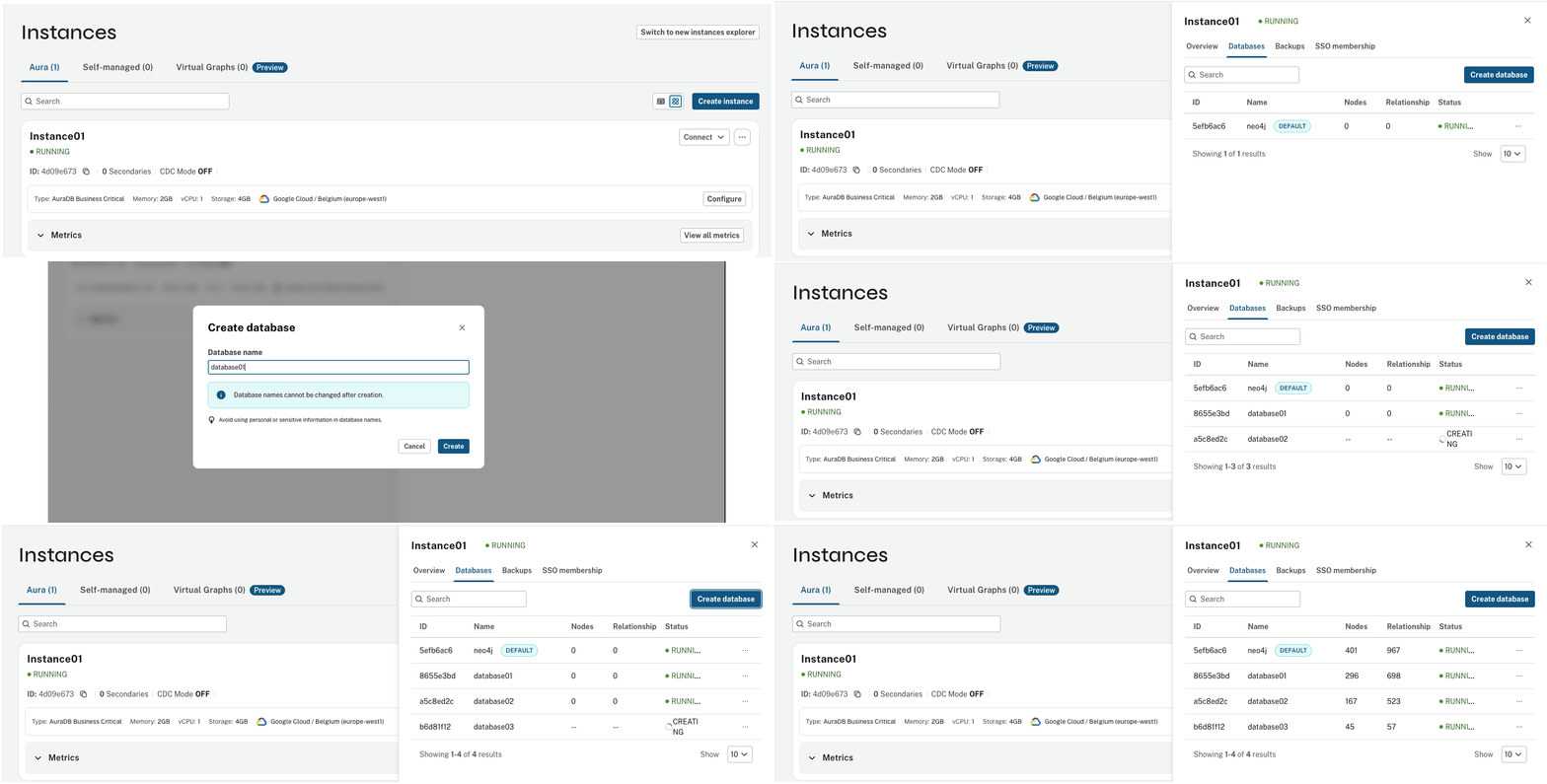
To address this, Neo4j has enhanced its managed cloud database service, AuraDB, with robust multiple databases support. For organizations running numerous distinct applications, multi-tenant environments, or isolated customer workloads, this capability allows administrators to consolidate multiple individual databases within a single Neo4j AuraDB instance while maintaining strict logical separation between tenants.
This consolidation drastically reduces both financial expenditure and administrative overhead as database counts multiply. For software-as-a-service (SaaS) providers and enterprises managing data on behalf of multiple external end customers, every single customer can now be provisioned with their own dedicated, isolated database running on the same underlying AuraDB instance. Furthermore, with comprehensive support integrated directly into the Aura API, this entire provisioning lifecycle can be fully automated from end to end, eliminating manual intervention.
Complementing this multi-tenancy support, Neo4j has expanded the configuration limits of its largest AuraDB deployments. The platform now officially supports up to 2 terabytes (TB) of RAM and 5 terabytes (TB) of storage for rapidly growing enterprise workloads. This substantial architectural headroom can be flexibly allocated to serve either a single, massive enterprise-grade knowledge graph or a dense consolidation of countless smaller databases operating within the same high-performance instance.
High Availability and Disaster Recovery via Cross-Cluster Replication
In mission-critical production environments—particularly those powering real-time fraud detection, customer-facing applications, or automated operational workflows—system downtime is commercially unacceptable. Ensuring uninterrupted data availability during localized infrastructure outages, hardware failures, or regional cloud provider disruptions is a paramount requirement for modern enterprise IT architects.
Addressing this requirement, Neo4j has announced the general availability of cross-cluster database replication within the Neo4j Graph Database Enterprise Edition, with native support across AuraDB environments also firmly on the roadmap. This feature empowers organizations to maintain a continuously synchronized, up-to-date replica of a primary operational database across a completely separate cluster or geographic region. In the event of an unexpected primary cluster failure, the secondary cluster is immediately primed to take over operational traffic, ensuring business continuity and high availability for mission-critical applications.
Decoupling Operational and Analytical Workloads
As AI applications mature, they often impose conflicting demands on underlying database infrastructure. Real-time operational applications require low-latency read and write operations, whereas deep graph analytics, machine learning feature engineering, and complex network traversal queries demand massive computational throughput. When both workload types compete for the exact same underlying hardware resources, system performance inevitably degrades.
To solve this resource contention challenge, Neo4j is introducing Neo4j Graph Analytics, launching in Preview via an Early Access Program. This specialized capability enables self-managed enterprise customers to scale graph analytics completely independently of their operational transactional database. By decoupling these workloads, heavy analytical computations and machine learning model training routines can run at scale without starving the operational database of the CPU, memory, and I/O resources required to maintain rapid, real-time application responsiveness.
Industry Implications and Strategic Outlook
When evaluated holistically, Neo4j’s latest product announcements signal a mature evolution in how graph database technology intersects with the broader artificial intelligence movement. The enterprise software market has officially entered an era where raw technological novelty is no longer sufficient; buyers demand proven reliability, elastic scalability, ironclad security, and immediate applicability to domain-specific business pain points.
By simultaneously releasing verticalized domain solutions like GraphAware Financial Crime Intelligence and horizontal infrastructural advancements—such as zero-copy Virtual Graphs, expanded AuraDB multi-tenancy, cross-cluster replication, and decoupled graph analytics—Neo4j is attempting to capture a commanding stake in the enterprise AI infrastructure stack.
Market analysts observe that as organizations transition their AI experiments into core operational infrastructure, the battleground for data platforms will increasingly be defined by how seamlessly they can ingest fragmented enterprise data, establish contextual relationships, and maintain high availability under heavy production loads. By directly addressing these friction points, Neo4j aims to cement knowledge graphs not merely as a specialized database alternative, but as the indispensable cognitive architecture powering the next generation of enterprise artificial intelligence.
Organizations looking to evaluate these new capabilities can access the updated documentation, explore the AuraDB multi-tenant configuration options, and review implementation pathways for the GraphAware Financial Crime Intelligence solution directly through the official Neo4j developer portal and enterprise sales channels.