The contemporary landscape of software engineering is currently undergoing its most profound structural evolution since the transition from procedural to object-oriented programming. With the proliferation of generative artificial intelligence and Large Language Models (LLMs), developers are no longer merely writing code line by line; they are acting as orchestrators of autonomous and semi-autonomous coding agents. However, this shift has precipitated a paralyzing debate within the developer community. Across forums, repositories, and technical roundtables, the prevailing inquiry has become an obsessive search for the single best framework: "Which agentic coding methodology should I use?"
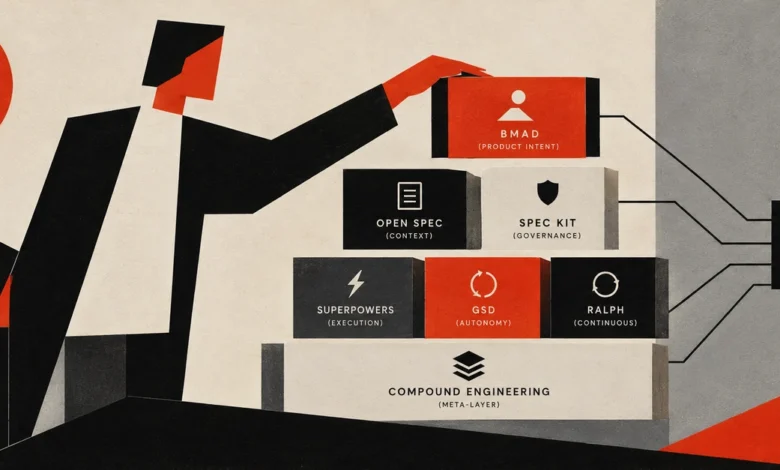
According to industry analysts and prominent software architects such as Dmitry Amelchenko, this foundational question is fundamentally flawed. The current ecosystem is saturated with an overwhelming array of systems—including Superpowers, BMAD, Compound Engineering, OpenSpec, SpecKit, GSD, and Ralph—each fiercely marketing itself as the definitive solution for managing AI coding assistants. Yet, the consensus emerging from senior engineering leaders is clear: there is no universal winner. The search for a silver bullet misunderstands the architectural nature of modern software development. Instead of searching for one overarching framework, engineering teams must recognize that these systems operate at vastly different layers of the development stack. Success in the age of agentic coding requires not a choice, but a synthesis.
The Fragmentation of the AI Development Ecosystem
To understand why the "one methodology" mindset fails, one must examine the rapid evolution of AI-assisted coding tools over the past twenty-four months. Initially, developers relied on rudimentary autocomplete tools and simple conversational chat windows to generate isolated functions or debug snippets. As LLM context windows expanded and reasoning capabilities improved, the industry transitioned toward multi-file editing and agent-driven workflows capable of executing complex terminal commands, running test suites, and committing code directly to version control systems.
This technological leap created a vacuum. Without standardized protocols for how human engineers should communicate intent, maintain context, and supervise execution, developers began inventing bespoke orchestration frameworks. Consequently, the market fractured into specialized methodologies, each addressing a very specific bottleneck in the software development lifecycle. Treating these frameworks as mutually exclusive alternatives is akin to asking whether a modern web application should use a database, a frontend framework, or a network protocol—they serve entirely different functions and must be integrated rather than substituted.
Execution Versus Intent: The Superpowers and BMAD Dichotomy
At the foundation of any agentic workflow lies the tension between high-level architectural intent and low-level mechanical execution. This division is most prominently illustrated by comparing execution-focused systems, such as Superpowers, with intent-driven frameworks like BMAD.
Execution frameworks are typically designed to optimize the immediate feedback loop between the developer, the agent, and the codebase. They excel at rapid iteration, syntax correction, and automated test-driven development cycles. When an engineer needs an agent to execute a tightly scoped task—such as refactoring a legacy component or implementing a well-defined API endpoint—execution-heavy systems provide the rigorous guardrails necessary to prevent the agent from hallucinating dependencies or breaking existing business logic.

Conversely, intent-driven frameworks operate at a strategic altitude. They are engineered to capture the product requirements, user stories, and architectural vision before a single line of code is written. By translating vague human requirements into structured specifications that LLMs can parse without ambiguity, intent frameworks bridge the chasm between product management and machine execution. Analysts note that failing to separate intent from execution frequently leads to "drift," where an agent executes a task flawlessly from a technical standpoint, yet completely violates the core business objective defined by the product roadmap.
Combating Context Drift: OpenSpec Versus SpecKit
One of the most persistent hurdles in agentic software engineering is context degradation. As a software project scales, LLMs inevitably lose track of global architectural constraints, resulting in fragmented codebases where newly generated modules fail to integrate seamlessly with legacy systems. To combat this phenomenon, the industry has birthed specialized documentation and specification frameworks, most notably OpenSpec and SpecKit.
Both OpenSpec and SpecKit approach the problem of context retention by anchoring requirements in version-controlled, human-readable files that live directly within the repository. Instead of relying on the ephemeral context of a chat window, these frameworks force both the human engineer and the AI agent to read from and write to a single source of truth.
OpenSpec typically emphasizes modularity and granular task decomposition, allowing developers to spin up ephemeral contexts for specific feature branches without polluting the global system prompt. SpecKit, on the other hand, often focuses on rigid compliance pipelines, ensuring that every piece of generated code maps back to an explicitly validated specification item. While their syntax and operational mechanics differ, their ultimate objective is identical: turning documentation from a passive afterthought into an active, machine-readable constraint engine that guides the agent’s behavior over long-term development cycles.
The Autonomy Layer: Navigating GSD and Ralph
Moving up the abstraction ladder, engineering teams inevitably confront the question of autonomy: How much independence should be granted to the AI agent? This is where polarizing frameworks like GSD (Get Stuff Done) and Ralph enter the conversation, requiring careful calibration by technical leadership.
High-autonomy frameworks are designed to minimize human friction, allowing agents to autonomously plan sprints, write code, run integration tests, and iterate through failures with minimal human intervention. While this level of automation promises exponential productivity gains, it also introduces significant operational risks. Unsupervised agents operating within high-autonomy environments can inadvertently introduce subtle security vulnerabilities, execute destructive database migrations, or generate massive quantities of technical debt that are difficult to untangle later.
Industry experts advise treating high-autonomy layers as powerful engines that require strict steering wheels. Organizations deploying GSD or Ralph-style pipelines typically implement robust automated guardrails, including mandatory pull request reviews, immutable staging environments, and strict permission boundaries around production infrastructure. The goal is not to remove the human from the loop entirely, but to elevate the engineer from a code writer to a system supervisor and code reviewer.

Compound Engineering and the Meta-Layer of AI Development
Perhaps the most sophisticated paradigm emerging in this space is Compound Engineering. Rather than focusing strictly on the immediate mechanics of writing a single feature or debugging a specific module, Compound Engineering shifts the overarching objective of the software development lifecycle: "How does the work completed today make the next task frictionless for the agent tomorrow?"
In a traditional engineering environment, documentation and knowledge retention are often neglected due to time constraints. In a Compound Engineering workflow, every completed feature delivery concludes with an automated or semi-automated distillation phase. Lessons learned, architectural edge cases discovered, and successful prompt patterns are systematically recorded into persistent knowledge bases that agents consume during subsequent tasks.
This creates a compounding feedback loop. As the project matures, the AI agents become increasingly fluent in the specific eccentricities, coding standards, and architectural patterns of the organization. For engineering leaders, startup founders, and technical directors who view software development through a strategic lens, this meta-layer represents the ultimate objective of agentic integration.
The Winning Synthesis: Building a Cohesive Stack
Given the myriad options available, the directive from seasoned practitioners is unequivocal: do not attempt to install and use every framework simultaneously, nor should you search for a single all-encompassing tool. Instead, engineering teams must construct a deliberate, tiered stack tailored to their specific project requirements and organizational maturity.
A balanced, high-performing synthesis typically begins by establishing a high-level harness—such as BMAD—to govern intent, product requirements, and architectural vision. This intent layer is then coupled with a context-retention framework like OpenSpec to ensure that codebase documentation remains synchronized with ongoing development. Finally, execution and autonomy protocols are integrated to handle the day-to-day generation, testing, and deployment of code under strict supervisory oversight.
As Dmitry Amelchenko and other industry pioneers emphasize, the debate over which individual methodology to use is a distraction from the real work of systems design. The future of software engineering will not be defined by which framework wins the popularity contest, but by how effectively engineering teams orchestrate these disparate layers into a unified, compounding workflow. The tools are mature, the ecosystem is established, and the path forward is clear. Stop searching for a silver bullet, and start building your stack.