React Native 0.86 Official Release Brings Android 15 Edge-to-Edge Support and DevTools Enhancements Without Breaking Changes

The mobile development landscape has received a notable update with the official release of React Native 0.86, bringing robust improvements to Android compatibility, developer tooling, and structural project governance. Announced today, this new version marks the second consecutive release following version 0.83 to feature zero user-facing breaking changes. This achievement highlights the core maintainers’ ongoing dedication to making the upgrade path as predictable, seamless, and frictionless as possible for enterprise teams and independent developers alike.
Built by a vast community of contributors, React Native 0.86 incorporates more than 596 individual commits from 97 authors worldwide. Alongside platform-specific stability updates, the release reflects a historic transition in governance for the broader React ecosystem. As mobile application requirements evolve to meet modern UI standards, version 0.86 arrives at a critical juncture, addressing crucial operating system updates while expanding the capabilities of underlying native interfaces.
A Historic Governance Transition to the React Foundation
Perhaps the most significant structural milestone accompanying this software release is the relocation of the React Native repository, alongside related core projects, to a new digital home. The source code repositories for React Native, React, Metro, Yoga, and the official React Native website have officially migrated from the historical facebook GitHub organization to the independent react organization.
This move formalizes the transition of React and its associated technologies to the React Foundation, an independent entity established to ensure the long-term stewardship, neutrality, and decentralized growth of the entire React ecosystem. For developers and corporate contributors, the transition is designed to be completely transparent. GitHub has implemented automated URL redirection systems, meaning that all existing web links, open issues, and pending pull requests will automatically route to their new locations without requiring manual intervention from community members.
Comprehensive Edge-to-Edge Support for Android 15 and Beyond
On the technical front, React Native 0.86 delivers comprehensive solutions for edge-to-edge layout rendering on Android 15 and subsequent operating system iterations. Modern Android versions increasingly enforce edge-to-edge display modes by default, often overriding legacy view configurations even when developers have not explicitly declared the edgeToEdgeEnabled Gradle property within their application configurations.
Prior to this release, developers frequently encountered visual artifacts, overlapping status bars, and misaligned navigation insets when deploying applications to newer Android environments. Version 0.86 introduces deep rendering fixes that gracefully handle these system-level enforcement policies. By automatically managing window insets and drawing behind system bars correctly, the framework ensures that cross-platform applications maintain a native look and feel on the latest hardware without requiring extensive boilerplate code adjustments from developers.
Enhanced Developer Ergonomics Through React Native DevTools
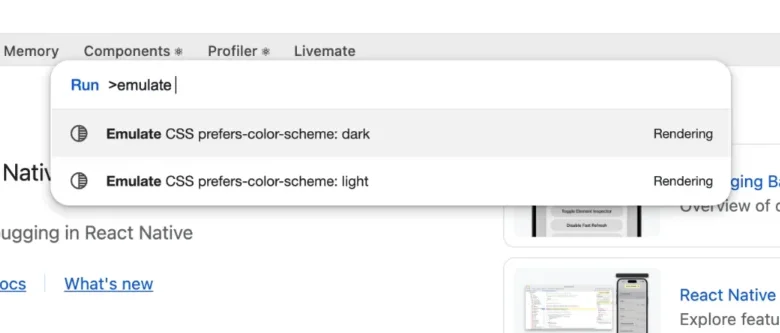
Debugging and inspecting mobile applications has also become more efficient with targeted upgrades to React Native DevTools. A standout addition in version 0.86 is the native support for light and dark mode emulation through the Emulation.setEmulatedMedia API.
Previously, developers testing color scheme transitions had to dive deep into physical device settings or simulator configurations to toggle between dark and light themes. With this release, developers can instantly switch appearance modes directly inside the DevTools interface via the Command Palette—accessed simply by pressing cmd or ctrl + shift + P. Mirroring web development workflows, this emulation switch acts as a temporary testing state that automatically resets the moment the developer disconnects the DevTools session. This small but impactful workflow enhancement drastically reduces friction when verifying accessibility contrast ratios and UI theme consistency.

Diving Into JSI and Advanced Native Interfaces
Beneath the user interface layer, React Native 0.86 introduces powerful additions to the JavaScript Interface (JSI). The JSI serves as the foundational communication bridge connecting JavaScript code running in the runtime engine directly to C++ native modules, bypassing the performance bottlenecks of traditional asynchronous bridge architectures.
The new JSI APIs incorporated into this release significantly expand the capability and expressive power of the C++ native interface. By giving developers more direct, synchronous control over memory management, thread synchronization, and data marshaling between JavaScript and native environments, these enhancements lay the groundwork for high-performance modules—ranging from complex gesture handlers to real-time graphics rendering engines.
Stability, Deprecations, and the Migration Path
Maintaining backward compatibility remains a primary objective for the React Native engineering team. True to its release notes, version 0.86 contains zero user-facing breaking changes. Organizations currently maintaining applications on version 0.85 can theoretically execute an in-place upgrade to version 0.86 without modifying their application business logic or component architecture.
While no breaking changes are introduced, the release does outline a targeted set of API deprecations designed to clear technical debt in future cycles. Developers reviewing their codebase are encouraged to inspect deprecation warnings during compilation to ensure long-term maintainability. Furthermore, with the official debut of version 0.86, older iterations such as version 0.83.x officially transition to unsupported status in accordance with the project’s formal support lifecycle policy.
To facilitate smooth transitions, the core team recommends utilizing the community-driven React Native Upgrade Helper tool to visually compare differences between project templates. New project scaffolding can be initiated immediately using the latest CLI command:
npx @react-native-community/cli@latest init MyProject --version latestFor teams building applications within the Expo ecosystem, version 0.86 will roll out as part of the ongoing expo@canary release channels, allowing early adopters to test integration stability before wider mainstream adoption.
Industry Implications and Future Outlook
The release of React Native 0.86 underscores the maturity of cross-platform mobile development frameworks. By prioritizing zero-breaking-change upgrade cycles, the React Native maintainers are actively reducing the maintenance tax that historically deterred enterprise organizations from adopting rapid version updates.
Furthermore, the stabilization of Android 15 edge-to-edge handling ensures that cross-platform applications will not lag behind native Android applications in adhering to modern visual design standards. As the project settles into its new home within the React Foundation, the collaborative momentum demonstrated by nearly a hundred contributors signals a healthy, sustainable ecosystem poised to power the next generation of mobile and multi-platform digital experiences.
Related posts: