The evolution of software development lifecycle (SDLC) automation has reached a critical juncture with the intersection of Large Language Models (LLMs) and deterministic infrastructure monitoring. As engineering teams increasingly deploy autonomous agents to handle production incidents, the method by which these agents are triggered dictates their operational efficiency, token expenditure, and overall efficacy. Recent technical evaluations of Anthropic’s AI-native SDLC playbook highlight a fundamental architectural debate: whether autonomous agents should be initiated by raw metric alerts or by pre-diagnosed causal chains.
Industry analysis reveals that while traditional threshold-based triggers initiate agent sessions upon a control band breach, they force the AI to spend its initial and most computationally expensive phase determining the root cause of a failure. Conversely, integrating deterministic causal engines—such as Causely—allows systems to deliver a fully mapped causal chain directly to the agent upon activation, bypassing the exploratory phase entirely and streamlining remediation to code-level execution.
Background Context of the AI-Native SDLC Playbook
Released by Anthropic, The AI-Native SDLC Playbook establishes a structured six-stage framework mapping out the transition from software planning to production maintenance. While early large language model adoption heavily favored Stage Three (Build), focusing on code generation and feature implementation, Stage Six (Maintain) has emerged as the most critical proving ground for autonomous operations. Stage Six closes the loop between continuous observation and automated remediation, offering a blueprint for systems that self-heal under human supervision.
Within this framework, standard monitoring relies on scripts utilizing Western Electric rules over rolling baselines to detect metric drift. When a metric breaches a designated control band—such as a 2σ or 3σ deviation—the system escalates its response from logging to read-only diagnostics, and finally to automated pull request generation or runbook execution. However, Anthropic maintains a strict operational boundary: the detection mechanism must remain entirely deterministic. Language models are explicitly excluded from the detection phase to ensure audibility, predictability, and compliance with enterprise change management boards.
The Architectural Limitations of Threshold-Based Triggers
Relying solely on metric control bands presents significant operational hurdles in modern microservice architectures. A single threshold breach communicates only that a specific metric has left its expected operating range. It does not identify the affected entity, the upstream or downstream dependencies, or the broader propagation of the failure across a cluster.
In complex, highly distributed environments, service degradation frequently spreads across multiple components simultaneously without triggering a definitive breach on any individual metric. Services may simply exhibit subtle performance degradation. When this occurs, isolated detection scripts fail to fire, leaving systemic cascading failures unaddressed until catastrophic user-facing errors manifest. Furthermore, when a threshold trigger does initiate a Claude-managed agent session based on a generic symptom—such as a high error rate—the agent must exhaust valuable API tokens and compute time pulling raw logs, querying telemetry databases, and mapping dependencies before it can even begin drafting a remediation strategy.
The Causal Alternative: Transforming Symptoms into Root-Cause Issues
To eliminate exploratory overhead, modern observability platforms incorporate deterministic causal models that evaluate runtime telemetry against pre-encoded topological signatures. Rather than generating an isolated alert for every aberrant metric, a causal engine maps real-time metrics, alerts, and events to specific entities within the infrastructure topology.

When a failure occurs, the causal layer determines which root cause best explains the observed signals across the entire dependency tree. For instance, a saturated connection pool on a database client or a slow consumer on a messaging topic produces distinct, mathematically verifiable signatures. The resulting output—termed an "Issue"—includes the primary diagnosis, the affected entity, and the complete chain of observed evidence supporting the conclusion. Because this inference is strictly deterministic, executing the same signals over the same topology yields identical diagnostic results, satisfying the strict requirement that detection mechanisms remain model-free.
Chronology of an Autonomous End-to-End Incident Resolution
To evaluate the practical implications of trigger methodologies, engineering teams have benchmarked autonomous agent workflows integrating causal issue notifications directly with the Claude Managed Agents API. Because the Managed Agents API relies on cron mechanisms and manual deployment triggers rather than native inbound webhooks, implementations typically utilize lightweight auxiliary web services—such as FastAPI applications—to authenticate incoming notifications and initialize agent sessions.
A documented production incident involving a payment processing failure illustrates the efficiency gains of causal triggering:
- 18:14:03 UTC: Causely raises a critical-severity Issue on the
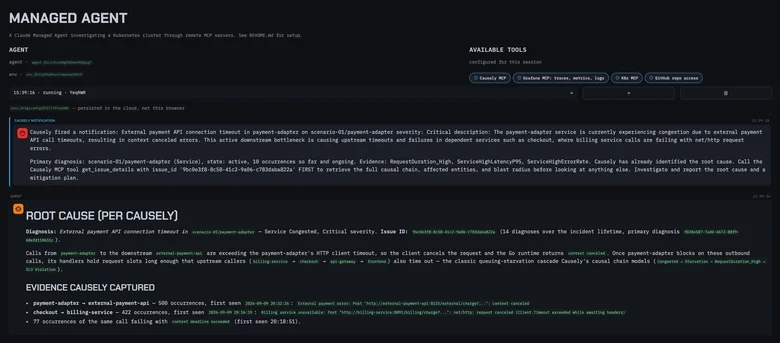
payment-adapterservice. Telemetry indicates that calls to an external payment API (external-payment-api:8115) are timing out and being canceled. An auxiliary webhook receiver captures the payload and initiates a Claude session, passing the affected entity, initial diagnosis, and evidence chain directly to the agent. - 18:14:05 UTC: The agent executes its initial instruction, calling
get_issue_detailsto retrieve the full causal context. Within seconds, it identifies that the external payment API’s slow response rate is holding caller requests open, triggering a cascading client timeout across downstream services. Specifically, the cascade accounts for 796 canceled calls on the payment adapter, 500 failed calls on the billing service, and 657 timeouts on the checkout service, affecting five distinct microservices. - 18:14:19 UTC: Having established the exact root cause, complete evidence, and precise blast radius in approximately 16 seconds, the agent transitions immediately to code-level remediation.
- 18:14:20 to 18:18:57 UTC: Operating entirely within the source repository (
payment-adapter/main.go), the agent locates the outbound call, implements a circuit breaker and per-call deadline to contain the cascade, reviews its own code diff, commits the changes, and opens a comprehensive pull request containing an 87-line modification across a single file.
The entire lifecycle from initial system degradation detection to pull request submission concluded in precisely four minutes and fifty-four seconds, with seventeen seconds dedicated to causal diagnosis and the remainder allocated entirely to generating a robust code fix.
Broader Implications for Enterprise Engineering and Token Economics
The integration of deterministic causal engines with advanced generative AI agents has profound implications for enterprise software maintenance, operational expenditure, and security governance.
From an economic perspective, token utilization represents a major cost factor in autonomous agent operations. When agents are initialized via generic alerts, a substantial portion of their token budget and context window is consumed by investigative reconnaissance—querying log aggregators, analyzing metrics, and mapping service dependencies. By shifting the diagnostic burden to a deterministic causal model prior to agent activation, engineering organizations reserve the entirety of the model’s token allocation for targeted code generation and validation.
From a governance standpoint, this architecture preserves strict human oversight without sacrificing automation velocity. Because the causal chain is fully exposed within the body of the resulting pull request, human reviewers can inspect not only the proposed code modification but also the precise telemetry and topological evidence that justified the change. Furthermore, standard branch protection policies prevent autonomous agents from merging their own code, ensuring that all production modifications remain subject to mandatory peer review and institutional approval workflows.
As artificial intelligence agents transition from experimental developer tools to autonomous operators within production environments, the design of the triggering mechanism will remain a cornerstone of system stability. Combining deterministic detection and causal inference with generative execution frameworks establishes a scalable, auditable, and economically viable path toward self-healing enterprise infrastructure.