Demystifying Large Language Model Embedding Spaces Through Probing Classifiers and Explainable AI Techniques

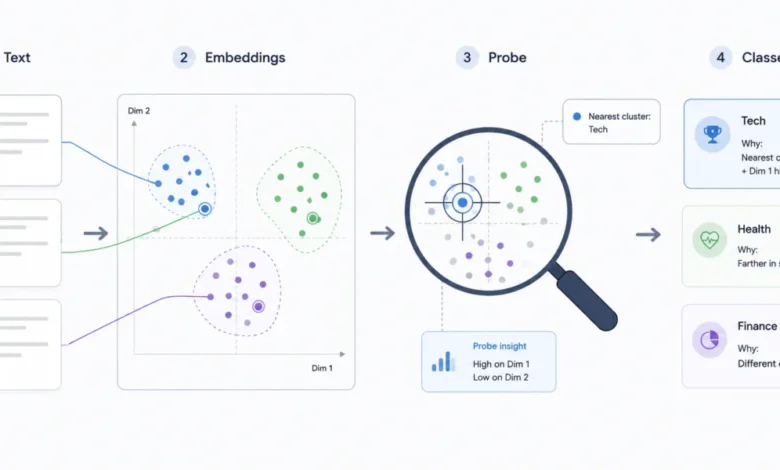
The rapid proliferation of Large Language Models (LLMs) has fundamentally altered the landscape of natural language processing (NLP). While these models have achieved unprecedented benchmarks in generative tasks and text classification, their architectural complexity—often referred to as the "black box" problem—poses significant challenges for developers and researchers. As organizations increasingly rely on LLMs to convert raw text into high-dimensional vector representations known as embeddings, understanding the semantic integrity of these vectors has become a critical requirement for robust machine learning pipelines. By employing probing classifiers, UMAP visualization, and SHAP (SHapley Additive exPlanations) values, practitioners can now audit the internal decision-making processes of these models, ensuring that the features extracted are not only accurate but also interpretable.
The Evolution of Text Representation
Historically, text classification relied on static feature engineering techniques such as Bag-of-Words (BoW) or TF-IDF, which mapped text to sparse, high-dimensional spaces based on word frequency. The subsequent introduction of Word2Vec and GloVe marked a shift toward dense, static word embeddings that captured semantic relationships. Today, LLMs have pushed this paradigm further by generating dynamic, context-aware embeddings. Unlike their predecessors, these embeddings adjust based on the surrounding text, allowing for a nuanced understanding of polysemy and syntactic structure.
However, the shift from transparent, frequency-based models to opaque neural networks has created a "transparency gap." When a classification model consumes an LLM-generated embedding, it is often unclear which specific dimensions of the vector correspond to semantic features like sentiment, tone, or topicality. This lack of visibility complicates model debugging and raises concerns regarding bias and reliability in high-stakes applications.
Establishing a Diagnostic Framework
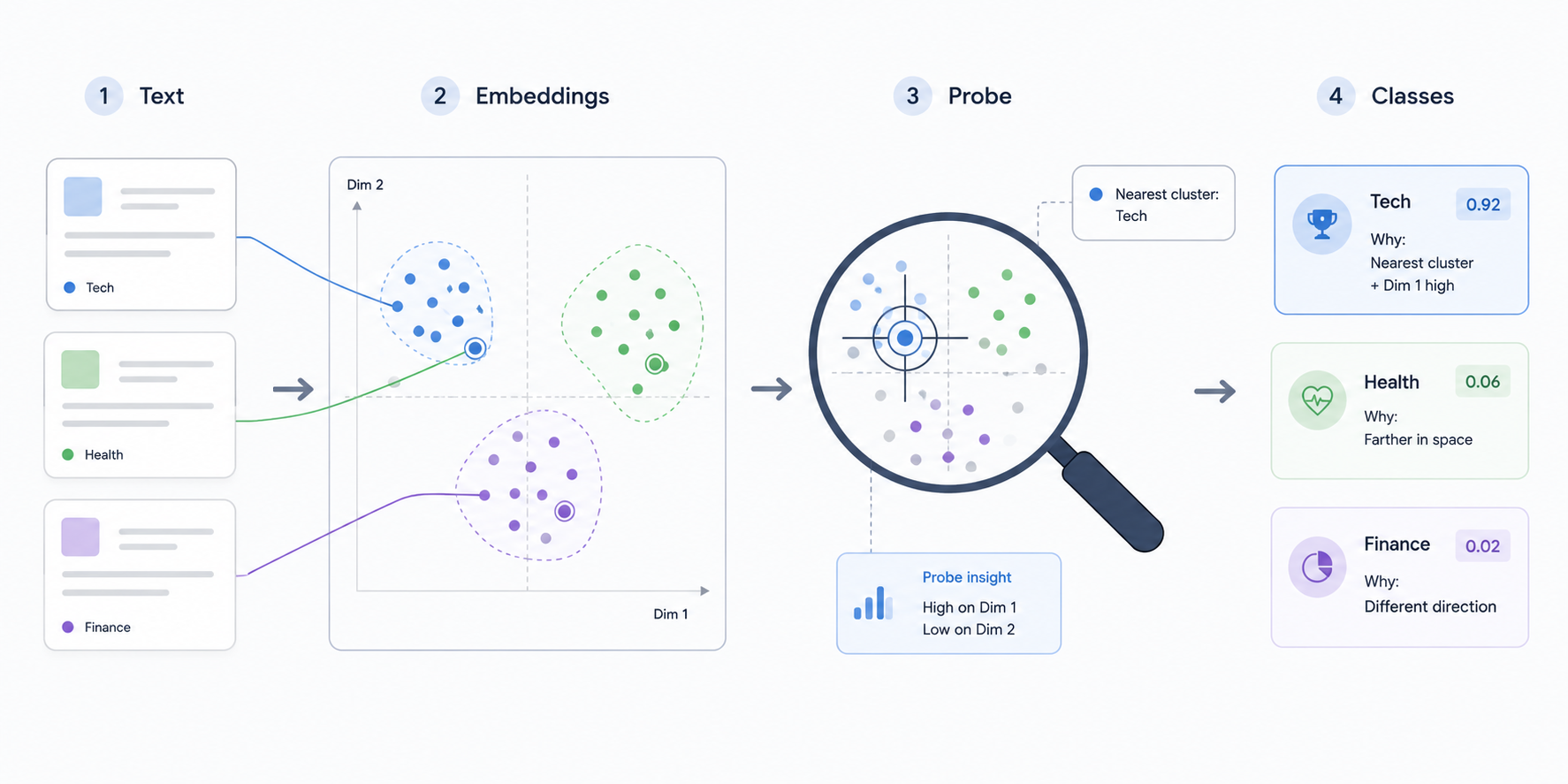
To address this, developers are increasingly turning to "probing," a methodology borrowed from cognitive neuroscience and behavioral linguistics. A probing classifier is a simple, interpretable model—typically a logistic regression or a shallow neural network—trained on the frozen outputs of a larger, frozen model. If the probe achieves high performance on a target task, it serves as evidence that the complex model has successfully encoded the relevant information in its latent space.
The process begins by setting up a local environment. Using the Scikit-LLM framework, which bridges the gap between the modularity of Scikit-Learn and the generative power of LLMs, developers can integrate local inference servers such as Ollama. By utilizing models like all-minilm, which are optimized for efficient embedding generation, researchers can process thousands of documents without incurring the latency or cost associated with proprietary cloud-based APIs.
Data Preparation and Feature Extraction
In a standard workflow, the IMDB movie review dataset serves as an ideal baseline for testing embedding quality. By curating a balanced subset of 1,000 reviews—500 positive and 500 negative—practitioners can conduct a controlled experiment. The methodology involves:
- Dataset Stratification: Ensuring an equal distribution of classes to prevent model bias during the probing phase.
- Vectorization: Leveraging the
GPTVectorizerclass to transform raw text into high-dimensional numerical vectors. - Probing: Training a Logistic Regression model on these vectors.
Data gathered from these experiments consistently shows that even a simple linear classifier can achieve F1-scores exceeding 0.75-0.80 on sentiment classification tasks when fed high-quality embeddings. This performance indicates that the LLM has effectively compressed complex linguistic features into a format that is linearly separable.
Visualizing Latent Manifolds with UMAP
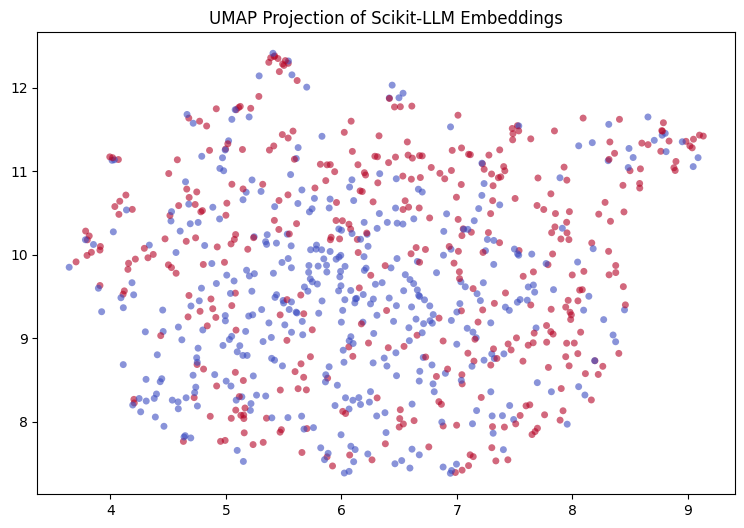
Once the probing classifier confirms the utility of the embeddings, the next step is to map these high-dimensional vectors into a human-readable format. Uniform Manifold Approximation and Projection (UMAP) is the industry standard for this task. Unlike Principal Component Analysis (PCA), which focuses on linear variance, UMAP preserves the local and global structure of the data by constructing a fuzzy topological representation of the manifold.
When plotting these embeddings, a clear spatial separation often emerges between positive and negative sentiments. In practice, this visualization acts as a qualitative audit. If the clusters are highly overlapped, it suggests that the embedding model may not be capturing the nuances required for the specific task at hand, prompting the developer to switch models or refine the prompt.
Quantifying Influence with SHAP
While UMAP provides a global view, SHAP values offer granular insight into feature importance. Originating from cooperative game theory, SHAP attributes a specific weight to each input feature, identifying exactly which latent dimensions contribute to a model’s prediction.
In the context of text embeddings, a SHAP summary plot can reveal, for instance, that "Dimension 208" and "Dimension 317" are the primary indicators for negative sentiment, while "Dimension 139" strongly correlates with positive sentiment. This allows for "feature ablation," where developers can potentially prune irrelevant dimensions to reduce the computational footprint of their models without sacrificing performance. This level of granularity is essential for compliance in regulated industries, where stakeholders may require an explanation for why an automated system classified a specific input in a particular way.
Broader Implications for AI Governance
The adoption of these interpretability tools represents a wider trend toward "AI Accountability." As regulations such as the EU AI Act begin to take effect, the ability to explain why a model reached a specific conclusion is no longer a "nice-to-have" feature but a legal and operational necessity. By integrating probing and SHAP-based auditing into the development lifecycle, organizations can:
- Identify Bias: Determine if the model is relying on sensitive features rather than the intended semantic content.
- Optimize Performance: Trim redundant dimensions, leading to faster inference times and lower infrastructure costs.
- Enhance Trust: Provide stakeholders with concrete evidence of the model’s logical reasoning, rather than relying on black-box accuracy metrics alone.
Conclusion and Future Outlook
The transition from traditional machine learning to LLM-driven workflows necessitates a corresponding evolution in our diagnostic tools. Probing classifiers, combined with the visual power of UMAP and the statistical rigor of SHAP, provide a comprehensive suite for analyzing the internal representations of modern language models. By treating LLMs as systems that can be interrogated rather than simply observed, developers can bridge the gap between high-performance AI and the need for human-centric transparency. As the field moves toward more sophisticated architectures, the principles of probing and explainable AI will remain the cornerstone of safe, reliable, and interpretable machine learning. The ability to peer into the embedding space ensures that as models become more powerful, they also become more understandable, ultimately fostering a more responsible technological landscape.