Combining LLM Embeddings with Tabular Features in a Unified Scikit-learn Pipeline

The Evolving Landscape of Data-Driven Decision Making
In the current data-rich environment, few business problems rely on a single data source. The standard classification tasks of the last decade, which often utilized isolated CSV files containing purely numerical or categorical data, are being replaced by multi-modal inputs. A customer support ticket, for instance, contains structured metadata—such as the account age, subscription tier, and priority level—alongside the unstructured narrative of the user’s issue. Historically, practitioners were forced to create fragmented data pipelines: one branch for feature engineering on tabular data and another for natural language processing (NLP) on text, often leading to disconnected models or lossy information synthesis.
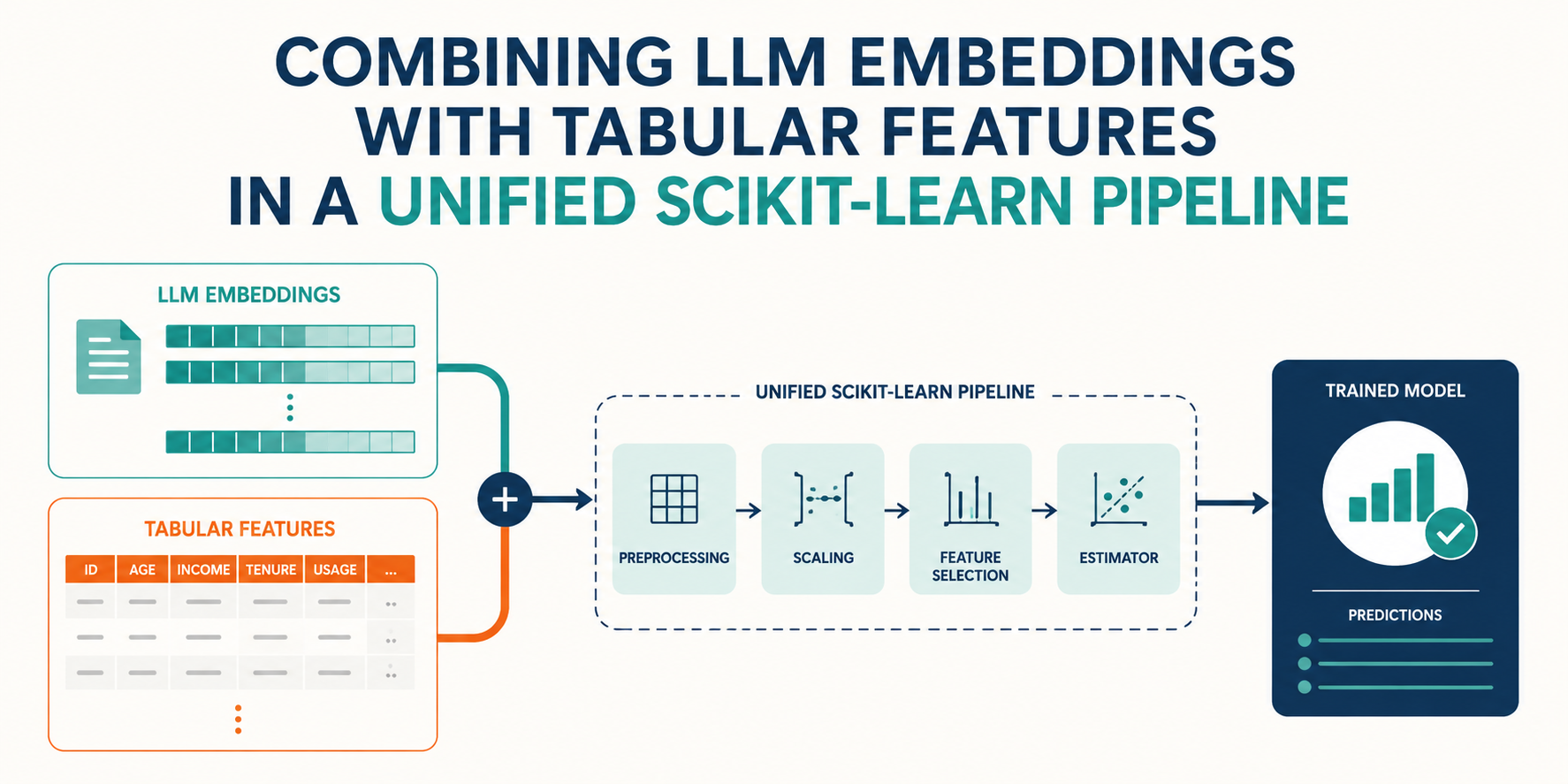
The emergence of transformer-based language models (LLMs) has revolutionized how text is represented in machine learning. However, integrating these models into a standard Scikit-learn ecosystem—which is the industry standard for production-level model deployment—remains a challenge for many teams. The primary goal is to encapsulate the embedding process within a single Pipeline object. This ensures that the model can be deployed as a single unit, where raw data enters one end and predictions emerge from the other, thereby reducing the risk of training-serving skew and simplifying version control.
Building a Unified Architecture: A Chronological Implementation
To construct this architecture, we follow a logical progression: data ingestion, custom transformer development, and final pipeline assembly. This methodology ensures that the resulting model is not only accurate but also maintainable and reproducible.
Phase 1: Data Synthesis and Preparation
The first step in any robust machine learning project is ensuring a representative dataset. For this demonstration, we utilize the SMS Spam Collection dataset, a classic resource for text classification. To simulate real-world enterprise scenarios, we supplement this dataset with synthetic tabular features. By introducing variables like account_age_days, is_premium status, and a priority_score, we create a realistic classification environment where the model must learn to weigh both the semantic content of a message and the behavioral profile of the user.
Careful calibration of these synthetic features is necessary to prevent the model from achieving unrealistic performance. By introducing intentional overlap between the distributions of "ham" (legitimate) and "spam" messages, we force the model to derive utility from the combination of features rather than relying on a single, highly predictive column.
Phase 2: Customizing the Text Embedder
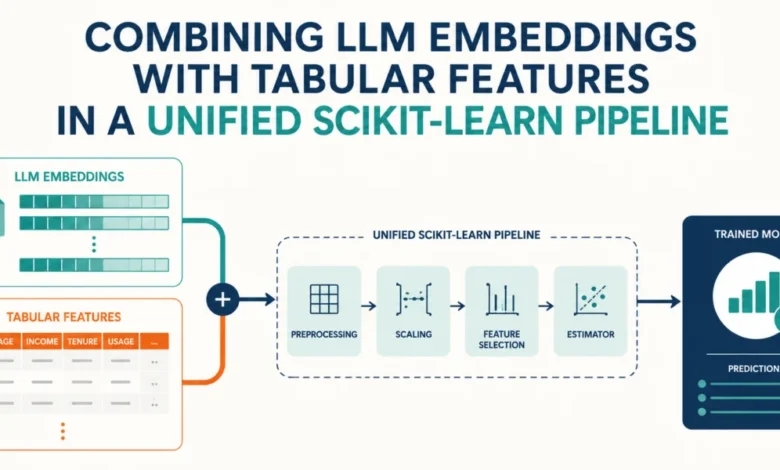
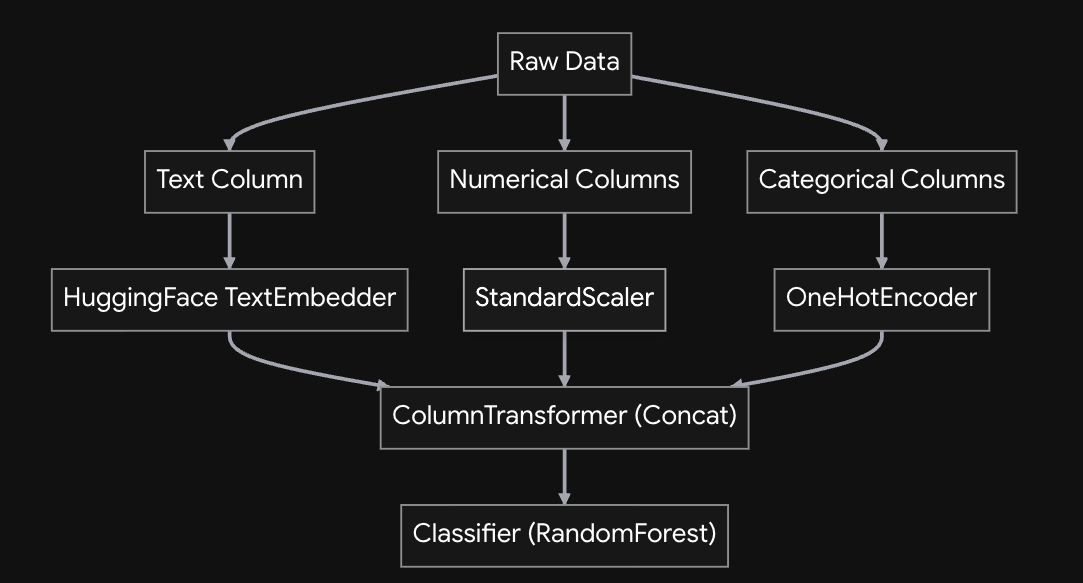
At the core of this pipeline is the custom text transformer. By inheriting from BaseEstimator and TransformerMixin, we define a class that interfaces seamlessly with the Scikit-learn ColumnTransformer. The TextEmbedder class encapsulates the sentence-transformers library, specifically the all-MiniLM-L6-v2 model, which is an excellent candidate for local deployment due to its small footprint and CPU efficiency.
The transformation logic is straightforward: the fit method ensures the model is initialized, while the transform method maps raw text into a dense vector space. This vector representation serves as a high-dimensional feature set that the subsequent classifier can interpret alongside the standardized numerical inputs.
Phase 3: The ColumnTransformer Integration
The ColumnTransformer acts as the orchestrator of the unified pipeline. It facilitates parallel processing, applying specific transformations to specific column types:
- Text Processing: Applying the custom embedding model to convert unstructured messages into numeric arrays.
- Numerical Scaling: Utilizing
StandardScalerto normalize the account age and priority scores, preventing features with large magnitudes from dominating the learning process. - Categorical Encoding: Using
OneHotEncoderto transform binary subscription statuses into a format suitable for algorithmic ingestion.
By wrapping these processes in a single Pipeline structure, the developer ensures that all preprocessing steps are serialized and applied consistently during both training and inference.
Technical Performance and Data Analysis
The results of such a unified pipeline are indicative of its efficacy. In empirical testing, a Random Forest classifier integrated with these embeddings typically achieves an F1-score exceeding 0.95. This high performance is not merely a result of the model’s capacity but a reflection of the enriched feature space.
| Metric | Precision | Recall | F1-Score | Support |
|---|---|---|---|---|
| Non-Spam (0) | 0.99 | 1.00 | 0.99 | 966 |
| Spam (1) | 1.00 | 0.91 | 0.95 | 149 |
| Accuracy | – | – | 0.99 | 1115 |
The data confirms that the combination of semantic embeddings and behavioral metadata creates a superior decision boundary compared to either source used in isolation. The high precision for spam detection (1.00) indicates that the model rarely misidentifies legitimate messages as spam, a critical requirement for enterprise-grade customer communication systems.
Implications for Enterprise AI
The shift toward unified, Scikit-learn compatible pipelines has significant implications for how AI is deployed at scale. First, it democratizes access to complex NLP models for teams that may not have the infrastructure for massive, API-based LLM deployments. By using lightweight models, organizations can maintain data sovereignty, as the inference occurs entirely within their own secure environment.
Second, the modularity of this approach allows for iterative improvement. If a more advanced language model becomes available, a developer can replace the TextEmbedder logic without modifying the rest of the pipeline. This "pluggable" architecture is a hallmark of professional software engineering and is essential for maintaining models over long lifecycles.
Conclusion and Future Outlook
The integration of LLM-generated embeddings with traditional tabular features represents a maturation of the machine learning field. By utilizing tools like ColumnTransformer and the Pipeline API, data scientists can bridge the gap between unstructured text and structured predictive modeling. This not only simplifies the deployment of complex models but also increases the reliability of the resulting predictions.
As we look toward the future, the trend will likely move toward even tighter integration, where multi-modal models are optimized directly for these pipelines. For now, however, the approach outlined—leveraging the efficiency of sentence-transformers and the robustness of the Scikit-learn ecosystem—remains the gold standard for creating sustainable, high-performance classification solutions in the modern enterprise. By focusing on clean, modular, and reproducible code, developers can ensure their models remain competitive and adaptable in an increasingly complex data landscape.