AWS Announces General Availability of AWS Glue 6.0 Delivering 30% Price Reduction and Full Apache Iceberg v3 Support

Amazon Web Services (AWS) has officially announced the general availability of AWS Glue 6.0, a major update to its serverless data integration and extract, transform, and load (ETL) service. This latest iteration introduces a substantial 30% reduction in pricing compared to previous versions, alongside comprehensive support for Apache Iceberg v3 features. Built upon a modernized execution runtime that includes Apache Spark 4.1, Python 3.13, and Scala 2.13, AWS Glue 6.0 is designed to deliver significantly faster performance while lowering the total cost of ownership for organizations processing massive data workloads at scale.
The release marks a notable milestone in the evolution of managed serverless analytics infrastructure. By combining lower costs with advanced engine performance and robust open-table format support, AWS aims to address the growing operational and financial challenges faced by data engineering teams managing complex data lakes and lakehouses.
Main Facts and Core Technical Enhancements
AWS Glue 6.0 introduces several foundational improvements to its underlying technology stack. At the heart of the release is Apache Spark 4.1, which serves as the core runtime engine, providing enhanced execution efficiency, advanced query optimization, and modern language support via Python 3.13 and Scala 2.13. This upgrade allows developers and data engineers to run resource-intensive workloads with greater speed and resource efficiency.
In addition to the runtime modernization, AWS Glue 6.0 provides the industry’s most complete Apache Iceberg v3 implementation available on any fully serverless managed Spark service. Based on Iceberg version 1.11.0, the update highlights the integration of the VARIANT data type complete with advanced shredding support. Traditionally, querying semi-structured data such as JSON files, system logs, and application event streams required storing information as standard string data types, which often necessitated expensive flattening processes, custom parsing scripts, and rigid schemas that frequently broke when downstream data structures evolved.
With the new VARIANT data type and shredding capabilities in AWS Glue 6.0, organizations can store, process, and query semi-structured data natively. This eliminates the need for duplicate data copies, complex custom parsing code, and pipeline maintenance headaches associated with schema drift. Query read performance for semi-structured data is substantially accelerated, giving analytics and data science teams faster access to operational insights without the traditional computational overhead.
Furthermore, AWS Glue 6.0 enables real-time streaming capabilities capable of delivering single-digit millisecond latency. This allows enterprises to ingest, process, and analyze streaming data continuously, bridging the gap between batch processing and real-time operational intelligence within a unified serverless environment.
Background Context and Evolution of AWS Glue
To understand the significance of the AWS Glue 6.0 release, it is helpful to examine the trajectory of cloud-based ETL and data cataloging services over the past decade. When AWS Glue was first introduced, traditional data integration required provisioning, configuring, and maintaining dedicated clusters—typically Apache Hadoop or early Spark clusters—which introduced administrative burdens, idle resource costs, and scaling bottlenecks.

The shift toward serverless architectures revolutionized this space by abstracting infrastructure management, allowing users to pay strictly for the compute resources consumed during job execution, measured by the second. Over subsequent versions, AWS incrementally enhanced Glue by introducing interactive notebooks, fine-grained monitoring, integration with services like Amazon SageMaker, and native support for open-table formats such as Apache Iceberg and Delta Lake.
The rapid adoption of data lakehouses—architectures combining the flexibility and cost-effectiveness of object storage with the transactional reliability of traditional data warehouses—placed new demands on data integration tools. Open-table formats like Apache Iceberg became the standard for organizing data lakes, enabling ACID transactions, time-travel queries, and schema evolution. However, maintaining these formats at scale often required specialized tuning and deep technical expertise. With AWS Glue 6.0, AWS has integrated these complex capabilities directly into a managed, serverless framework, removing the operational friction of manual optimization.
Chronology and Migration Pathways
The path to AWS Glue 6.0 follows a rigorous development and deployment cycle standard for enterprise cloud infrastructure. Following internal testing and preview phases, the generally available release rolls out across all AWS Regions where AWS Glue operates.
A critical design consideration for AWS engineers during the development of Glue 6.0 was ensuring backward compatibility and frictionless migration pathways for existing customers. Organizations do not need to rewrite or alter their existing application programming interfaces (APIs) to adopt the new version. The upgrade can be initiated by specifying the --glue-version parameter—set to version 6.0—within the create-job or update-job APIs via the AWS Command Line Interface (AWS SDKs), or directly through development environments such as AWS Glue Studio, Amazon SageMaker Unified Studio, and integrated development environments (IDEs).
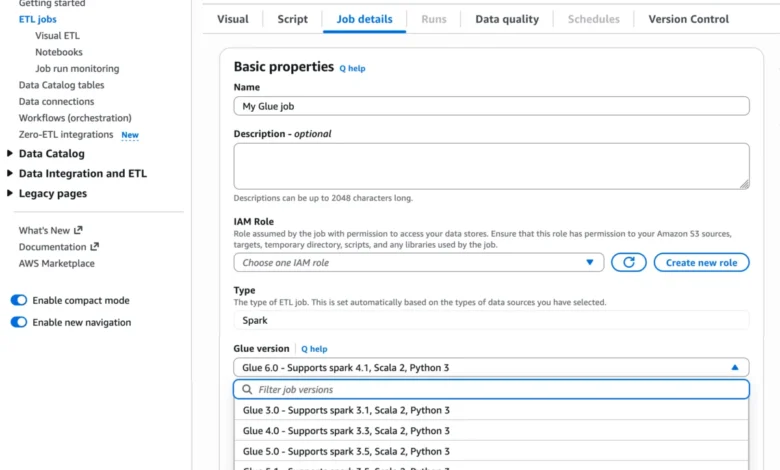
For teams utilizing the AWS Glue Studio console, upgrading is accomplished by navigating to the Job Details tab and selecting "Glue 6.0 – Supports Spark 4.1, Scala 2, Python 3." Notebook users can activate the runtime within interactive sessions or AWS Glue Studio notebooks by defining 6.0 in the %glue_version magic command.
To assist enterprises with large fleets of legacy jobs, AWS has introduced the Spark upgrade agent within AWS Glue Studio. This automated utility assists engineers in identifying potential deprecations or syntax changes required when moving from older versions of Spark to Apache Spark 4.1. Additionally, an auto-upgrade feature is provided to streamline the transition of qualifying production workloads to the new runtime engine.
Supporting Financial Data and Pricing Structure
The 30% price reduction accompanying the launch of AWS Glue 6.0 represents a strategic shift in cloud pricing models, aligning infrastructure costs more closely with the deflationary curve of modern computing hardware and software efficiency gains.
Under the AWS Glue pricing model, customers continue to pay an hourly rate billed by the second for crawlers used in data discovery and ETL jobs used for data processing and loading. The AWS Glue Data Catalog operates on a predictable monthly fee model for storing and accessing metadata. To encourage experimentation and reduce barriers to entry for smaller projects, AWS maintains a generous free tier: the first one million objects stored in the Data Catalog and the first one million metadata accesses each month are provided free of charge.

Industry Implications and Strategic Analysis
The introduction of AWS Glue 6.0 carries several notable implications for the broader data engineering and cloud analytics landscape.
First, the aggressive 30% price cut reflects increasing competition in the cloud data integration and data lakehouse market. As alternative cloud platforms and independent data orchestration tools vie for enterprise workloads, major cloud providers are leveraging their scale and optimized runtime stacks to pass cost savings directly to consumers. This pricing adjustment lowers the financial barrier for organizations looking to migrate monolithic on-premises data pipelines to fully managed cloud environments.
Second, the deep integration of Apache Iceberg v3 and the VARIANT data type signals a maturing consensus around open-table formats. By standardizing on Iceberg, AWS is helping customers avoid vendor lock-in while providing the performance optimizations necessary to make open formats competitive with proprietary data warehouse storage layers. The elimination of custom parsing code for semi-structured data addresses one of the most persistent pain points in modern data engineering, freeing technical talent to focus on higher-value data modeling and machine learning initiatives rather than routine pipeline maintenance.
Finally, the combination of sub-millisecond real-time streaming, modern Spark 4.1 performance, and simplified serverless management positions AWS Glue 6.0 as a comprehensive tool capable of handling both traditional batch ETL and modern event-driven architectures within a single pane of glass.
Availability and Getting Started
AWS Glue 6.0 is generally available immediately across all commercial AWS Regions supporting the service. Regional availability specifics and future capability roadmaps can be tracked through the AWS Capabilities by Region documentation.
For developers seeking programmatic assistance, API reference materials, regional status checks, and troubleshooting guidance, AWS supports integration with the AWS MCP Server and associated plugins for use with AI-assisted development tools.
Organizations interested in evaluating the performance and cost benefits of the new release can begin testing immediately via the AWS Glue Community and Console, with official support channels and community forums available through AWS re:Post for AWS Glue.