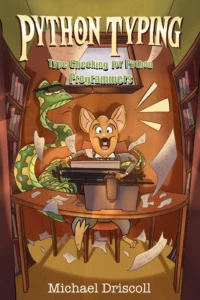
Python Typing: Type Checking for Python Programmers is Now Available Across All Major Platforms


Python developers seeking to write more robust, maintainable, and scalable code have a new resource at their disposal with the official release of Python Typing: Type Checking for Python Programmers. Authored by prominent programming educator and writer Michael Driscoll, the comprehensive guide aims to demystify Python’s type-hinting ecosystem, which has undergone significant evolution since its inception. The publication arrives at a time when enterprise adoption of strongly typed dynamic languages is accelerating, driven by the need for enhanced software reliability in large-scale engineering environments.
The book is now available for purchase globally across major distribution channels, including Gumroad, Leanpub, and Amazon. Designed to cater to intermediate and advanced Python practitioners, the text bridges the gap between traditional dynamic scripting and modern static analysis methodologies.
Background Context and Evolution of Python Type Hints
To understand the necessity of this new publication, one must examine the trajectory of typing within the Python ecosystem. For the first two decades of its existence, Python was celebrated almost exclusively for its dynamic typing system. Programmers enjoyed the rapid prototyping capabilities afforded by variables that could change types at runtime, alongside a lack of boilerplate syntax. However, as codebases grew into millions of lines and enterprise software engineering teams expanded, the absence of compile-time type checking became a notable friction point. Code refactoring, large-scale maintenance, and developer onboarding frequently suffered from hidden runtime type errors that could have been prevented with static analysis.
A major paradigm shift occurred in September 2015 with the official release of Python 3.5. Spearheaded by PEP 484, this milestone introduced standard syntax for type hints, allowing developers to annotate function arguments and return values. Yet, because type hinting was introduced as an additive feature to a mature language, its implementation has not been static. Over the subsequent decade, through Python releases 3.6 up to the latest modern versions, type annotations have changed repeatedly. New modules such as typing, expanded generics, Protocol classes, and structural subtyping have continuously shifted best practices.
This rapid iteration has left many developers navigating a fragmented landscape of documentation and blog posts. Driscoll’s new book addresses this fragmentation by consolidating a decade of evolution into a single, cohesive curriculum.
Core Curriculum and Technical Scope
Python Typing: Type Checking for Python Programmers is structured to take readers from foundational concepts to advanced production pipelines. The curriculum is divided into several logical modules designed to ensure comprehensive mastery of the subject matter.
At the foundational level, the book thoroughly explains Python’s support for type hinting and annotations. Readers are introduced to basic scalar types, collection types, and the nuances of working with built-in data structures using type hints. As the text progresses, it delves into more sophisticated constructs, including Callable types, Union types, TypeVars, and generics, which allow developers to write flexible yet strictly verified code.
Beyond syntax, the book places heavy emphasis on tooling. Writing type annotations is only beneficial if they are actively validated by the development environment. The publication details how to select, configure, and operate Python type checkers—most notably Mypy, the flagship static analyzer for the language. Readers learn how to handle third-party libraries that lack type stubs, utilize stub files (.pyi) effectively, and configure strict checking modes to catch subtle bugs before code execution.
Automation, CI/CD Integration, and Team Workflows
A critical component of modern software engineering is the automation of code quality checks. Driscoll dedicates substantial focus to integrating type checking into continuous integration and continuous deployment (CI/CD) pipelines.
The book provides step-by-step instructions on setting up automated type checking within pre-commit hooks and GitHub Actions workflows. By embedding these checks into the development lifecycle, engineering teams can enforce strict type safety standards automatically. Code that fails static analysis is intercepted before it can be merged into main branches, drastically reducing the likelihood of type-related defects reaching production environments.
This automation aspect is particularly valuable for distributed teams and open-source projects where multiple contributors push code simultaneously. Standardizing type checks ensures architectural consistency and codebase readability across large engineering organizations.
Industry Implications and Market Analysis
The release of a dedicated, comprehensive manual on Python typing underscores a broader industry trend: the maturation of Python as an enterprise-grade language. While Python remains the undisputed dominant force in data science, artificial intelligence, machine learning, and web backend development, its adoption in mission-critical financial and enterprise systems relies heavily on maintainability.
Static analysis tools and type checkers have transformed how development teams perceive Python. What was once viewed merely as a scripting language is now routinely deployed in massive, highly concurrent systems where type safety is paramount. Books like Python Typing serve as critical enablement tools, accelerating the upskilling of engineering workforces and reducing the learning curve associated with advanced static analysis configurations.
Industry observers note that as organizations increasingly migrate legacy Python codebases to modern versions supporting advanced typing features, the demand for specialized knowledge in this domain will continue to rise. Developers equipped with the ability to architect cleanly typed, self-documenting code are increasingly positioned at an advantage in the job market.
Availability and Purchasing Information
Python Typing: Type Checking for Python Programmers is immediately available in digital formats. Interested buyers can acquire their copies directly through the author’s Gumroad storefront, the Leanpub publishing platform, or via Amazon’s digital marketplace. With its detailed breakdowns, practical configuration guides, and focus on automated workflows, the book stands as an essential reference for any serious Python programmer aiming to elevate their software engineering standards.
Related posts: